
Reading an EV charging bill in Nepal: what did you pay for?
Compare the energy rate with parking, session fees and the amount billed. A worked receipt shows why a cheap-looking charger can cost more for a short stop.
A sign says Rs 18 per unit. You buy five units and pay Rs 210. Before deciding that the charger overcharged you, look for a session fee, parking charge or minimum payment. Before accepting the bill, ask whether those charges were disclosed.
Public charging has several prices that are easy to mix up. NEA sells electricity to the connection holder. The operator supplies a charging service to the driver. The car then turns the electricity it receives into stored battery energy, with some losses. The numbers at those stages need not match.
For someone using public charging around Kathmandu, a receipt matters more than an attractive price on a social-media post. It tells you what the station measured, what it charged and how to compare the next stop.
The supply tariff and the driver's bill
NEA publishes consumer tariff documents, while the Electricity Regulatory Commission publishes tariff orders. Check the connection category, voltage, effective period and any time bands before using a rate. A figure taken from the operator's electricity supply schedule does not, by itself, establish the final amount every driver must pay.
Likewise, a planning report that discusses service charges is not proof that a particular fee is currently lawful. If you dispute a charge, obtain the applicable order and the operator's written price terms. This article explains the arithmetic; it does not approve a tariff or declare a nationwide maximum retail price.
Ask whether the quoted rate includes applicable taxes, how parking is billed, and whether the site applies a minimum charge. Photograph the price notice before starting if the app and the notice disagree. A screenshot showing the date and location is more useful than a cropped number.
A receipt you can work backwards through
Consider this invented session. None of these prices is a current station quotation.
| Item | Calculation | Amount |
|---|---|---|
| Energy billed | 20 kWh × Rs 18 | Rs 360 |
| Parking | Assumed flat charge | Rs 80 |
| Session fee | Assumed flat charge | Rs 40 |
| Total | Rs 360 + Rs 80 + Rs 40 | Rs 480 |
| Effective price | Rs 480 ÷ 20 kWh | Rs 24/kWh |
That Rs 24 figure is useful when comparing an alternative stop with no fixed fees. It is not the station's energy tariff: it spreads this session's whole bill across the energy purchased.
With the same assumed Rs 120 in fixed fees, a five-kWh top-up costs Rs 210, or Rs 42 per billed kWh. A 40-kWh session costs Rs 840, or Rs 21 per billed kWh. The fixed part takes a larger share of a short stop.
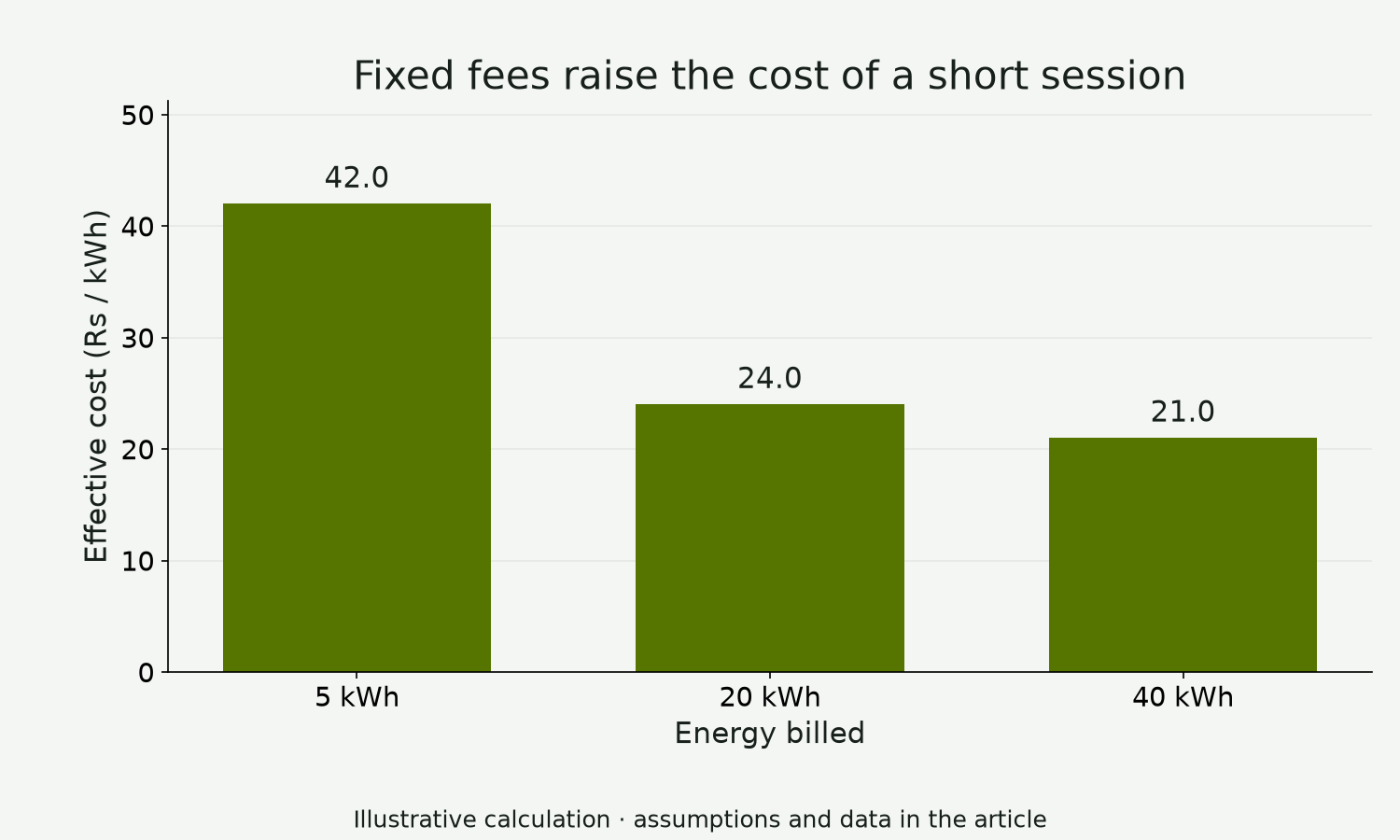
Original BijuliMotor calculation. Energy is assumed at Rs 18/kWh with Rs 120 fixed fees. This chart is not a Nepal price survey. The receipt table supplies the underlying assumptions.
Do not buy extra energy merely to make the average price look lower. If you need five kWh to get home, paying for 40 kWh still means spending more money. The comparison helps you choose a stop, not justify an unnecessary purchase.
Which energy did the station measure?
A charging screen might show energy delivered by its meter. Your dashboard may show a percentage increase, an estimated range increase or trip consumption. Those describe different things.
Suppose a car is described as having 50 kWh of usable capacity and its displayed charge rises by 20 percentage points. Multiplying gives an approximate ten-kWh change. That estimate relies on the usable-capacity figure and the meaning of the display. It is not a calibrated measurement of the station's output.
Battery conditioning, vehicle systems, charging losses and display rounding can also affect the comparison. A difference does not automatically prove fraud. An unexpectedly large or repeated difference deserves a documented query to the operator and, where necessary, a workshop check.
Save the starting and ending meter readings where shown, session identifier, start/end time and receipt. If the transaction includes a previous unpaid amount or a deposit, separate that from energy bought in this session. Otherwise your cost log will be wrong before you start comparing vehicles.
Time charges need an ending rule
Some charges relate to time rather than energy. A parking fee can run while you wait, charge and remain in the bay afterwards. An idle fee may begin after charging stops. A session fee may apply again if you disconnect and restart.
Before plugging in, ask when each clock starts and stops. Does the system send a notification? Is there a grace period? What happens if the machine stops because of a fault? Obtain the terms for that site rather than assuming an app used elsewhere has the same rules.
A family stopping for lunch should account for occupied-bay rules. Charging finishing halfway through the meal can require moving the car. A driver asleep in a hotel should ask whether overnight parking is included. These are ordinary access questions, not a reason to leave a cable connected indefinitely.
Failed sessions and money held in the wallet
An authorisation, deposit or wallet top-up is not always the final charge. Record whether the money was reserved, deducted or returned. A failed attempt can leave a transaction pending even when the car received no useful energy.
If the charger did not start, keep its identifier and the payment reference. Contact the operator through a verified channel. Do not send account passwords or one-time codes to someone claiming to arrange a refund. The operator needs a transaction reference, not access to your wallet.
The CG Motors directory includes operator/contact and connector information. It is a starting point for confirming the site. A directory listing does not prove today's price, opening hours or refund procedure.
Compare a complete stop
A cheaper energy rate can lose its advantage if you drive far out of the way. Use the whole journey in the comparison: detour distance, waiting time, charging purchased and additional charges. Do not turn lost time into an invented wage if you were going to stop for lunch anyway.
For an assumed 12-kWh purchase, a Rs 4/kWh difference saves Rs 48. A lengthy detour may be a poor trade for that saving, even before accounting for its energy. A regular commuter buying substantial energy each week has more reason to investigate the details.
Keep a simple log with date, station, billed kWh, total payment, non-energy charges and any unresolved refund. After several ordinary sessions, you can see what public charging actually costs for your routine. Use those totals in the EV versus petrol calculator, and keep the receipts that explain unusually expensive days.
The useful question at the next station is specific: "What will this session cost if I buy about ten kWh and park for 45 minutes?" A clear answer is worth obtaining before the payment screen opens.