
Why a 22 kW AC charger may charge your EV at only 7 kW
The car, phases, available current and site settings decide AC charging speed. Compare realistic overnight times before paying for a larger wall unit.
You plug into an AC unit marked 22 kW and the car shows about 7 kW. It is tempting to blame the station. The unit may be working correctly: your car may simply have a lower AC charging limit.
That distinction matters when buying equipment for a home in Kathmandu or checking charging at a Pokhara hotel. A larger number on the wall is useful only if the car and electrical connection can use it. Ask for the AC specification before spending money on a supply upgrade.
Check the vehicle's AC limit
During AC charging, the car's onboard charger sets a vehicle-side power limit. Maximum DC power is a separate specification. Our charging-plug guide explains the two energy paths and connector compatibility.
BYD identifies the onboard charger in its Atto 3 powertrain. Find the actual AC rating and supported phases for your locally supplied trim. A specification for another market or production version may describe different equipment.
A Nepal brochure shows why the footnotes matter
Sipradi's Tiago EV brochure distinguishes a supplied 3.3 kW wall box from a 7.2 kW charging option. Its charging times have specified percentage windows and conditions. A portable cable being present does not mean it provides the highest listed charging rate.
Ask the distributor which charger is included in the price, whether a different wall unit is an optional purchase, and the car's supported AC power and phases. Record the answer beside the exact trim and battery version. "Fast charger included" is too vague to settle those questions.
| Rating or label | What it describes | What it cannot establish alone |
|---|---|---|
| 22 kW AC wall unit | Equipment's maximum configured capability | Your car will receive 22 kW |
| Car's AC/OBC rating | Vehicle conversion capability under stated conditions | The building can supply it |
| Maximum DC rate | Separate fast-charging capability | AC rate at home |
| Cable current rating | One component's permitted current | Approval of the whole installation |
| Power on the display | A reading at a particular moment | The average over the whole session |
Three phases introduce another limit
Single-phase and three-phase connections distribute current differently. Charger manufacturer Alfen's product guidance asks buyers to consider their grid phases and charging capacity together. This is an equipment principle; it does not describe the approval or wiring of a Nepal home.
For an illustrative 230-volt single phase, 16 amps corresponds to about 3.68 kW and 32 amps to about 7.36 kW, before relevant power-factor and operating effects. Three phases can support a different total, provided the car uses them and the installation permits the load.
A nominal 11 kW three-phase unit can offer roughly 16 amps per phase. A car that uses only one phase may receive much less than 11 kW there. Compatibility depends on the exact vehicle and charger configuration. Do not assume every three-phase box charges every single-phase car at its maximum.
These examples explain labels. They are not cable-sizing instructions or permission to increase a breaker setting. A qualified designer must assess protection, earthing, supply capacity and the intended equipment.
What the measured rate means for a session
Suppose you need 20 kWh added to the battery. With an assumed 90% efficiency, the supply provides about 22.2 kWh. At a constant rate:
| Power available to the car | Approximate time | Fits an eight-hour stay? |
|---|---|---|
| 3.3 kW | 6.73 hours | Yes, in this example |
| 7 kW | 3.17 hours | Yes |
| 11 kW | 2.02 hours | Yes |
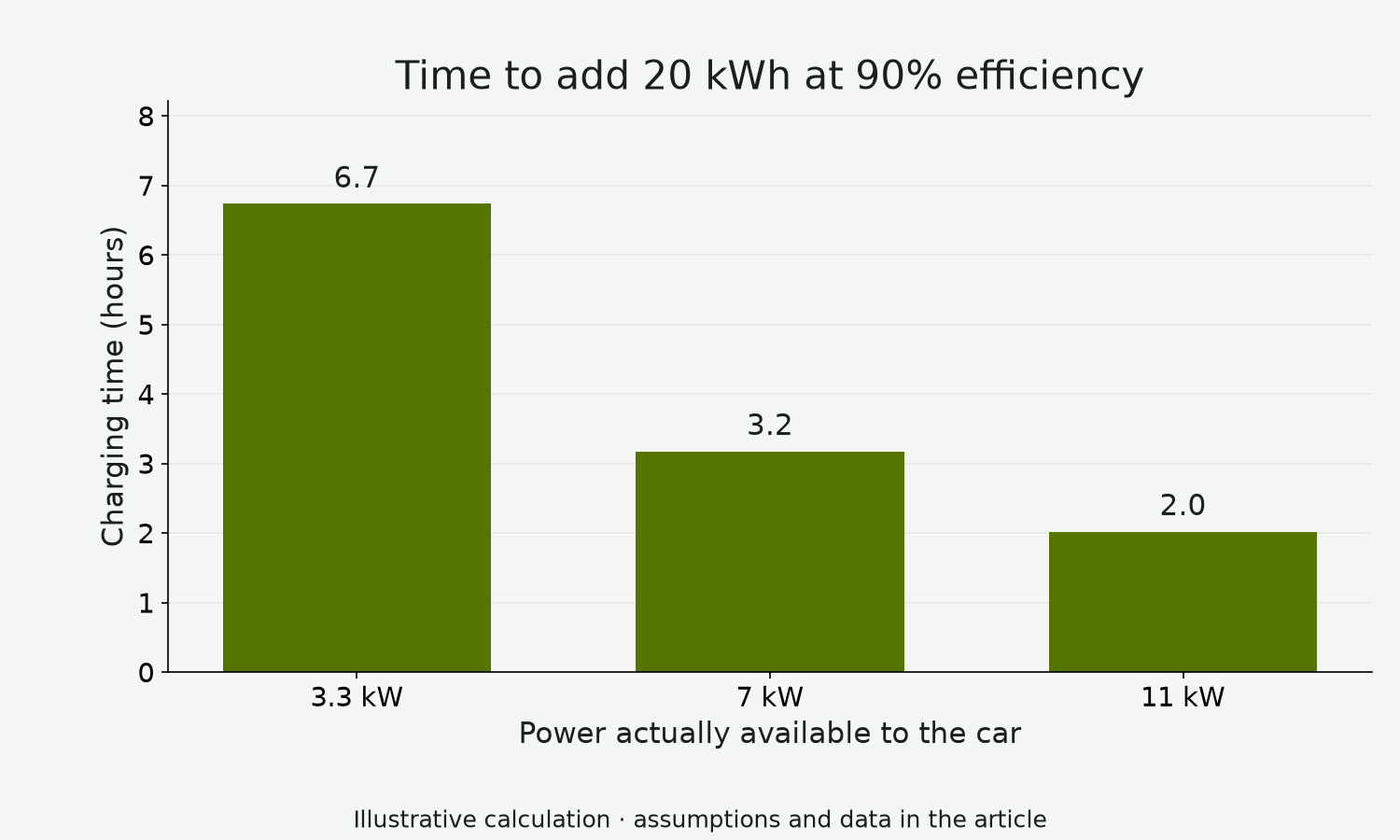
Original calculation; these are steady-power examples, not charging tests. Starting charge, vehicle limits, interruptions and temperature can change the result.
For a hotel lunch stop lasting 90 minutes, the decision changes. At an assumed steady 7 kW, the supply delivers 10.5 kWh and the battery gains about 9.45 kWh at 90% efficiency. The same equipment that is adequate overnight may provide too little for a short stop.
Diagnose a slow session with a record
Check the permitted settings in the car and charger. A departure schedule, current limit, shared load limit or site power allocation can reduce the displayed rate. Other cars charging at the site may affect a shared system.
Ask whether the reading is supply power or power reaching the battery. Compare an average from energy and elapsed charging time with the instantaneous screen figure. Include pauses separately. A ten-minute peak does not establish a three-hour average.
A repeatable low rate at one site points to a different investigation from a low rate everywhere. Record equipment identity, date, starting charge, temperatures where available, power shown and energy delivered. Give the workshop or operator that record. Do not experiment with adapters or open electrical equipment to diagnose the issue.
Give the operator or workshop a useful comparison
Compare records from compatible, approved sites. Note whether the car is slow at one point or throughout its usual AC charging. Include the agreed site limit and whether power is shared; otherwise a workshop may compare the car's maximum with a session the station deliberately limited.
Keep connector compatibility and accepted power as separate questions. The charging directory helps find candidate sites, but the operator must confirm the actual equipment and available rate. If a proposed repair or supply change promises faster charging, ask which recorded limit it addresses before authorising the work.