
EV bluebook renewal in Nepal: tax by province and kW
Bagmati charges Rs 6,500 to Rs 30,000 a year for a private EV car. Check the FY 2083/84 rate by province and kW, documents and late fees.
Rates and procedure checked 23 October 2026. Your transport office's bill is final.
A private electric car up to 50 kW registered in Bagmati pays Rs 6,500 in annual vehicle tax for FY 2083/84. The tax is due within three months of the date in the bluebook (Kokil Thapa, September 2026). On top of it, our calculator adds a Rs 500 renewal fee, a service charge and third-party insurance.
The tax steps with motor power. Price does not decide the band: Rs 15,000 for over 50 up to 125 kW, Rs 20,000 for over 125 up to 200 kW, and Rs 30,000 above 200 kW. For private EV cars, the provincial budget announced in June 2026 raised only the smallest band, from Rs 5,000 to Rs 6,500 (Meroauto, 30 June 2026; EV News Nepal, checked 14 October 2026).
This is the annual provincial tax. The federal import tax built into the showroom price is a separate charge. The EV tax guide separates the two. Use the bluebook calculator for your own province and motor power.
Check the record before the rate
Start with the bluebook before you look at the brochure. Vehicle tax is provincial, and the tax office uses the rated motor capacity on the registration record. That figure can be lower than the peak power in a dealer's spec sheet, and the difference can move a car into a lower band. The kW explainer covers why the two numbers differ.
Check four other details: the province printed on the book, the owner's name, whether the car is private or on a hire permit, and the last fiscal year paid. A Kathmandu rate does not apply to a car registered in Biratnagar. A public or commercial EV can pay a different rate; Madhesh, for one, gives public and commercial EVs 50% off the private rate (Meroauto, 21 July 2026).
If the owner's name is wrong, fix the transfer before you pay. If the motor power is wrong, ask the office what evidence it needs to correct it. Paying first and correcting later is harder.
Tax by province for FY 2083/84
Bagmati, Koshi and Madhesh are the three provinces where we have a current rate table with a named source. The bands are flat, so a 51 kW car and a 125 kW car pay the same in Bagmati.
| Province | Basis | First band | Second band | Third band | Fourth band |
|---|---|---|---|---|---|
| Bagmati | motor kW | up to 50 kW: Rs 6,500 | over 50 to 125 kW: Rs 15,000 | over 125 to 200 kW: Rs 20,000 | above 200 kW: Rs 30,000 |
| Koshi | motor kW | up to 50 kW: Rs 7,000 | over 50 to 125 kW: Rs 15,000 | over 125 to 200 kW: Rs 20,000 | above 200 kW: Rs 30,000 |
| Madhesh | vehicle value | up to Rs 30 lakh: Rs 11,000 | Rs 30 lakh to Rs 50 lakh: Rs 15,000 | Rs 50 lakh to Rs 1 crore: Rs 25,000 | above Rs 1 crore: Rs 40,000 |
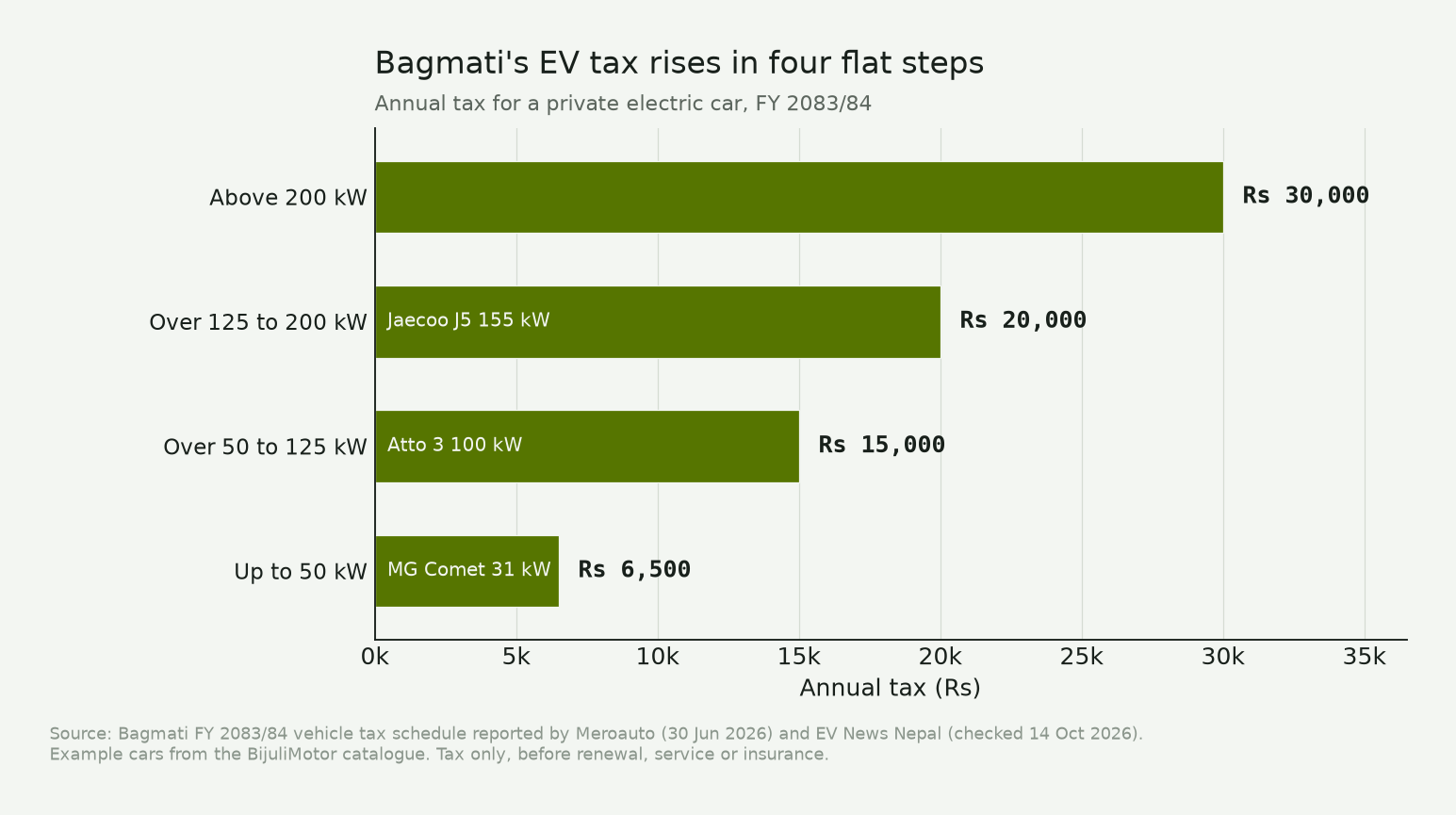
Bagmati's smallest band rose by Rs 1,500 this year; the other three stayed unchanged (Meroauto, 30 June 2026). Koshi's first band is Rs 7,000 in both Kokil Thapa's reading of the Act and EV News Nepal's table. The calculator's published table still shows Rs 5,000 for that band. It has not caught up, so use Rs 7,000 and check the office bill.
Madhesh is the exception. From 2083/84 it taxes private EVs on value. Motor power no longer sets the band. For an imported car the value is the customs-assessed value plus duties; for a locally sold car it is the VAT invoice value. Public and commercial EVs pay half (Meroauto, 21 July 2026). That means the same car can pay less in Madhesh than in Bagmati, or more, depending on its price.
For Gandaki, Lumbini, Karnali and Sudurpashchim, the calculator's published table still uses a placeholder. EV News Nepal's table gives Rs 17,000 for a 100 kW car in Gandaki, Rs 13,600 in Lumbini after its 20% EV discount, Rs 15,000 in Karnali and Rs 18,000 in Sudurpashchim (EV News Nepal, checked 14 October 2026). Those are leads from a secondary table. We did not read those rates from the Acts. Confirm with the office before you budget.
Four cars, three provinces
The table uses four current variants from the BijuliMotor catalogue. The Madhesh column treats the showroom price as the taxable value. That is an assumption: the customs value can be lower, which can push a car into a cheaper band.
| Variant | Motor | Showroom price | Bagmati | Koshi | Madhesh (value basis) |
|---|---|---|---|---|---|
| MG Comet Pace | 31.26 kW | Rs 18,75,000 | Rs 6,500 | Rs 7,000 | Rs 11,000 |
| BYD Atto 1 Dynamic | 45 kW | Rs 30,75,000 | Rs 6,500 | Rs 7,000 | Rs 15,000 |
| BYD Atto 3 Advanced | 100 kW | Rs 62,90,000 | Rs 15,000 | Rs 15,000 | Rs 25,000 |
| Jaecoo J5 Pro | 155 kW | Rs 47,99,000 | Rs 20,000 | Rs 20,000 | Rs 15,000 |
The last two rows show how the basis changes the answer. The 155 kW Jaecoo pays less tax in Madhesh than the 100 kW Atto 3 because the Jaecoo's showroom price is below Rs 50 lakh, while the Atto 3's is above it. In Bagmati, the Jaecoo pays more because its motor is in a higher band.
What the Bagmati bill adds up to
The tax is the largest government line. The renewal fee is Rs 500 for a private car. Our calculator also adds a Rs 350 service charge and an Rs 8,495 third-party insurance estimate.
| Car | Annual tax | Renewal | Service | Insurance estimate | All-in estimate |
|---|---|---|---|---|---|
| MG Comet Pace, 31.26 kW | Rs 6,500 | Rs 500 | Rs 350 | Rs 8,495 | Rs 15,845 |
| BYD Atto 3 Advanced, 100 kW | Rs 15,000 | Rs 500 | Rs 350 | Rs 8,495 | Rs 24,345 |
| Jaecoo J5 Pro, 155 kW | Rs 20,000 | Rs 500 | Rs 350 | Rs 8,495 | Rs 29,345 |
The tax and renewal columns are the ones to compare with your office bill. The service charge and insurance are planning figures. The government does not fix those rates. Third-party insurance is compulsory to drive, but you can buy it from an insurer, and the premium can change when the tariff is revised (EV News Nepal, checked 14 October 2026). If your bank financed the car, it may require comprehensive cover as well.
Documents to carry
The exact list varies by office. This is the common set:
- Original bluebook, the vehicle registration certificate.
- Owner's citizenship certificate or national ID. If someone else goes, an authorisation letter and that person's ID.
- Current third-party insurance.
- Last tax or renewal receipt, useful when the paid year is unclear.
- For a company vehicle, the office may ask for extra proof of authority; confirm what it needs before the visit (Tools Pasal, 4 July 2026).
- The payment receipt, printed or on your phone, if you paid online.
Ask for the office's citizen charter if a counter asks for something not on this list. The charter is the office's own statement of documents, fees and service time, and it is a better guide than a blog table for the final bill (Bimal Khatri, 10 September 2026).
How to renew, online or at the counter
- Check the bluebook date, province, motor power, owner and last paid year. Correct any error before paying.
- Renew the insurance. Third-party cover is the legal minimum; a lender may require comprehensive cover.
- Pay the tax. In Bagmati, the FY 2083/84 budget provides for online payment through the Vehicle Registration System (VRS). If the payment shows in VRS, the owner does not need to take the bluebook to a transport office for the renewal stamp (Fiscal Nepal, 30 June 2026).
- Check the record. If you paid online, reopen VRS and confirm the fiscal year and amount. If you paid at the counter, check the stamp or entry before you leave.
- Keep the receipt and set a reminder for three months before the next bluebook date.
The online route exists on paper. It may not work when you try it. We tried the Bagmati VRS portal on 23 October 2026 and it timed out, as did the provincial ministry site. We could not test the current screen or confirm that every transport office accepts a digital receipt. Pay online only through the official portal. Do not give your bluebook, citizenship or OTP to an agent who offers to handle the renewal, and check that the receipt carries the owner's name. Do not treat the payment as a completed renewal until VRS shows the year.
In Koshi and Madhesh, pay at the transport office that holds your vehicle's file, or use the provincial portal if your office points you to one. The same rule applies. The receipt only proves you paid, so check that the record changed.
If the bluebook is lost
A lost bluebook is replaced with a duplicate. You cannot simply renew it. Report the loss through the traffic police lost-document system, or your district traffic office outside the valley, get the recommendation, then go in person to the transport office that holds the vehicle's file with your citizenship, photographs and current tax and insurance papers. The reported fee is Rs 1,000 for a four-wheeler (Meroauto, 12 October 2025).
The police form is at ldims.nepalpolice.gov.np and was reachable on 23 October 2026. The duplicate application itself is not online. If the car is on a loan, call the lender first: the original bluebook may be in the bank's document room, and a duplicate would create two books for one vehicle (Bimal Khatri, 10 September 2026).
Renewal is not ownership transfer
Paying the tax does not change the owner's name. Namsari, the ownership transfer, is a separate application. In Bagmati the tax must be cleared before the office renews the book or transfers the name (Tools Pasal, 4 July 2026; Kokil Thapa, September 2026). If you bought a used EV and never completed the transfer, the seller is still the registered owner. Fix that before the book is lost or the tax years pile up.
What a late renewal adds
Bagmati's late charge has two parts: a fine on the tax and a surcharge on the renewal fee. The fine steps in bands.
| Delay after the three-month deadline | Fine on the tax |
|---|---|
| First 30 days | 5% |
| Day 31 to day 75 | 10% |
| Day 76 to the end of the fiscal year | 20% |
| Each later fiscal year | 32%, up to five years |
The 10% band runs for 45 days, from day 31 to day 75. Some tables stop it at day 45. Tools Pasal and Kokil Thapa read the Act's "next 45 days" as running to day 75 (Tools Pasal, 4 July 2026; Kokil Thapa, September 2026).
The renewal fee also rises. It doubles once you are late, then adds another 100% for each year, up to an extra 500% at five years (Kokil Thapa, September 2026). A Rs 500 renewal fee becomes Rs 1,000 in the first late year.
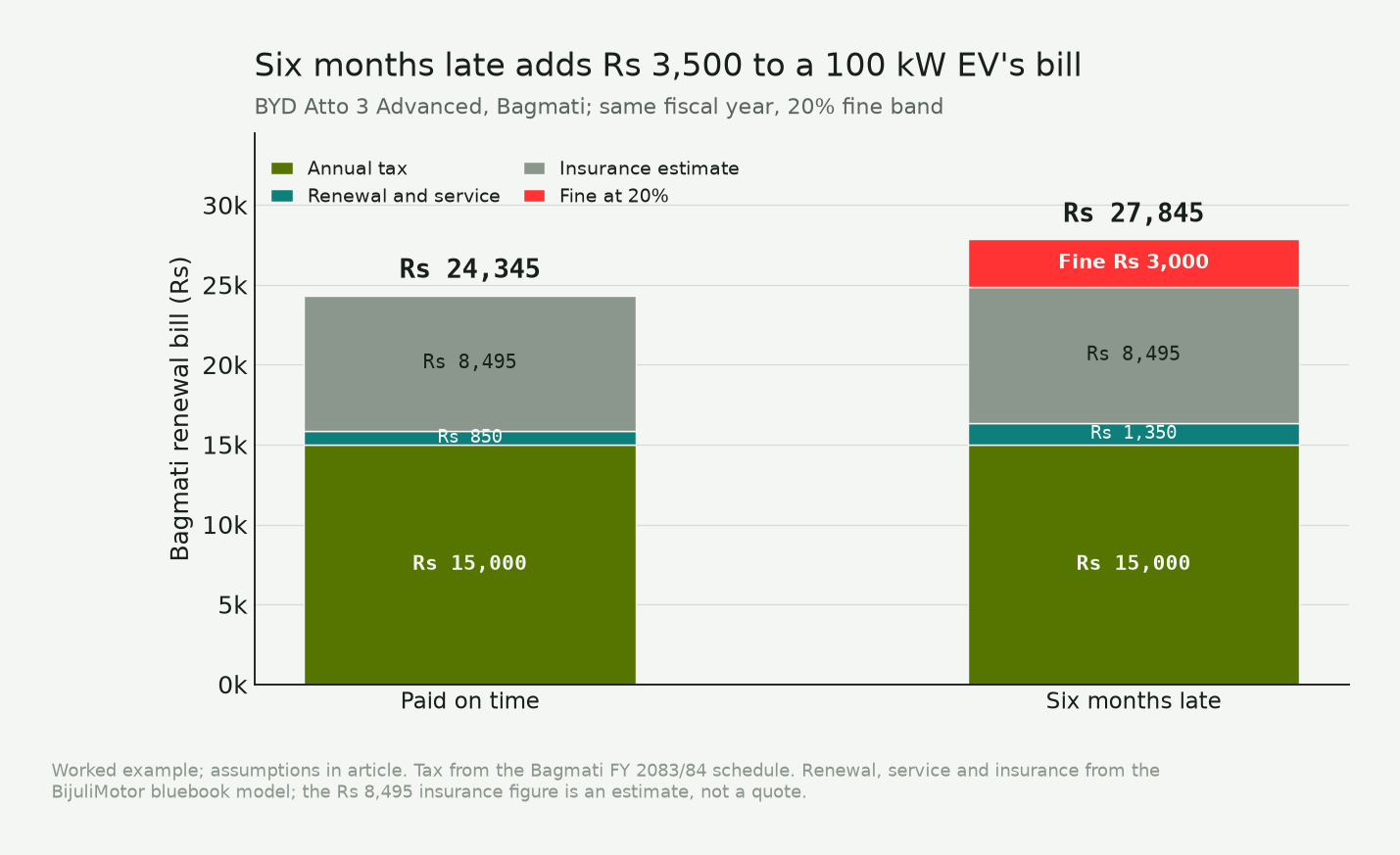
Take an Atto 3 Advanced, 100 kW, in Bagmati. The tax is Rs 15,000. Assumption: the bluebook date is in Bhadra, the deadline falls in Mangsir, and the owner pays six months later in Jestha, so the payment stays inside the same fiscal year. The fine is 20% of Rs 15,000, or Rs 3,000. The renewal fee doubles from Rs 500 to Rs 1,000. Service stays at Rs 350 and the insurance estimate at Rs 8,495. The total is Rs 27,845, which is Rs 3,500 more than paying on time.
If the payment crosses into the next fiscal year, the 32% band may apply instead. A deadline in Baisakh paid after Asar end is a different calculation.
EV News Nepal says the Bagmati Finance Act itself contains no late-fine schedule; the fine comes from the province's standing transport law, which is not published online (EV News Nepal, checked 14 October 2026). The bands above are the reading used by Tools Pasal and Kokil Thapa. They do not appear as a line in the budget. If more than one year is unpaid, each year is charged separately and the renewal surcharge grows. Ask for a year-by-year breakdown before you pay.
Check the receipt before you leave
Look for the registration number, owner's name, fiscal year paid, annual tax, renewal fee, any service charge, arrears, fine and next due date. If the receipt shows one lump sum, ask for the breakup. Check that the fiscal year is the one you meant to pay, especially if you also cleared an old year.
Keep the old and new receipts. The paid years are part of the vehicle's history, and a buyer will ask for them. The resale guide explains why a clean tax record helps an asking price. If you are comparing the renewal cost with the rest of ownership, the EV price quote checklist puts insurance, charging and taxes in one place.
Questions people ask
How much is EV bluebook renewal in Bagmati?
A private car up to 50 kW pays Rs 6,500 in annual tax, plus a Rs 500 renewal fee and any service charge. With the calculator's Rs 350 service charge and Rs 8,495 insurance estimate, a 45 kW Atto 1 comes to Rs 15,845. A 100 kW Atto 3 comes to Rs 24,345. A 155 kW Jaecoo J5 comes to Rs 29,345.
Can I renew an EV bluebook online in Nepal?
In Bagmati, the FY 2083/84 budget provides for it if the payment shows in VRS. We could not test the portal on 23 October 2026 because it timed out. In Koshi and Madhesh, use the provincial office or portal. Keep the receipt and check the record.
What happens if I pay late?
Bagmati adds 5% of the tax for the first 30 days, 10% for days 31 to 75, 20% to the fiscal year end, then 32% for each later fiscal year up to five. The renewal fee doubles. A 100 kW car paid six months late, still in the same fiscal year, pays Rs 27,845 all-in instead of Rs 24,345.
Is insurance included in the renewal fee?
No. Third-party insurance is a separate premium and is compulsory to drive. The Rs 8,495 figure in our calculator is an estimate. Get a quote from an insurer before you rely on it. Buy it from an insurer or through the transport office if that service is offered.
What if I lost the bluebook?
Get a police recommendation through the lost-document system, then apply at the transport office that holds the vehicle's file. The reported duplicate fee is Rs 1,000 for a four-wheeler. Clear any unpaid tax first. If the car is on loan, check with the lender before applying.
Sources and checks
- Meroauto, "Bagmati Province hikes annual tax on small EVs", 30 June 2026: Bagmati EV bands for FY 2083/84.
- Fiscal Nepal, "Bagmati introduces online vehicle tax payment", 30 June 2026: online payment and the VRS provision.
- EV News Nepal, "EV Tax in Nepal 2026 (FY 2083/84)", checked 14 October 2026: province tables and the note that the Finance Act has no fine schedule.
- Kokil Thapa, "Vehicle Tax in Nepal FY 2083/84", reviewed September 2026: deadlines, late bands, renewal surcharge, insurance tariff.
- Tools Pasal, "Bluebook Renewal & Vehicle Tax Payment in Nepal", 4 July 2026: documents, Section 176 bands, tax-before-transfer rule.
- Meroauto, "Madhesh Province follows federal policy", 21 July 2026: Madhesh value bands and 50% public/commercial discount.
- Meroauto, "How to apply online for a duplicate driver's license or bluebook after loss", 12 October 2025: duplicate process and reported fee.
- Bimal Khatri, "Lost Your Bluebook in Nepal?", 10 September 2026: police-first process, office file, citizen charter, lender caution.
- Nepal Police lost-document form, checked 23 October 2026.
- BijuliMotor bluebook calculator; vehicle prices and motor power from the site catalogue.
- The official Bagmati Finance Act PDF host (giwmscdnone.gov.np), the Bagmati ministry site and the VRS portal timed out on 23 October 2026. The rates above rely on the published readings listed here. Where those readings disagree, the difference is noted above.