
Atto 3 or Nexon EV? Compare the exact cars on offer
The Atto 3 costs about Rs 20.4 lakh more than the Nexon EV in Nepal. Compare the current trims, battery, charging, space and warranty before choosing.
The BYD Atto 3 and the Tata Nexon EV sit in different price bands in Nepal. On 23 October 2026 the 2026 Atto 3 Advanced was listed at Rs 62,90,000 and the Nexon EV at Rs 42,49,000, a gap of Rs 20,41,000. The decision comes down to what the extra Rs 20 lakh pays for and whether your family will use it. Which car is better in theory matters less.
The Nexon EV listing now shows one car: the 45 kWh model at Rs 42,49,000. Some comparisons still quote the older 30.2 kWh Nexon EV Prime XM at Rs 38,99,000. That trim is still in the BijuliMotor catalogue, but it is not on EV Nepal's current Nexon EV listing, and Tata's Nepal site could not be reached to check. If a dealer still offers one, the gap to the Atto 3 Advanced is Rs 23,91,000. Ask for the battery size and build date before you compare an old quotation with the current car.
The two cars at a glance
| Atto 3 Advanced | Atto 3 Superior | Nexon EV (45 kWh) | |
|---|---|---|---|
| Listed price | Rs 62,90,000 | Rs 78,00,000 | Rs 42,49,000 |
| Battery | 49.92 kWh | 60.48 kWh | 45 kWh |
| Claimed range | 345 km WLTP | 420 km WLTP | 325 km Nepal testing; 490 km MIDC |
| Motor | 100 kW, 310 Nm | 100 kW, 310 Nm | 98 kW, 215 Nm |
| 0–100 km/h | 10.1 s | 10.1 s | 8.9 s |
| AC charging | 7 kW, Type 2 | 7 kW, Type 2 | 7.2 kW wall box |
| DC charging | 105 kW, CCS2 | 105 kW, CCS2 | 60 kW, CCS2 |
| DC window | 0–80% in 50 min | 0–80% in 50 min | 10–80% in 40 min |
| Length / width | 4,455 / 1,875 mm | 4,455 / 1,875 mm | 3,995 / 1,802 mm |
| Wheelbase | 2,720 mm | 2,720 mm | 2,498 mm |
| Boot, seats up | 434 L | 434 L | 350 L |
| Ground clearance | 175 mm | 175 mm | 190 mm |
| Kerb weight | 1,680 kg | 1,750 kg | Not listed |
| Seats / airbags | 5 / 6* | 5 / 6* | 5 / 6 |
| Safety rating | 5-star Euro NCAP, 2022 | 5-star Euro NCAP, 2022 | 5-star Bharat NCAP, 2024 |
Sources: Atto 3 prices and warranty from Cimex's Atto 3 page; dimensions, charging and boot from the Atto 3 brochure and EV Nepal's Atto 3 table. Nexon EV figures from EV Nepal's Nexon EV table, which cites the Tata Nepal brochure. All checked 23 October 2026. The catalogue spells the BYD trim "Advance"; Cimex's brochure says "Advanced", which is used here.
*EV Nepal lists six airbags for the Atto 3, while the BijuliMotor catalogue lists seven. Check the count on the brochure attached to your quotation.
The range figures in that table come from three different tests. The Atto 3's 345 km and 420 km are WLTP results. The Nexon's 325 km is Sipradi's figure from in-market testing in Nepal, and its 490 km is an MIDC certification result. Read why the test label matters before you treat any of them as the kilometres you will get.
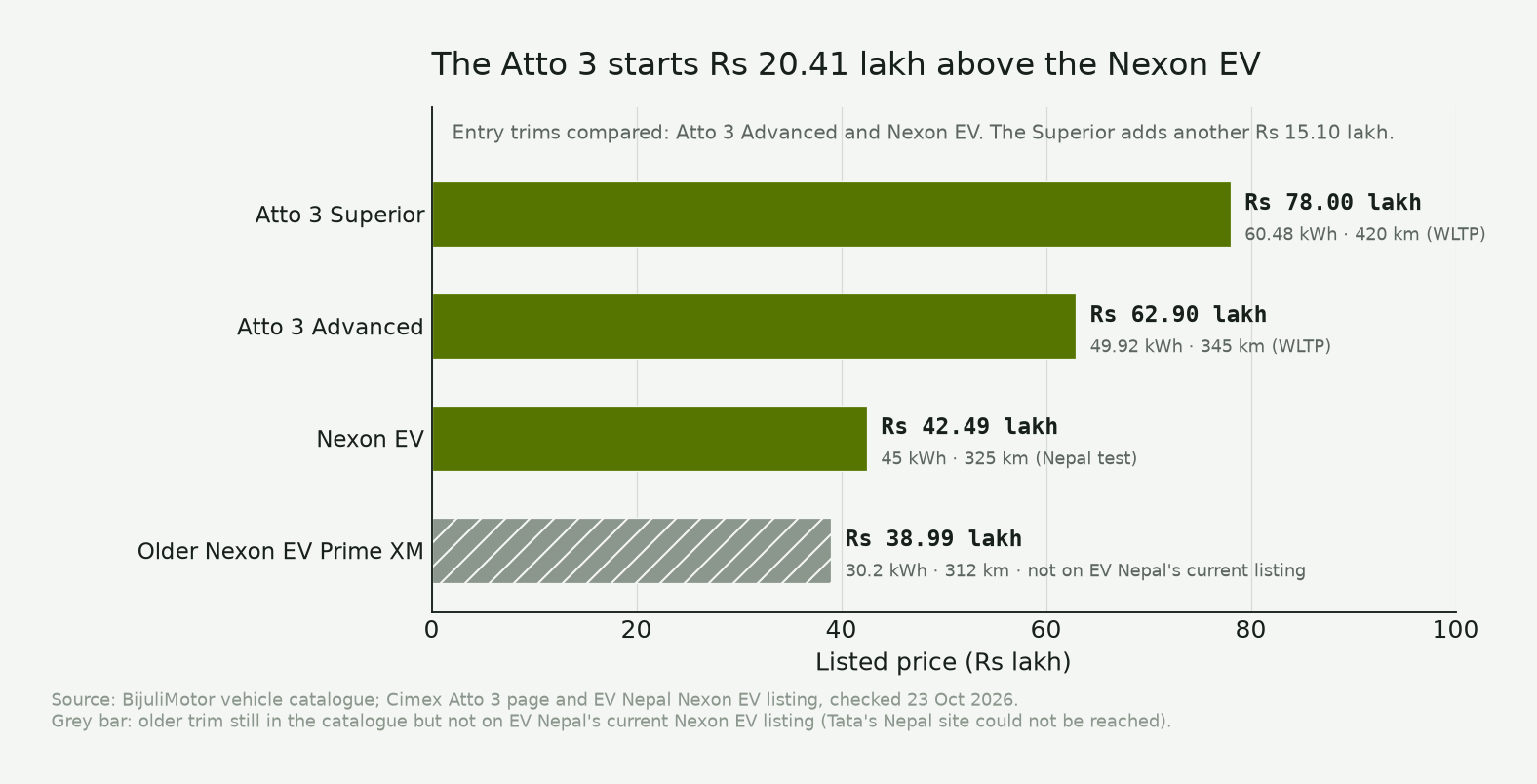
What the extra Rs 20.41 lakh buys
It doesn't buy much more battery. The Atto 3 Advanced has 4.92 kWh more than the Nexon, about 11%. Its motor is 2 kW stronger, and the Nexon is still quicker to 100 km/h, 8.9 seconds against 10.1.
Most of the money goes on size. The Atto 3 is 460 mm longer, 73 mm wider and has 222 mm more wheelbase. Its boot holds 84 litres more. It also sits 15 mm lower, which counts against it on broken roads and steep ramps, although neither car has a lot of clearance.
The equipment gap is narrower than the price gap suggests. Both cars have a 360-degree camera, a panoramic sunroof and ventilated front seats as standard. What the Atto 3 adds, on both trims, is a head-up display and a driver-assistance suite: adaptive cruise control, automatic emergency braking, lane keeping and blind-spot detection. EV Nepal notes that the Nepal Nexon has no lane keeping or automatic emergency braking. Its blind-spot view comes from a camera image on the screen. There is no radar warning. Equipment changes between batches, so check the brochure attached to your quotation.
DC charging hardware is the last measurable difference, 105 kW against 60 kW. The current network can use very little of that.
BYD's own range gives a useful comparison. The smaller Atto 2 Premium is listed at Rs 48,99,000 with a 51.13 kWh battery and the same 345 km WLTP claim as the Atto 3 Advanced. That is Rs 13,91,000 less for the same claimed range in a smaller body, which tells you the Atto 3's premium pays for space and equipment. It buys very little extra battery.
Charging: the charger sets the pace
Both cars take DC through a CCS2 plug, so the same public charger serves either. For AC, the Atto 3 has a Type 2 inlet and a 7 kW onboard charger; Tata lists a 7.2 kW AC wall box for the Nexon. Neither car's Nepal brochure lists a GB/T or CHAdeMO inlet.
On paper the Atto 3 charges much faster: up to 105 kW and 0–80% in 50 minutes, against the Nexon's 60 kW and 10–80% in 40 minutes. The windows differ, so convert them to energy. The Atto 3 adds about 39.9 kWh in its window and the Nexon about 31.5 kWh in its window (both on gross battery capacity). Divide by the time and both average about 48 kW. On the brochure numbers the two cars refill at almost the same average rate, and the Atto 3 has a bigger battery to fill.
The public network narrows the difference further. Of the 392 records in the BijuliMotor charging list, 68 name a CCS2 connector with a DC rating. Of those, 49 are 30 kW and 19 are 60 kW. None is faster. The only 80 kW record, CG Motors at Ratamate Jhangholi, is GB/T only, and so are the 60 kW units at CG Motors Hetauda and Nepalgunj Buspark; the CCS2 charger at both of those sites is 30 kW.
At a 30 kW site both cars draw 30 kW, so a 10–80% stop takes roughly 70 minutes in the Atto 3 Advanced and 63 minutes in the Nexon before charging losses. At a 60 kW site both are capped at 60 kW, which is the Nexon's peak and well under the Atto 3's. The Atto 3's 105 kW hardware would only help at a charger above 60 kW, and the list doesn't have one.
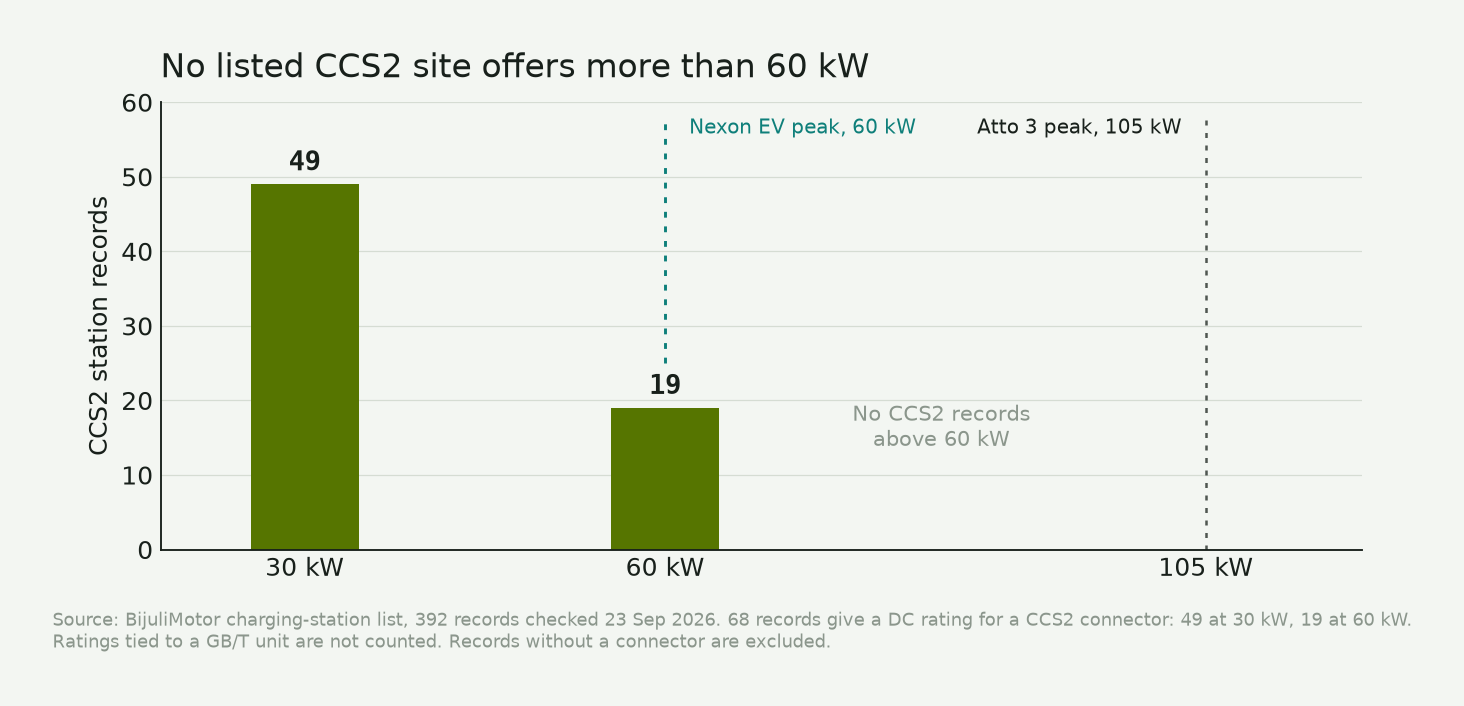
Check the plug before the power rating. The same list has 68 records naming CCS2, 73 naming only GB/T, and 251 with no connector recorded. A 60 kW charger with the wrong connector is a 0 kW charger, unless the operator confirms an adapter you can use. Nine of the nineteen 60 kW records list CCS2 and GB/T under a single 60 kW rating, so the list doesn't say whether the CCS2 side gets the full power. Ask the operator. The charging-plugs guide explains the connectors.
For a Kathmandu–Pokhara run, the site's trip guide works from a 210 km route. Both cars have enough claimed range for that trip. A full car, the climbs and air-conditioning use more than the brochure figure, so plan a short top-up around Kurintar or Damauli.
| Stop | Station in the list | Listed equipment |
|---|---|---|
| Kathmandu | CG Motors, Naxal | 60 kW CCS2 |
| Kurintar | Thee Digo, Darechowk | 60 kW DC, CCS2 and GB/T |
| Kurintar | MG, Riverside Spring Resort | 30 kW CCS2 |
| Damauli | Yatri, The Original Highway Restaurant | 60 kW DC, CCS2 and GB/T |
| Pokhara | CG Motors, Pokhara | 60 kW and 30 kW CCS2; 30 kW GB/T |
These are directory listings. They cannot tell you whether a charger is free right now. Call the operator first and know where the next compatible site is. The fast-charging guide explains why the last part of a session slows down.
Family fit
On paper the Atto 3 is the roomier car. The extra 84 litres of boot is roughly one large suitcase. The extra 222 mm of wheelbase usually means more rear legroom, though seat shape and floor height matter as much as the number.
The Nexon's case is its footprint. At 3,995 mm it is 460 mm shorter, which helps in Kathmandu lanes, on tight ramps and in older parking areas. It has 15 mm more ground clearance and a published 5.3 m turning circle; the Atto 3's turning circle isn't in the Nepal tables.
Numbers won't tell you whether three adults fit across the rear bench or whether your child seat goes in without hitting the front seats. Take the people and the child seat to the showroom. Set the driver's seat for the usual driver, then sit behind it, and put your normal luggage in the boot. The test-drive route guide has a checklist for ramps, parking and a loaded climb.
Warranty and service
| Cover | Atto 3 | Nexon EV |
|---|---|---|
| Vehicle | 8 years / 160,000 km† | 3 years / 125,000 km |
| High-voltage battery | 8 years / 160,000 km | 8 years / 160,000 km |
| Drive motor | Not stated separately | 8 years / 160,000 km |
| 12 V battery | 6 years / 150,000 km | Not stated |
†BYD Nepal's product page puts the battery and vehicle under one heading, "8 Year / 1,60,000 km Warranty", with terms and exclusions applying. The Nexon EV table lists the three parts separately, each "whichever is earlier". Confirm the vehicle term in the written booklet. If the BYD grouping holds, the big difference is vehicle cover: eight years against three.
Neither page publishes the battery capacity-loss threshold, whether the cover moves to a second owner, or the service conditions that keep the warranty valid. Get the written booklet and read the exclusions before you compare headline years. The battery warranty guide explains what those clauses usually say.
Service is harder to compare from a price list. Both brands sell in Kathmandu and Pokhara, which doesn't tell you where the car will be repaired. Ask which workshop handles high-voltage work, whether it can test the battery, and how long a replacement pack takes to arrive. An eight-year warranty is worth less if the nearest authorised workshop is a day's drive away.
Five years of running costs
Both cars use roughly the same energy per kilometre, so electricity can't close a Rs 20 lakh purchase gap.
| Assumption | Atto 3 Advanced | Nexon EV |
|---|---|---|
| Annual distance | 12,000 km | 12,000 km |
| Electricity tariff | Rs 12/kWh | Rs 12/kWh |
| Consumption | 18 kWh/100 km | 18 kWh/100 km |
| Five-year electricity | Rs 1,29,600 | Rs 1,29,600 |
| Purchase plus electricity | Rs 64,19,600 | Rs 43,78,600 |
The 18 kWh/100 km figure is an assumption for both cars. Use it as a planning estimate until you have your own measured figure. It is about a quarter above the consumption implied by the Atto 3's WLTP range and about 30% above the Nexon's Nepal-tested figure, which allows for hills and a loaded car. If the Atto 3 used 1 kWh/100 km more, its five-year bill would rise by about Rs 7,200. The Rs 12/kWh tariff is also an assumption. Check your current NEA bill before you rely on it. At Rs 25,920 a year for the Nexon, the Rs 20,41,000 gap equals about 79 years of its electricity.
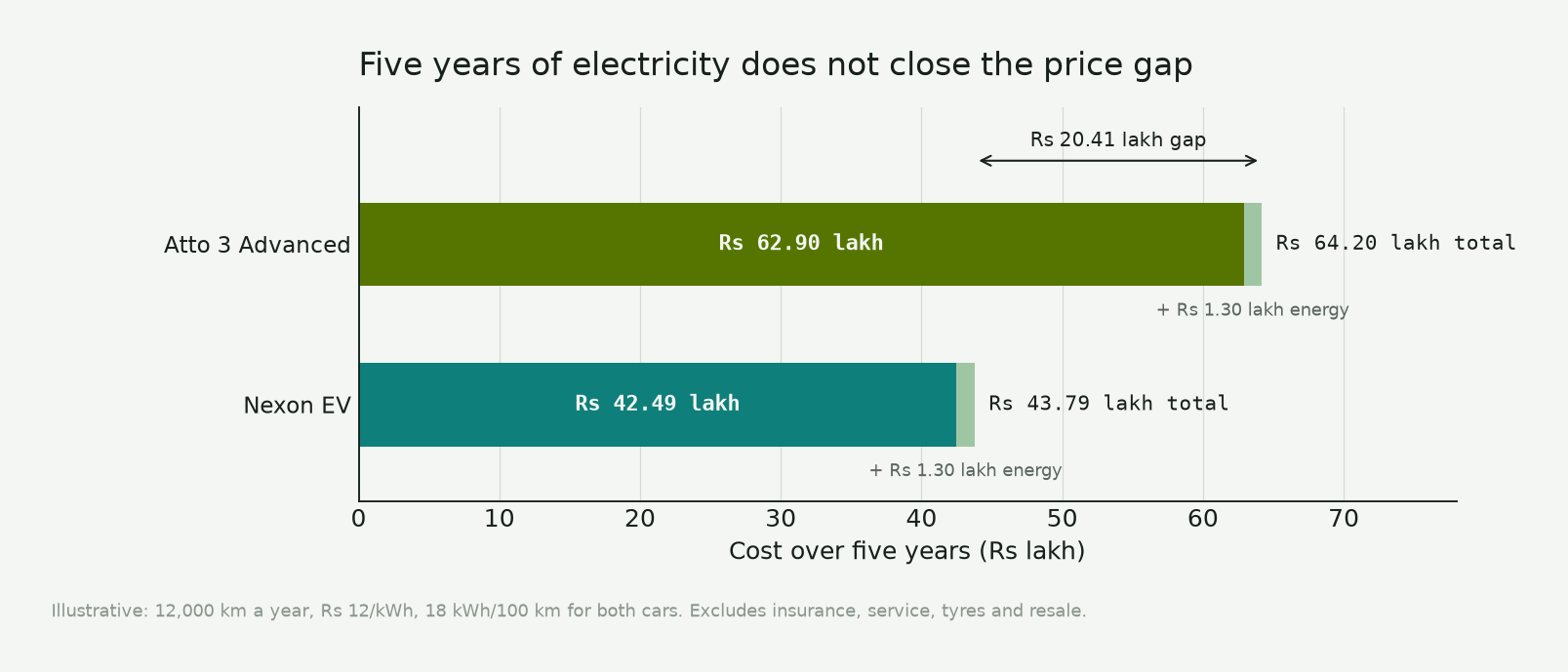
The gap is a capital cost. Borrow the whole Rs 20,41,000 at an assumed 9% over five years and the EMI is about Rs 42,400 a month, with about Rs 5.01 lakh in interest. Leave it invested at an assumed 8% a year and it grows to about Rs 30 lakh in five years. These are worked examples for comparison. Ask your bank for a loan offer and a licensed adviser for investment advice. The EMI calculator takes your own rate and tenure.
This leaves out insurance, servicing, tyres and resale. Insurance is usually priced on the car's value, so it would widen the gap. Resale might narrow it, but there is no reliable Nepal resale index for these two models, so any percentage would be a guess. If you plan to keep the car for eight years, the Atto 3's longer vehicle warranty is worth something, though it is hard to put a number on it.
Which one to buy
The Nexon EV
Buy it if your budget is around Rs 45 lakh, you mostly drive in the Valley, and 350 litres of boot is enough for your usual load. It costs far less, it is quicker to 100 km/h, it sits higher, and at 460 mm shorter it is easier in tight lanes. It still gets the 360-degree camera, sunroof and ventilated seats. On the current CCS2 network its 60 kW limit costs it nothing, because no listed site goes higher.
The Atto 3 Advanced
Buy it if you regularly carry four or five adults, need the 434-litre boot, and want the driver-assistance suite, the head-up display and the longer vehicle warranty. The Rs 20.41 lakh pays for space, those features and the warranty. The extra range is small, and today's chargers cannot make it charge any faster.
The Atto 3 Superior
This one makes sense only if you need the 60.48 kWh battery and 420 km WLTP claim for regular long runs. At Rs 78,00,000 it is Rs 15,10,000 above the Advanced for 10.56 kWh and 75 km of WLTP range. At that price, look at the rest of the Rs 70–80 lakh class on the EV price list first.
Neither car pays back its price through electricity savings against the other. Both are cheap to run compared with petrol, and the difference between them is small. Choose on space, equipment and the dealer you trust, then use the comparison tool to check the exact variants on your quotation.
Questions buyers ask
Is the Atto 3 worth Rs 20.41 lakh more than the Nexon EV? Only if you need the extra rear space, the bigger boot, the driver-assistance suite or the longer vehicle warranty. On range and running cost alone, no.
Which one charges faster in Nepal? On the current network, neither has a real advantage. Of the 68 CCS2 records with a DC rating, 49 are 30 kW, where both cars draw the same 30 kW. The other 19 are 60 kW, the Nexon's peak, so both cars are capped at 60 kW there too. The Atto 3's 105 kW peak would only matter at a CCS2 charger above 60 kW, and the list has none.
Is the Nexon EV big enough for five? It has five seats and a 350-litre boot in a 3,995 mm body. Three adults across the rear bench will be tight. Bring the people who will actually travel to the showroom.
Which has more boot space? The Atto 3, with 434 litres against 350 litres with the seats up. Folded, the Atto 3 holds 1,340 litres; the Nexon's Nepal table doesn't give a folded figure.
Do both have a sunroof and 360-degree camera? Yes. Both list a panoramic sunroof, ventilated front seats and a 360-degree camera as standard. Only the Atto 3 lists a head-up display, adaptive cruise control, automatic emergency braking and lane keeping.
What should I check in the warranty? The battery capacity-loss threshold, whether cover transfers to a second owner, the required service intervals, and what "whichever is earlier" means for your mileage. Neither Nepal page publishes all four.
Sources and checks
- Atto 3 Advanced and Superior prices: Cimex's Atto 3 page, checked 23 October 2026. Dimensions, charging, boot and warranty from the Atto 3 brochure.
- Atto 3 specifications and equipment (360-degree monitor, panoramic sunroof, ventilated front seats, head-up display, driver assistance): EV Nepal's Atto 3 table, checked 23 October 2026.
- Nexon EV price, battery, charging, dimensions, equipment and warranty: EV Nepal's Nexon EV table, which cites the Tata Nepal brochure, checked 23 October 2026. Tata's Nepal specification site could not be reached that day, so confirm with Sipradi before booking.
- Older Nexon Prime XM price and battery: BijuliMotor vehicle catalogue.
- Charging counts: BijuliMotor charging-station list, 392 records, checked 23 September 2026. A record's DC rating is counted only against the connector it names.
- Five-year cost, EMI and investment figures: worked examples, with the assumptions stated above and in the chart footer.