
Electric delivery vans in Nepal: cost per completed drop
Four cargo EVs with Nepal prices, what their payloads really carry, a 90 km day in an Ace EV, and the depot bill behind your cost per completed drop.
Prices checked 25 October 2026.
The cheapest electric cargo vehicle with a published Nepal price is the Foton TM1 EV at Rs 33,99,000. It is a 38.64 kWh mini-truck with a published 1,400 kg payload, and Foton lists the cargo box as an optional extra, so that price is a starting point rather than a delivered vehicle. The Tata Ace EV is the smaller, better known option at 21.3 kWh and 600 kg, but Tata's Nepal page does not publish its price and Sipradi's commercial-vehicle site could not be reached when checked on 25 October 2026.
A delivery business buys a working day. The questions that decide the purchase are how much load leaves the depot, how many drops it makes, how long it is parked, and what the electricity supply at that parking place can deliver. A vehicle that fits those four answers will look cheap to run. One that does not will cost more per delivery, whatever the brochure says about range.
What you can buy in Nepal
| Model | Body | Listed price | Battery | Published range | Payload | Cargo space |
|---|---|---|---|---|---|---|
| Tata Ace EV | mini-truck | Not published | 21.3 kWh | 155 km certified | 600 kg | About 4.8 m³ (load body 2,211 × 1,459 × 1,475 mm) |
| Foton TM1 EV | mini-truck | Rs 33,99,000 | 38.64 kWh | 280 km NEDC | 1,400 kg | About 7.5 m³ with the tall body; 1.71 m³ with the low side |
| Foton Aumark EV | light truck | Rs 65,00,000 | 100.27 kWh | Not published | Not published | Not published |
| Foton eTunland | pickup | Rs 69,99,000 | 88 kWh | 430 km NEDC | 900 kg including occupants | 1.06 m³ bed |
| Foton eMiler | light truck | On request | 100.27 kWh | Not published | Not published | Not published |
| Model | AC charging | DC charging | Connector | Warranty published in Nepal | Distributor |
|---|---|---|---|---|---|
| Tata Ace EV | Not published | Not published | Not published | 6 years, battery | Sipradi |
| Foton TM1 EV | 6.6 kW | 0 to 100% in 1 hour or less | CCS2 | Not published | MAW Vriddhi |
| Foton Aumark EV | Not published | Not published | Not published | Not published | MAW Vriddhi |
| Foton eTunland | Not published | Not published | Not published | Battery 8 years or 400,000 km; motor 5 years or 200,000 km | MAW Vriddhi |
| Foton eMiler | Not published | Not published | Not published | Not published | MAW Vriddhi |
Prices are list prices from the distributors, checked on 25 October 2026. They exclude body building, registration, insurance and any fleet discount. Foton's TM1 page shows Rs 33,99,000 and its Aumark page shows Rs 65,00,000.
The eTunland page showed no price that day, so its Rs 69,99,000 comes from the August 2025 Nepal announcement recorded in the BijuliMotor catalogue.
The catalogue also lists two Foton vans at Rs 52,99,000 and Rs 63,49,000. Both are passenger vehicles, with 11+3 and 14/15 seats, so they are not in the table. Neither is the BAW E7 Pro at Rs 23,99,000: EV Nepal lists it as a four-seat, five-door city hatchback, which is not a delivery body. A low price on a small electric car does not make it a cargo vehicle.
Payload and volume run out at different loads
Two numbers decide whether a body suits your goods: the payload in kilograms and the volume in cubic metres. Dense goods reach the weight limit first. Light goods fill the space first.
The TM1's tall cargo body measures 3,050 × 1,560 × 1,570 mm, which is about 7.5 m³. Those dimensions come from an older Nepal brochure, so confirm the delivered box in the quotation. Divide its 1,400 kg payload by that volume and the body reaches its weight limit at about 187 kg/m³ of cargo. A cubic metre of water weighs 1,000 kg, so 1.4 m³ of bottled water would use the whole payload and leave more than 6 m³ empty. Cartons averaging about 100 kg/m³ would fill the body at around 747 kg, well under the payload. That 100 kg/m³ is an assumption for this example; your own consignment note has the real figure.
The eTunland goes the other way. Its bed holds 1.06 m³ and its 900 kg rating includes the occupants, so the cargo allowance is lower and the bed reaches its weight limit at less than 850 kg/m³. For most light cargo, volume will stop you before weight does.
The Ace EV carries less weight and less volume. Tata lists its load body at 2,211 × 1,459 × 1,475 mm, about 4.76 m³, so its 600 kg payload is reached at about 126 kg/m³. Light cartons will fill that body well before the payload is used, while water or rice will reach 600 kg with room to spare. Tata's page does not say whether the load-body figures are internal or external, so ask Sipradi to confirm the internal size. Also check that the body's own weight is already counted inside the payload. The dealer should give you a weight calculation for the completed vehicle, including the body and any rack or refrigeration unit.
A 90 km day in a 21.3 kWh Ace EV
Tata's Nepal page gives the Ace EV a 21.3 kWh battery and a certified range of 155 km. Those two figures imply 13.7 kWh/100 km on the certification cycle. That is a test result. A loaded van on a Kathmandu route was never part of the test.
Take a 90 km day. The table adds a 1.5 kWh allowance for lights, a phone charger, a cargo-area fan and any stationary work. The 1.5 kWh is our assumption. Tata did not supply it. So are the 18 kWh/100 km middle case and the 22 kWh/100 km heavy case.
| Consumption | Energy for 90 km | Plus ancillary | Total from the pack | Left in a 21.3 kWh pack |
|---|---|---|---|---|
| 13.7 kWh/100 km, certified cycle | 12.4 kWh | 1.5 kWh | 13.9 kWh | 7.4 kWh, 35% |
| 18 kWh/100 km, assumed | 16.2 kWh | 1.5 kWh | 17.7 kWh | 3.6 kWh, 17% |
| 22 kWh/100 km, assumed heavy load | 19.8 kWh | 1.5 kWh | 21.3 kWh | 0 kWh, 0% |
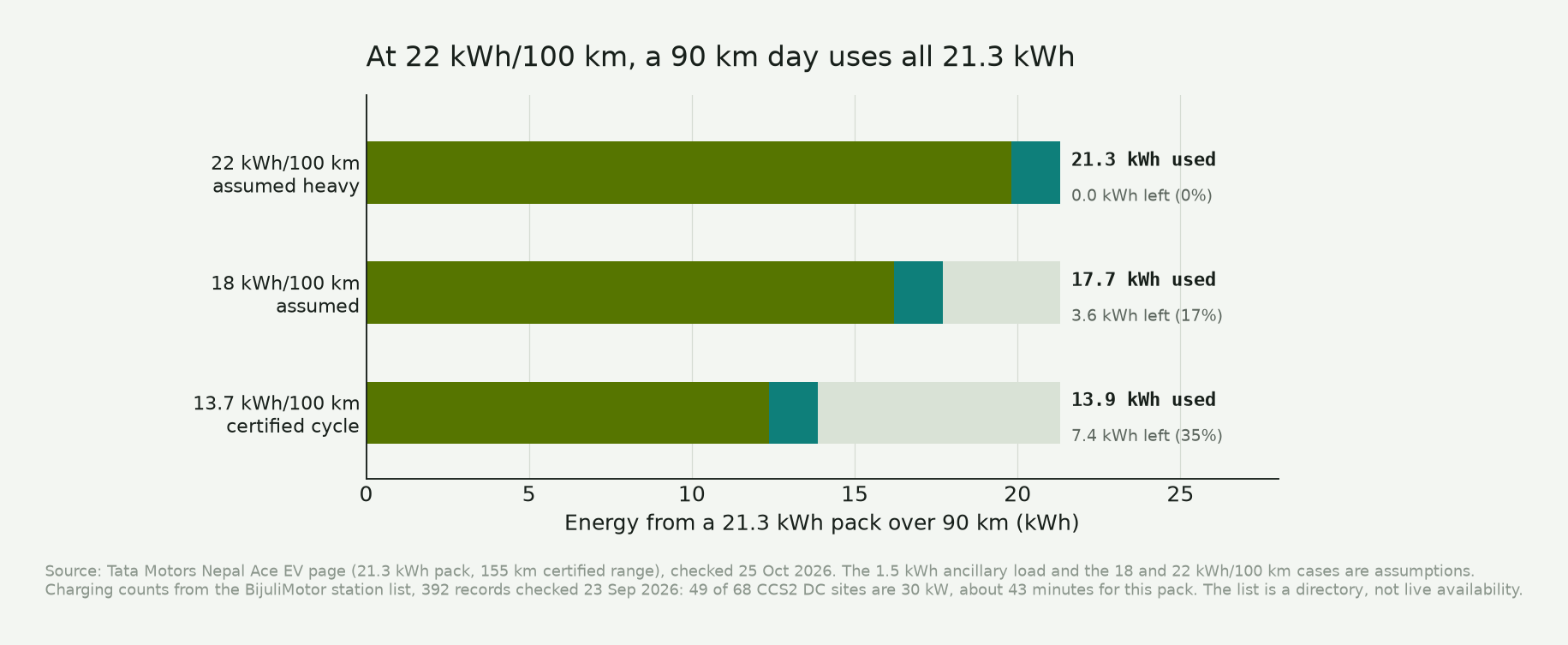
At 22 kWh/100 km the day uses the entire nominal pack and leaves nothing for a detour, a queue at the last stop or the battery's own degradation. Even the middle case leaves 17%, which is thin if the last drop is up a hill.
Tata does not publish the Ace EV's usable capacity, so the 21.3 kWh may not all be available. That makes the arithmetic more cautious than it would otherwise be. If your first week shows 22 kWh/100 km, a 90 km day needs a charge in the middle or a bigger pack. It does not mean the van is unsuitable for every route.
Charging hours and the demand charge
Replacing 21.3 kWh at 90% charging efficiency takes 23.7 kWh at the meter. The charging time then depends on the charger. The table uses a 3.3 kW charger as an example and a 6.6 kW charger, the rating Foton publishes for the TM1. Tata does not publish the Ace EV's AC rating.
| AC power | Time for 23.7 kWh | Approximate connection |
|---|---|---|
| 3.3 kW | 7.2 hours | 4 kVA |
| 6.6 kW | 3.6 hours | 8 kVA |
The connection figures assume a power factor near 0.85 with some margin. Check them with the installer.
An overnight window of eleven hours, from 8pm to 7am, is enough for either. The limit is usually the parking space and the plug. The charger itself is rarely the problem. A van that comes back at 11pm and leaves at 5am has six hours, which adds about 19.8 kWh at 3.3 kW. That covers a 90 km day at 18 kWh/100 km, but not a full pack.
The bill has a fixed part. ERC's calculator, checked on 25 October 2026, applies a low-voltage commercial tariff of NPR 325 per kVA a month plus NPR 11.20 a unit, before VAT. A 4 kVA increment costs Rs 1,300 a month whether the van drives 90 km a day or sits idle. At 8 kVA it is Rs 2,600. That fixed charge is why a lightly used van has a worse cost per kilometre than a busy one.
If your existing connection cannot carry the charger, apply to NEA for a bigger one through its three-phase meter application. The load upgrade guide sets out what the application asks for. Use a qualified electrician for the wiring, earthing and protection, and get the supply approved before the vehicle arrives.
Three vans charging at 6.6 kW each is a 19.8 kW load. Plan the wiring for that total and do not run it off three extension leads. Add the simultaneous demand and decide what happens when one charger fails.
Treat public DC as a backup. It cannot replace charging at your own depot. The BijuliMotor charging list has 392 records; 68 name a CCS2 connector with a DC rating, of which 49 are 30 kW and 19 are 60 kW. At a 30 kW site, 21.3 kWh would take about 43 minutes from empty before losses and the slow final part of the session. The list is a directory. It cannot tell you whether a charger is free right now. Call the operator before you plan a route around one.
What a month costs
Assume the van runs 90 km a day, six days a week. That is 2,340 km a month and 28,080 km a year. Assume 18 kWh/100 km and 90% charging efficiency. At the ERC tariff above, the meter takes 468 kWh, which costs Rs 5,241.60. Add the Rs 2,600 demand charge for an 8 kVA connection and the month comes to Rs 7,841.60, or Rs 3.35 a kilometre.
Diesel is the comparison most buyers make. Nepal Oil Corporation's price page listed diesel at Rs 197.50 a litre in the first category, which applies within 15 km of a depot, on 25 October 2026. A small diesel mini-truck might return 12 to 15 km a litre on this kind of route. That range is an assumption; your route, load and driver will move it.
| Monthly cost | Electric | Diesel at 15 km/l | Diesel at 12 km/l |
|---|---|---|---|
| Distance | 2,340 km | 2,340 km | 2,340 km |
| Fuel or meter energy | 468 kWh | 156 L | 195 L |
| Cost | Rs 7,841.60 | Rs 30,810 | Rs 38,512.50 |
| Cost per km | Rs 3.35 | Rs 13.17 | Rs 16.46 |
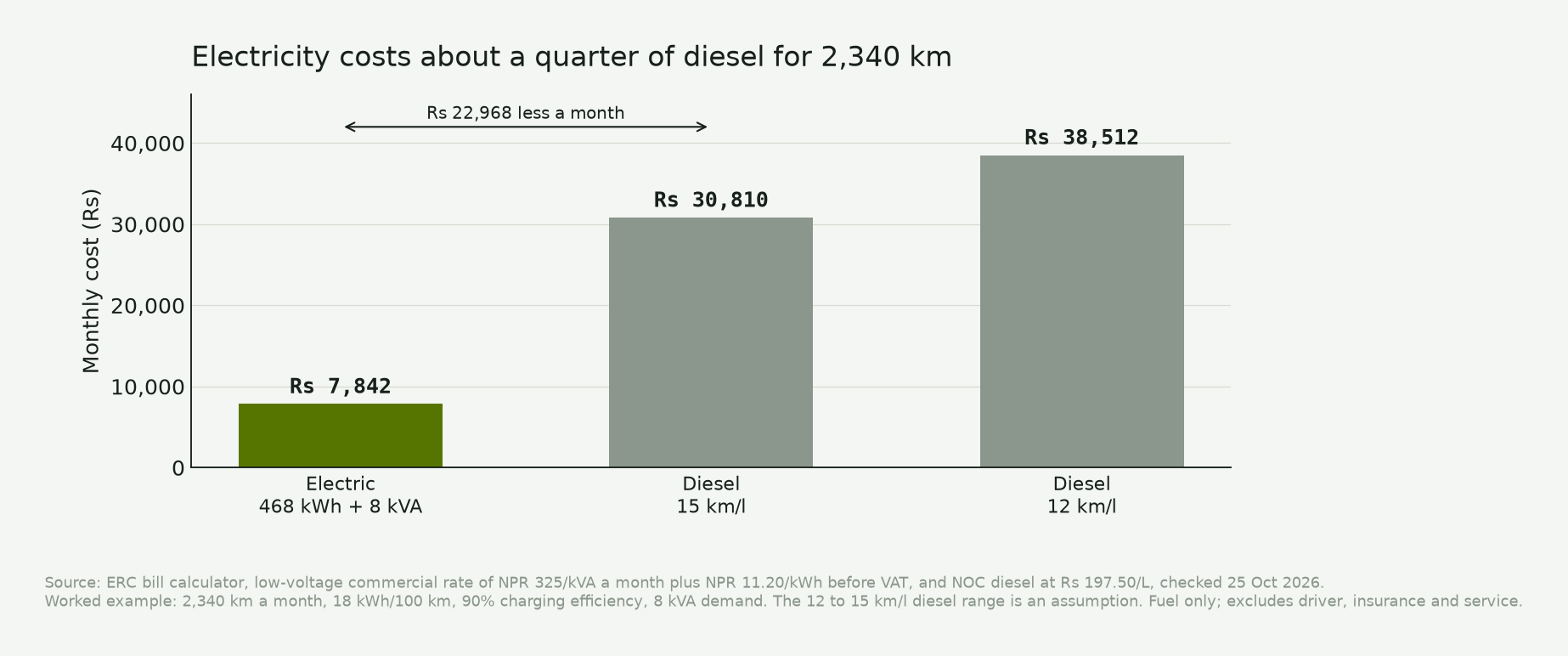
The electric figure includes the demand charge. The diesel figure includes only fuel. Neither includes the driver, insurance, servicing, tyres or finance.
At 15 km/l the saving is Rs 22,968 a month, or about Rs 13.8 lakh over five years at today's prices. That number is only as good as the diesel assumption. It also says nothing about payback, because the Ace EV price is unpublished and the price of a diesel Ace is equally unconfirmed. Get both quotes before you put a saving like this into a business case.
Cost per completed drop
A monthly cost hides the risk that matters. A vehicle that misses deliveries still carries its finance and its demand charge, so the number to watch is cost per completed drop. The electric taxi cost guide makes a similar point about empty kilometres.
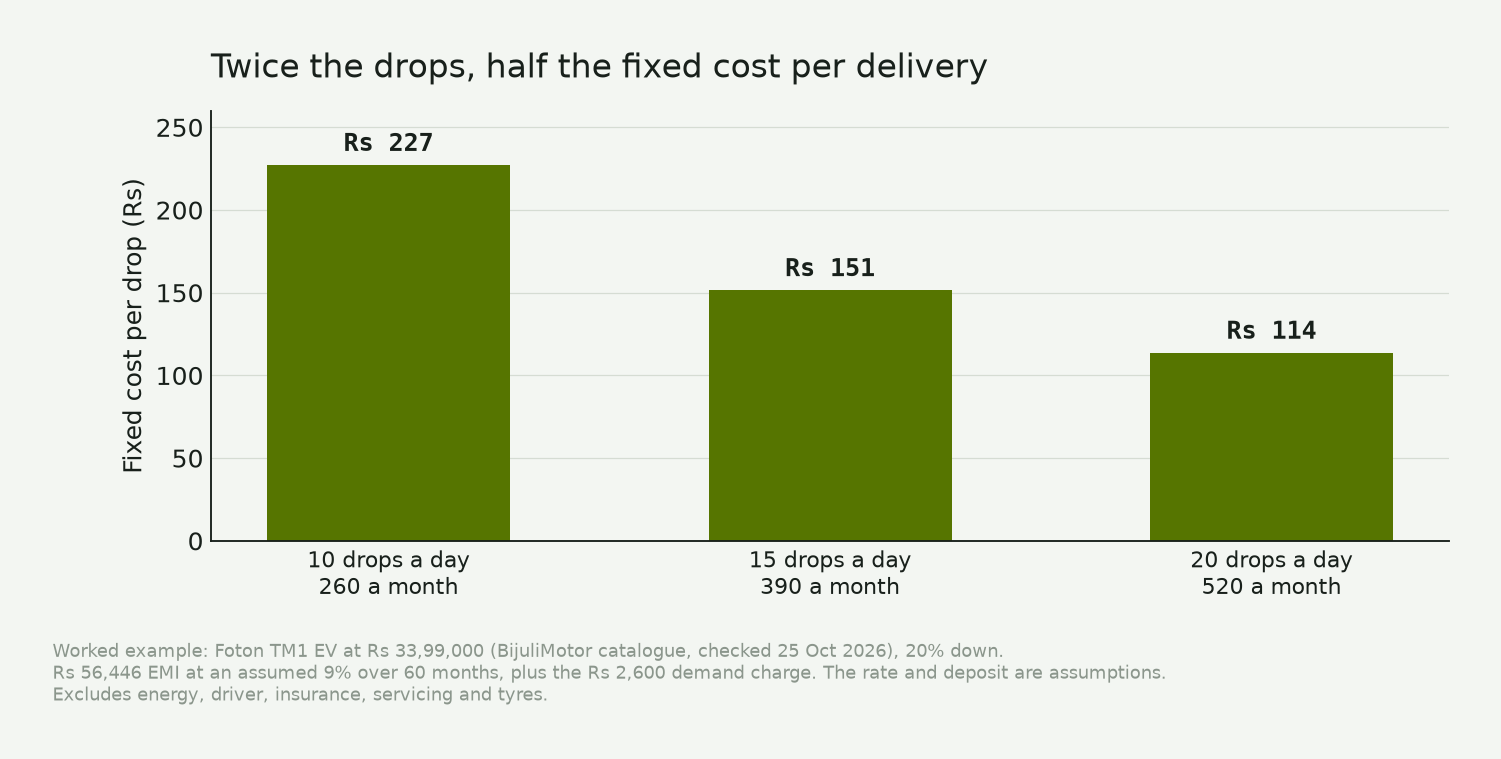
Take the TM1 at Rs 33,99,000, because it has a published price. Put 20% down and finance Rs 27,19,200 at an assumed 9% over 60 months. The EMI is Rs 56,446 a month and the interest over the term is Rs 6,67,567. These are worked-example terms. A bank will quote its own rate and deposit, and the EMI calculator takes your own figures.
Add the Rs 2,600 demand charge and the fixed cost is Rs 59,046 a month before the van moves. At 20 drops a day, six days a week, that is 520 drops and Rs 113.55 a drop. At 10 drops a day it is Rs 227.10. The 468 kWh month above adds about Rs 10 a drop at 520 drops, and a loaded TM1 will use more. Either way, the drop count moves the total far more than the electricity price does.
| Line | Your figure | Where to get it |
|---|---|---|
| EMI or lease | Bank quote | |
| Demand charge | NEA bill | |
| Energy | Meter readings | |
| Driver | Payroll | |
| Insurance | Insurer quote | |
| Servicing | Dealer schedule | |
| Tyres | Dealer quote | |
| Backup vehicle | Hire rate | |
| Permits and taxes | Transport office | |
| Drops completed | Dispatch records |
Fill it in monthly. Keep the loan payment and depreciation in separate columns: the first is cash out, the second is the van losing value. A cost per kilometre can look healthy while the van completes fewer drops than the route needs.
One more caution about the TM1 price: Foton lists the cargo box as optional. If your Rs 33,99,000 quotation does not include a box, the finance figure above is too low.
Run a one-week trial
Pick the hardest recurring week on your calendar. An easy week will not test the van. Load the van the way your customers load it, drive the real routes, and record:
- start and end state of charge each day
- the meter reading before and after charging
- kilometres driven and drops completed
- failed or late drops and why
- load weight and the number of cartons or sacks
- charging hours and any session that failed
- waiting time at stops and at any public charger
A week will not cover the monsoon, the festival peaks or the steepest month. It will show whether the pack, the body and the charging window survive a normal week, which is enough to reject a vehicle that clearly does not fit. The test drive guide covers the unloaded drive; this trial is the loaded one.
If you already run a diesel van on the route, lend the electric one to the same driver and compare the same week. Driver habits change consumption more than a brochure does.
Warranty and support
Tata's Nepal page lists a six-year battery warranty for the Ace EV. It does not publish a kilometre limit, a capacity-loss threshold or whether commercial use is covered. Ask for the booklet and read those three clauses before you sign.
Foton's August 2025 eTunland announcement listed an eight-year or 400,000 km battery warranty and a five-year or 200,000 km motor warranty. The TM1, Aumark and eMiler pages publish no warranty at all. That does not mean there is no warranty. It means the websites give you nothing to compare.
Four questions belong in writing before you order:
- Is the warranty valid for commercial delivery use?
- At what battery capacity loss does a claim qualify?
- Does the cover transfer if you sell the van?
- Which workshop does high-voltage work, and how long does a part take to arrive?
The battery warranty guide explains why the kilometre limit matters more for a working vehicle. A 400,000 km limit sounds generous until you divide it by 28,080 km a year, which is a little over 14 years at the mileage above.
Tata's Nepal dealer locator listed 26 Sipradi locations when checked on 25 October 2026, including several in Kathmandu and Pokhara. Foton's distributor MAW Vriddhi lists its showroom at Balkumari, Lalitpur. A long dealer list does not prove that any workshop can diagnose a battery, so ask which location does that work. The EV servicing guide lists what still needs attention on an electric vehicle.
Questions buyers ask
Can an Ace EV do 100 km loaded? On Tata's certified range of 155 km, yes on paper. At 18 kWh/100 km a 100 km day needs 18 kWh plus ancillary load, which leaves about 2 kWh in a 21.3 kWh pack. That leaves almost no reserve. Measure the route before you plan 100 km every day.
What does it cost per kilometre? About Rs 3.35 in energy and demand charge at the assumptions above. The TM1's EMI alone adds Rs 24.12 a kilometre at 2,340 km a month; with the demand charge the fixed cost is Rs 25.23. That is why the cost per drop is the more useful number.
Can I charge it at my shop? If the supply and wiring can carry the charger, yes. A 3.3 kW charger adds about 4 kVA of demand and a 6.6 kW charger about 8 kVA. Apply to NEA for the connection first and use an electrician for the installation. The demand charge applies even in a month when the van hardly moves.
Is a cargo EV eligible for a business loan? Banks finance commercial vehicles. A scheme aimed specifically at electric cargo vehicles could not be confirmed. Ask two banks for the rate, the deposit and any balloon payment, then put those terms into the EMI calculator.
What is it worth after five years? There is no published resale index for electric cargo vehicles in Nepal, so any percentage would be a guess. Ask the distributor about a buy-back or trade-in and treat the answer as part of the price.
Sources and checks
- Tata Ace EV specifications (21.3 kWh, 155 km certified range, 600 kg payload, 160 mm ground clearance, six-year battery warranty, load body 2,211 × 1,459 × 1,475 mm): Tata Motors Nepal, checked 25 October 2026. One feature heading on that page says 154 km; the range block says 155 km.
- Foton TM1 EV price and specifications: Foton Nepal TM1 page and the TM1 specification page, checked 25 October 2026. Payload, body dimensions and charging ratings are recorded in the BijuliMotor catalogue.
- Foton Aumark EV price: Foton Nepal Aumark page, checked 25 October 2026.
- Foton eTunland price, payload and warranty: BijuliMotor catalogue record
foton-etunland-88-kwh, from the August 2025 MAW Vriddhi announcement. Foton's eTunland page showed no price on 25 October 2026. - Foton eMiler: BijuliMotor catalogue record
foton-emiler-100-27-kwh; no Nepal price published. - Passenger vans and the BAW E7 Pro: BijuliMotor catalogue, and EV Nepal's E7 Pro page, which lists a four-seat, five-door hatchback, checked 25 October 2026.
- Electricity tariff: ERC electricity bill calculator, checked 25 October 2026. Low-voltage commercial rate of NPR 325 per kVA a month and NPR 11.20 a unit, before VAT.
- Diesel price: Nepal Oil Corporation price page, checked 25 October 2026.
- New connection: NEA three-phase meter application.
- Charging counts: BijuliMotor charging-station list, 392 records, checked 23 September 2026. A record's DC rating is counted only against the connector it names.
- Sipradi's commercial-vehicle site could not be reached on 25 October 2026, so no Ace EV price or dealer term was confirmed there.
- Route energy, charging time, monthly cost, EMI and cost per drop are worked examples. The assumptions sit next to each calculation and in the chart footers.