
Low mileage in Nepal: buy an EV, rent or take taxis?
At 3,000 km a year, a small EV can cost Rs 77 a kilometre once capital is counted. Compare bus, taxi and rental fares before you buy.
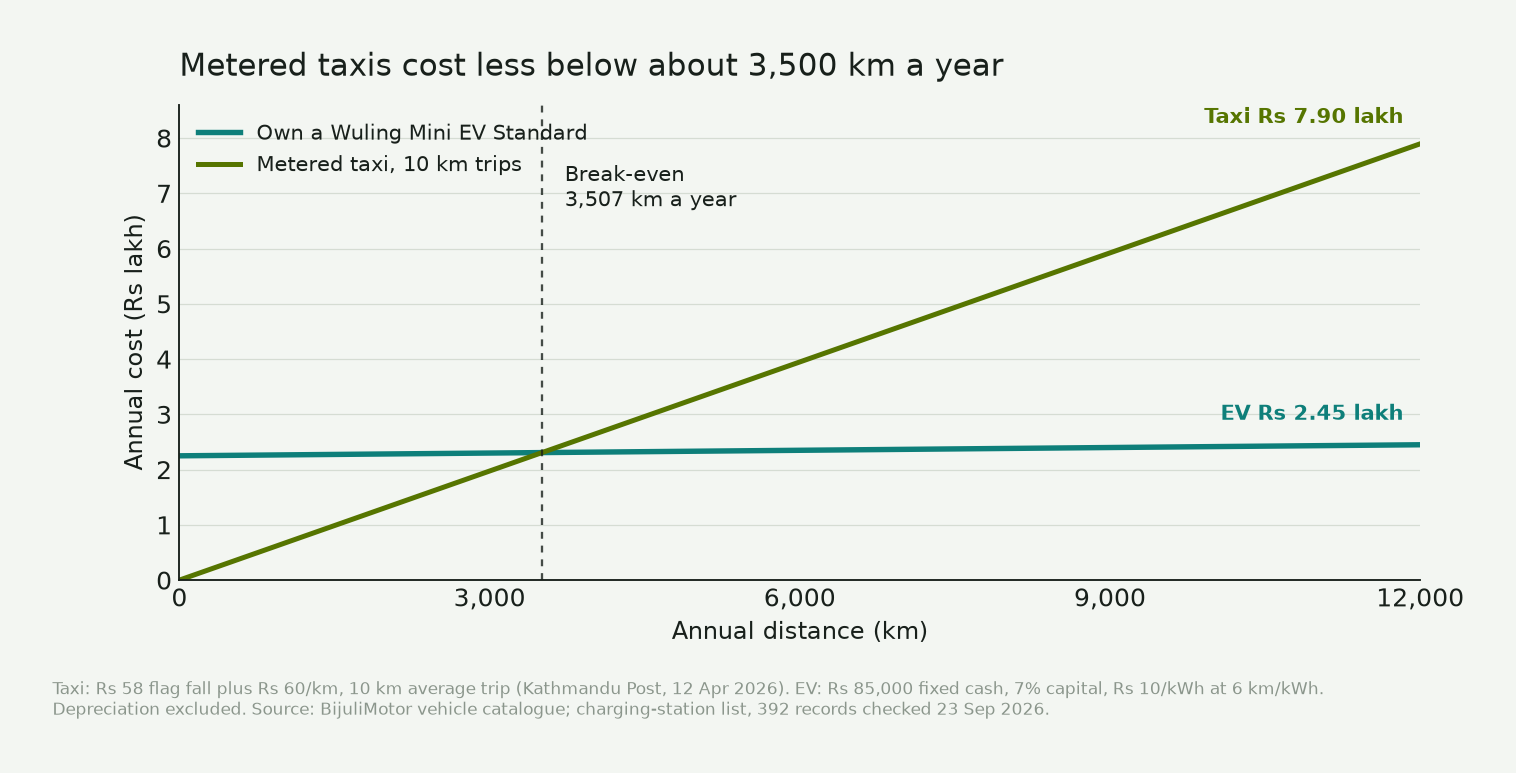
At 3,000 km a year, a Wuling Mini EV Standard listed at Rs 19,99,000 costs about Rs 30 a kilometre in cash and Rs 77 once the capital tied up in the car is counted. A metered taxi on 10 km trips in the Kathmandu Valley costs about Rs 66 a kilometre. Below roughly 3,500 km a year, the taxi is cheaper unless the car is doing trips that a taxi cannot reliably serve.
The answer depends on the fare you can get and the journeys you make. A daily commuter on a direct bus route and a family doing a school run before dawn do not face the same alternative. The numbers below use fares published in Nepal in 2026, the site's own ownership assumptions, and three worked examples.
The arithmetic has a trap. A car has fixed costs whether it moves or not: insurance, parking, maintenance, a battery reserve, and the cost of the money tied up in it. At low mileage those costs spread over few kilometres. Driving more does not make the car cheaper to own. The cost per kilometre falls because the same fixed cost is spread over a larger distance.
What a low-mileage year costs
Take the Wuling Mini EV Standard at Rs 19,99,000. Its annual fixed cash costs are Rs 85,000 before electricity: Rs 38,000 for insurance, Rs 8,000 for maintenance, Rs 15,000 set aside for the battery, and Rs 24,000 for parking at Rs 2,000 a month. The first three figures come from BijuliMotor's ownership model. They are planning assumptions. Ask an insurer and a workshop for written quotes before you rely on them. Parking is an assumption too. Use your own rent, or the value of the space you give up.
Electricity uses 6 km/kWh, the site's assumption, and Rs 10/kWh, a round figure for a home charger. That is Rs 1.67 a km. The table charges capital at 7% of the purchase price a year, Rs 1,39,930, as a proxy for loan interest or the return you give up on cash. Pick one of the two and leave the other out of the sum. Depreciation is not in the table. Add it and the car costs more.
| Annual distance | Fixed cash | Electricity | Cash total | Cash per km | Capital at 7% | Cash plus capital | Cost per km |
|---|---|---|---|---|---|---|---|
| 3,000 km | Rs 85,000 | Rs 5,000 | Rs 90,000 | Rs 30.00 | Rs 1,39,930 | Rs 2,29,930 | Rs 76.64 |
| 6,000 km | Rs 85,000 | Rs 10,000 | Rs 95,000 | Rs 15.83 | Rs 1,39,930 | Rs 2,34,930 | Rs 39.16 |
| 12,000 km | Rs 85,000 | Rs 20,000 | Rs 1,05,000 | Rs 8.75 | Rs 1,39,930 | Rs 2,44,930 | Rs 20.41 |
| 18,000 km | Rs 85,000 | Rs 30,000 | Rs 1,15,000 | Rs 6.39 | Rs 1,39,930 | Rs 2,54,930 | Rs 14.16 |
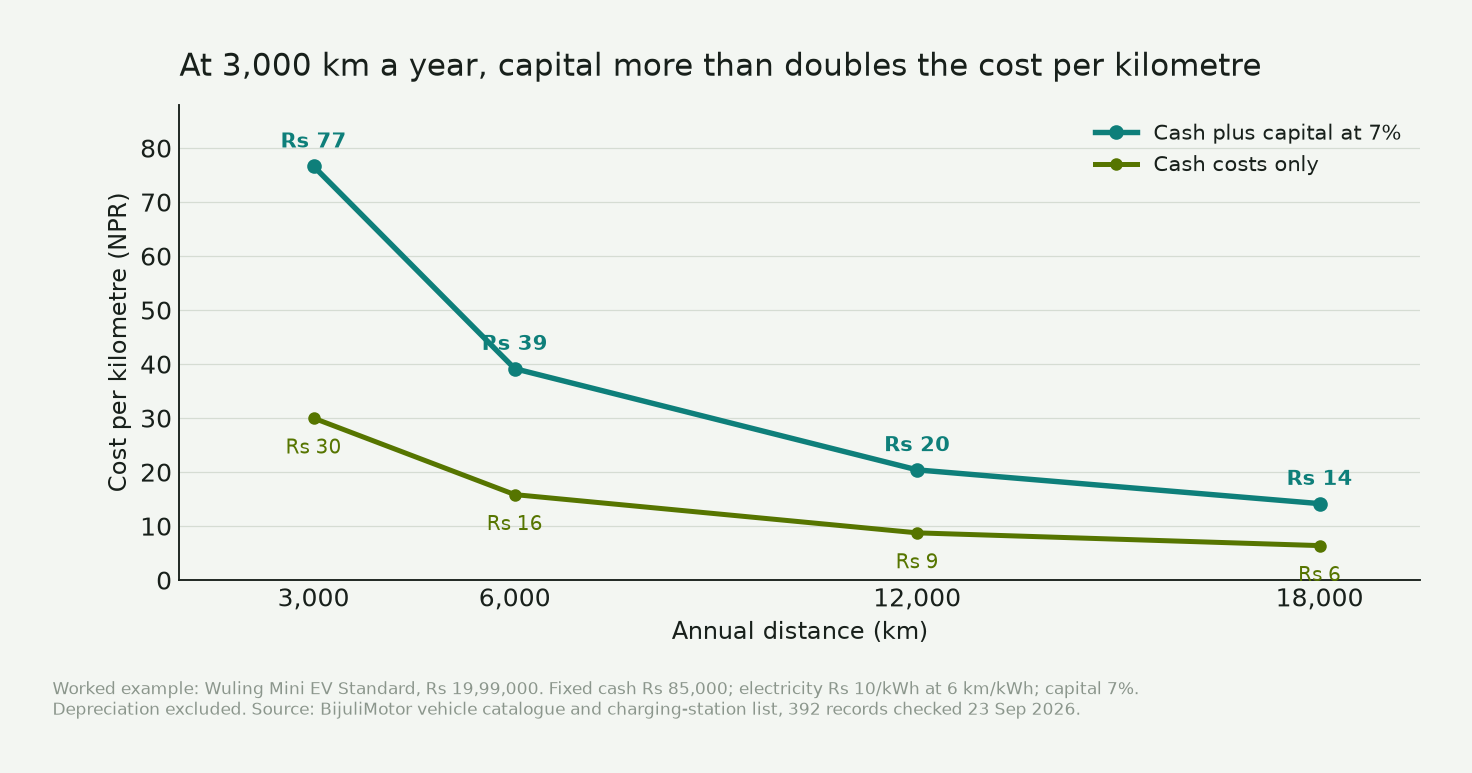
At 3,000 km, the fixed cash costs alone are Rs 28.33 a km before a single unit of electricity. At 18,000 km they are Rs 4.72. The total annual cost still rises with distance: Rs 2,29,930 at 3,000 km and Rs 2,54,930 at 18,000 km once capital is included.
The fares to compare against
The taxi meter is the cleanest local benchmark. The Bagmati Province government set the flag-down rate at Rs 58 and the meter at Rs 12 for every 200 metres, which is Rs 60 a km (Kathmandu Post, 12 April 2026; checked 2 November 2026). Buses on the same notice cost Rs 24 up to 5 km, Rs 33 up to 10 km, Rs 39 up to 15 km, Rs 44 up to 20 km, and Rs 50 beyond 20 km.
| Service | Published fare | Source and check |
|---|---|---|
| Valley bus, up to 5 km | Rs 24 | Bagmati notice, 12 Apr 2026 |
| Valley bus, up to 10 km | Rs 33 | Same notice |
| Valley bus, up to 15 km | Rs 39 | Same notice |
| Valley bus, up to 20 km | Rs 44 | Same notice |
| Valley bus, beyond 20 km | Rs 50 | Same notice |
| Taxi flag-down | Rs 58 | Same notice |
| Taxi meter | Rs 12 per 200 m | Same notice, equal to Rs 60 a km |
| Kathmandu-Pokhara bus, normal | Rs 783 | DoTM notice, 2083-03-18 |
| Kathmandu-Pokhara bus, deluxe | Rs 940 | Same notice |
| Kathmandu-Pokhara bus, super deluxe | Rs 1,128 | Same notice |
| Inter-province bus, over 250 km | Rs 3.52 a km | Same notice |
| Inter-province bus, 25 to 250 km | Rs 3.61 a km | Same notice |
| Kathmandu-Pokhara and Pokhara-Narayangadh bus | Rs 3.89 a km | Same notice |
| Sajha Kathmandu-Baglung | Rs 1,070 | Sajha Yatayat, checked 2 Nov 2026 |
| Sajha Kathmandu-Kushma | Rs 1,000 | Same page |
| Car with driver, Kathmandu day rate | Rs 5,000 | Smile Car Rental, 2026 page checked 2 Nov 2026 |
| Jeep with driver, Kathmandu day rate | Rs 7,500 | Same page |
| Hiace with driver, Kathmandu day rate | Rs 8,500 | Same page |
| Kathmandu-Pokhara car, one way | Rs 15,000 | Same page; its FAQ says about Rs 14,000 |
The meter makes a 10 km trip Rs 658, or Rs 65.80 a km. A 5 km trip is Rs 358, or Rs 71.60 a km, because the flag fall is spread over fewer kilometres. A 20 km trip is Rs 1,258, or Rs 62.90 a km.
App taxis are a different market. Pathao's Nepal car page describes the service but publishes no per-km tariff (checked 2 November 2026). Its rental page asks you to offer a fare from a range, so the quote for your route and time is the number to record. inDrive's Nepal homepage uses an offer-your-fare model too (checked 2 November 2026). Put the app quote next to the meter fare rather than assuming the app is always cheaper.
The rental day rate covers up to nine hours and includes fuel, parking and tolls, according to the operator's page. It does not state a mileage cap. Ask about one before you plan a long trip. The same page gives two different Kathmandu-Pokhara figures: Rs 15,000 in its route table and about Rs 14,000 in its FAQ. A written quote settles which applies.
Three households, three answers
Each basket below is a worked example. All three use the same Wuling Mini EV Standard and the same fixed costs. The taxi column uses the meter. The bus column assumes a direct route with no transfer.
| Household basket | Annual km | EV cash | EV cash plus capital | Alternative | Difference |
|---|---|---|---|---|---|
| Short errands: 300 one-way trips of 10 km | 3,000 | Rs 90,000 | Rs 2,29,930 | Taxi Rs 1,97,400; bus Rs 9,900 | EV costs Rs 32,530 more than taxi, Rs 2,20,030 more than bus |
| Daily commute: 20 km each way, 300 days | 12,000 | Rs 1,05,000 | Rs 2,44,930 | Taxi Rs 7,54,800; bus Rs 26,400 | EV saves Rs 5,09,870 against taxi; bus saves Rs 2,18,530 against EV |
| School, weekends and three rentals | 8,000 | Rs 98,333 | Rs 2,38,263 | Taxi and rental Rs 4,04,200 | EV saves Rs 1,65,937 |
Short errands. Three hundred one-way trips of 10 km make 3,000 km. At the meter, 300 × (Rs 58 + 10 × Rs 60) = Rs 1,97,400. The bus at Rs 33 a trip is Rs 9,900. The EV costs Rs 90,000 in cash, or Rs 2,29,930 with capital. It is Rs 32,530 dearer than the taxi and Rs 2,20,030 dearer than the bus.
Daily commute. Twenty kilometres each way, 300 days, is 12,000 km and 600 one-way trips. The taxi bill is 600 × (Rs 58 + 20 × Rs 60) = Rs 7,54,800. The bus at Rs 44 each way is Rs 88 a day, or Rs 26,400. The EV with capital is Rs 2,44,930. It saves Rs 5,09,870 against the taxi. The bus still saves Rs 2,18,530 against the EV.
School run and longer trips. The basket has 250 school trips of 8 km, 150 weekend trips of 24 km, and three three-day rentals covering 2,400 km between them. The school taxi bill is 250 × (Rs 58 + 8 × Rs 60) = Rs 1,34,500. Weekends are 150 × (Rs 58 + 24 × Rs 60) = Rs 2,24,700. Rentals are 3 × 3 × Rs 5,000 = Rs 45,000. The alternative costs Rs 4,04,200. The EV, with 8,000 km of electricity and capital, costs Rs 2,38,263. It saves Rs 1,65,937.
Your own basket will look different. A school bus or a relative with a car changes the alternative column. So does a bus that stops running before your shift ends. The rental figure uses the Rs 5,000 day rate for each three-day booking; a mileage cap or route charge would raise the alternative cost.
Where the cheaper option stops working
A bus fare of Rs 33 assumes a route, a seat and a time that fit. It does not help at 5 am, after a late shift, with a sick child, with an older relative who cannot wait at a bus stop, or with two bags of shopping in the rain. A taxi meter assumes a driver accepts the trip. App taxis can be scarce at peak hours and in bad weather.
Write down the trips that fail the cheap option. If the failure is rare, a rental or a taxi may cover it. If it happens every week, the car is buying access, and that has a value. Put a number on the extra you are willing to pay. Then the decision is about that number rather than a fuel-saving claim.
Owning adds duties. You need a parking space and permission to charge. Someone must be able to drive. Insurance, servicing, tyres and breakdowns need a plan. A parked EV does not replace an ambulance, and a low-mileage car can still suffer a flat 12V battery or a flat tyre.
If you buy, keep the purchase price low
Capital cost and insurance scale with the price. At 3,000 km a year, every extra Rs 1,00,000 in price adds Rs 7,000 in annual capital cost at 7%, or Rs 2.33 a km. A cheaper car with enough range for your normal week is usually the better low-mileage buy.
Every current passenger variant in the catalogue at or below Rs 25 lakh is in the table below. Prices are ex-showroom and were checked in the catalogue on 22 September 2026. The range column keeps the standard the catalogue records. Do not compare a CLTC figure with a WLTP figure without checking the test.
| Model and variant | Price | Battery | Range | Standard |
|---|---|---|---|---|
| Henrey Volts Model H | Rs 18,50,000 | 17 kWh | 200 km | NEDC |
| MG Comet Pace | Rs 18,75,000 | 17.3 kWh | 230 km | ARAI |
| BAW Brumby Standard | Rs 19,99,000 | 17.28 kWh | 205 km | CLTC |
| Wuling Mini EV Standard | Rs 19,99,000 | 16.2 kWh | 201 km | Published |
| Jinpeng Lingbox EC01 Base | Rs 20,99,000 | 20.7 kWh | 240 km | NEDC |
| Viauto Honri BOMA Standard | Rs 20,99,000 | 29.9 kWh | 300 km | Published |
| MG Comet Play | Rs 21,50,000 | 17.3 kWh | 230 km | ARAI |
| Wuling Mini EV Top | Rs 21,99,000 | 25.1 kWh | 301 km | CLTC |
| Henrey Volts Model C Pro | Rs 22,50,000 | 25 kWh | 300 km | NEDC |
| Changan Lumin Standard | Rs 22,96,000 | 28.08 kWh | 301 km | NEDC |
| Kaiyi e-Qute 02 Standard | Rs 22,96,000 | 28.08 kWh | 300 km | CLTC |
| BAW E7 Pro Standard | Rs 23,99,000 | 22.29 kWh | 260 km | CLTC |
| Wuling Air EV Standard Range | Rs 24,99,000 | 17.3 kWh | 200 km | WLTP |
| Jinpeng Lingbox EC01 Premium | Rs 24,99,000 | 31.45 kWh | 340 km | NEDC |
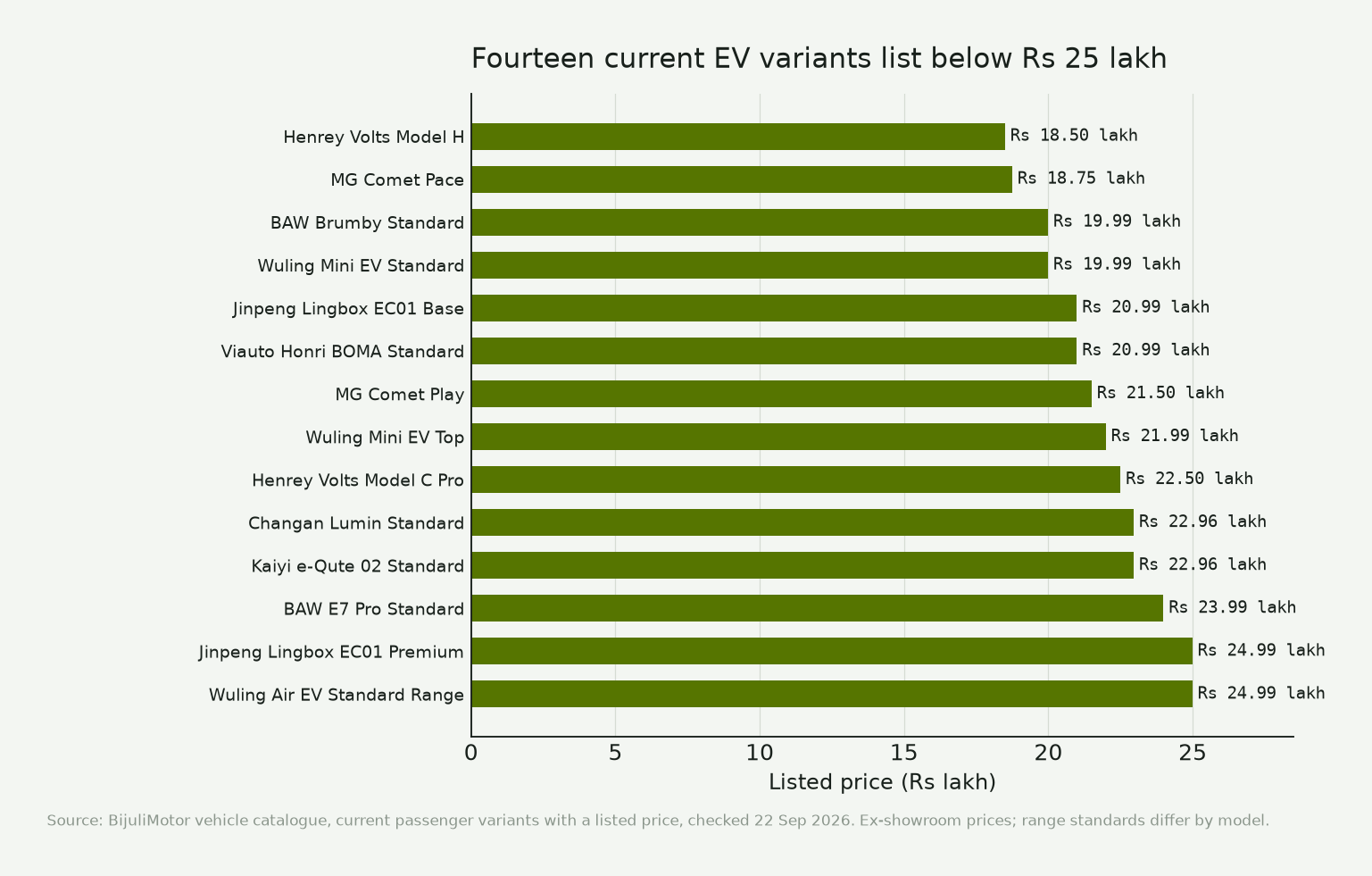
The Wuling Mini EV Standard and the BAW Brumby Standard both list at Rs 19,99,000. The Jinpeng Lingbox EC01 Premium lists at Rs 24,99,000, Rs 5,00,000 more. At 7%, that extra price adds Rs 35,000 a year in capital cost, or Rs 11.67 a km at 3,000 km, before insurance or anything else.
What to put on your worksheet
- List a normal month of journeys. Include the office run, school, shopping, hospital visits, relatives and luggage. Note how many people travel and at what time.
- Price each journey at the transport you can actually get. Use the bus fare, the meter, an app quote and a written rental quote. Include the return trip.
- Mark the journeys that fail the cheap option. Early starts, late finishes, school runs, hospital trips and monsoon days belong here.
- Add the car's fixed cash costs: insurance, maintenance, battery reserve, parking and charging equipment. Add the capital cost separately.
- Keep a cash-flow sheet for the down payment, instalments and annual bills. Keep a second sheet for the economic cost of the year.
- Compare the annual totals, then ask whether the difference buys access you need. If it does, write that amount down and decide whether it is worth paying.
A loan repayment includes principal, which is not an annual cost. It is cash moving from your account to the lender. Depreciation is the loss in value. Do not count the full principal and the full depreciation as separate costs. The site's loan guide explains what to check in an offer, and the EMI tool shows the monthly payment.
Use the resale guide before you assume a strong future value. The price list has current listings, and EV vs petrol compares energy costs for a given distance. The EV vs petrol cost guide shows the same distance-based comparison for a petrol car. These tools do not replace the transport basket. A taxi fare includes a vehicle and a driver; your ownership cost includes the car, the parking and the capital.
For occasional long trips, compare a rental with the cost of using your own car. The EV rental guide covers insurance, charging and damage terms. The Valley charging guide explains what to check before relying on a public charger.
FAQ
Does a low-mileage EV ever make financial sense?
Yes, when the alternative is a taxi or rental basket that costs more than the car's cash and capital costs. In the school-run example, the EV cost Rs 2,38,263 and the taxi and rental basket cost Rs 4,04,200. If a bus route covers the same trips, the bus is much cheaper.
What mileage is the break-even against a taxi?
About 3,500 km a year for 10 km trips at the April 2026 meter, using the assumptions set out above. Shorter trips raise the taxi's cost per km because of the Rs 58 flag fall, so the break-even falls to about 3,200 km. Longer trips push it to about 3,700 km.
Should I include depreciation?
For an economic comparison, yes. The tables leave it out because the catalogue has no resale values. Leaving it out makes ownership look cheaper. Add your own estimate and the case for a low-mileage car weakens further.
Are app taxis cheaper than the meter?
Sometimes. Pathao does not publish a per-km tariff in Nepal, so the app quote is the only number to use. Check it at the time you would travel.
What is the cheapest current EV in Nepal?
The Henrey Volts Model H at Rs 18,50,000 is the lowest current passenger price in the catalogue, followed by the MG Comet Pace at Rs 18,75,000. These are ex-showroom prices and can change.
Sources and checks
- Kathmandu Post, Bagmati revises public transport fares after fuel price hike, 12 April 2026, checked 2 November 2026. Valley bus and taxi fares.
- Department of Transport Management, adjusted fare notice, published 2083-03-18, checked 2 November 2026. Kathmandu-Pokhara fares and inter-province per-km rates.
- Sajha Yatayat, long routes, checked 2 November 2026. Kathmandu-Baglung and Kathmandu-Kushma fares.
- Smile Car Rental, 2026 price page, checked 2 November 2026. Car, jeep and Hiace day rates and the Kathmandu-Pokhara quote.
- Pathao, car service and rental page, checked 2 November 2026. Service description and the offer-your-fare rental format; no fixed per-km tariff published.
- inDrive, Nepal homepage, checked 2 November 2026. Offer-your-fare model; no fixed per-km tariff published.
- BijuliMotor vehicle catalogue, checked 22 September 2026. Vehicle prices, battery sizes and range figures.
- BijuliMotor charging-station list, 392 records checked 23 September 2026. 80 records are in the Kathmandu Valley and 68 give a CCS2 DC rating.
- BijuliMotor ownership model. Insurance, maintenance, battery reserve and 6 km/kWh assumptions.
The Rs 10/kWh electricity rate, Rs 2,000 monthly parking and 7% capital cost are labelled assumptions. The 8,000 km basket is a worked example. The charging list is a directory. It cannot tell you whether a charger is free right now. Call ahead before relying on a public charger.