
Using public charging in Kathmandu without a home charger
A directory of 80 Kathmandu Valley charging records, showing which name a plug, power or phone, plus costs and routines for drivers without home charging.
Public charging can replace a home charger in Kathmandu, but not with one favourite site. The BijuliMotor charging list has 80 records whose address or name puts them in Kathmandu, Lalitpur or Bhaktapur. Only 15 of those records name a connector, and only 26 give a kW figure. The list is a directory. It cannot show live availability, so the workable routine is two confirmed sites and a phone call before each visit.
The Valley records are sorted by plug and power. The sites with a DC rating you can plan around are named, and the time and cost of a 10-80% session is worked out. It also covers where this list disagrees with another directory, and what to ask before you plug in. Station records were last checked on 23 September 2026. Operator pages and other directories were checked on 23 October 2026.
What the Valley list contains
The list is built from operator directories, earlier BijuliMotor lists, a compiled public list and NEA highway records. Each record has a name, address and operator, and sometimes a connector, a power rating and a phone number. Of the 80 Valley records, 39 say DC, 25 say AC and 16 say neither. Tata/Sipradi accounts for 38 of the 80, Cimex (BYD) for 11, CG Motors for 11, Hyundai for 8, NEA for 6 and other operators for 6.
Only 15 records name a connector: six name CCS2, nine name GB/T only. Only 26 of the 80 give a kW figure. The rest leave you to call.
| Operator | Records | DC | AC | Type not recorded | Connector named | kW given |
|---|---|---|---|---|---|---|
| Tata/Sipradi | 38 | 13 | 25 | 0 | 0 | 0 |
| Cimex (BYD) | 11 | 11 | 0 | 0 | 0 | 11 |
| CG Motors | 11 | 11 | 0 | 0 | 11 | 11 |
| Hyundai Motors | 8 | 0 | 0 | 8 | 0 | 0 |
| NEA | 6 | 1 | 0 | 5 | 1 | 1 |
| Other | 6 | 3 | 0 | 3 | 3 | 3 |
| Total | 80 | 39 | 25 | 16 | 15 | 26 |
Read the table as a measure of what the list can answer. It does not measure what exists. A blank connector field means the record does not say whether the site has a plug. The gap tells you nothing about the site itself. The same applies to power.
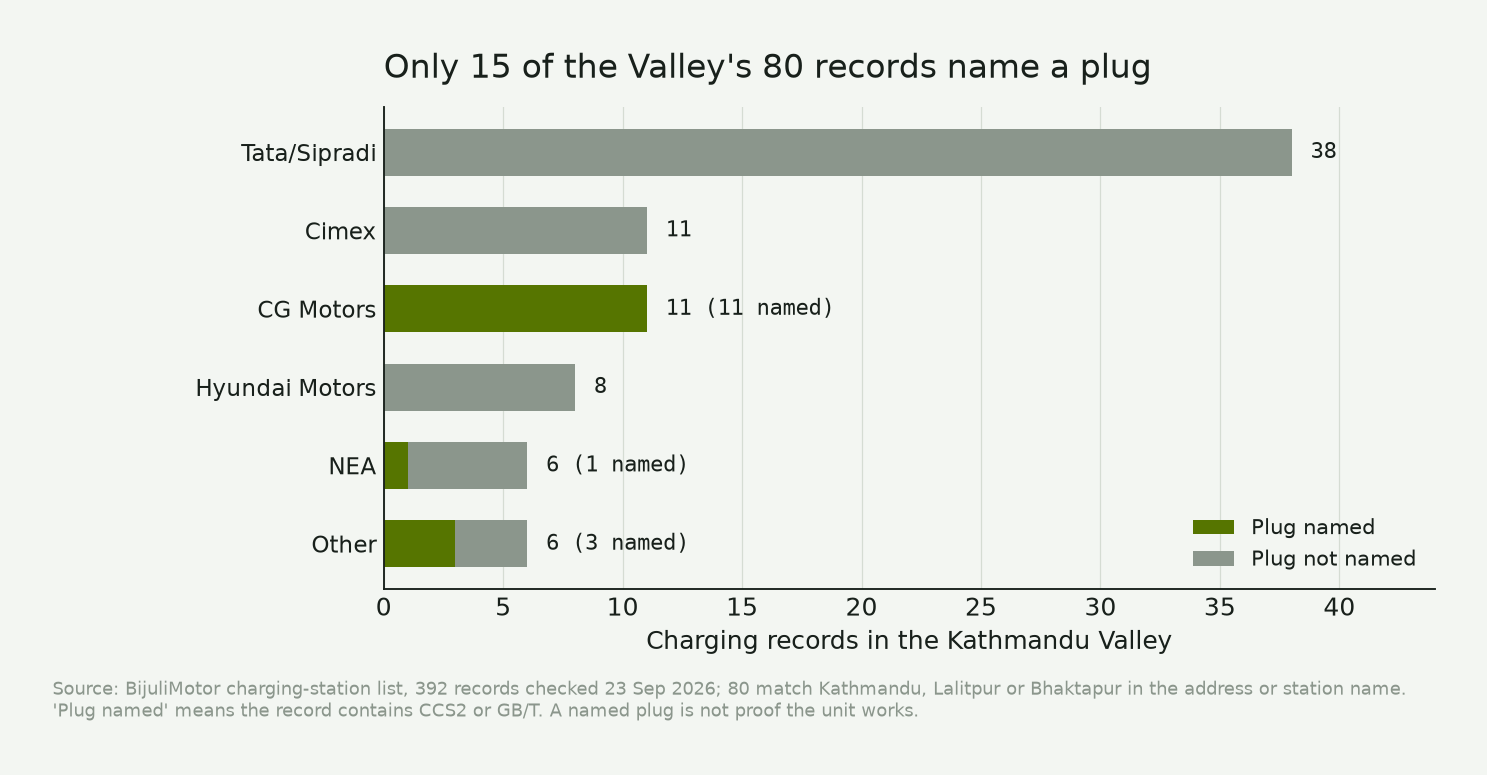
The gaps follow the operator. CG Motors records a connector and a rating for all 11 Valley sites. Tata/Sipradi records neither for its 38, including 13 DC sites. Cimex records a rating for every Valley site but no connector. Hyundai records neither for its eight. A Tata driver and a BYD driver get different use from the same map because of those omissions.
The CCS2 sites with a recorded plug
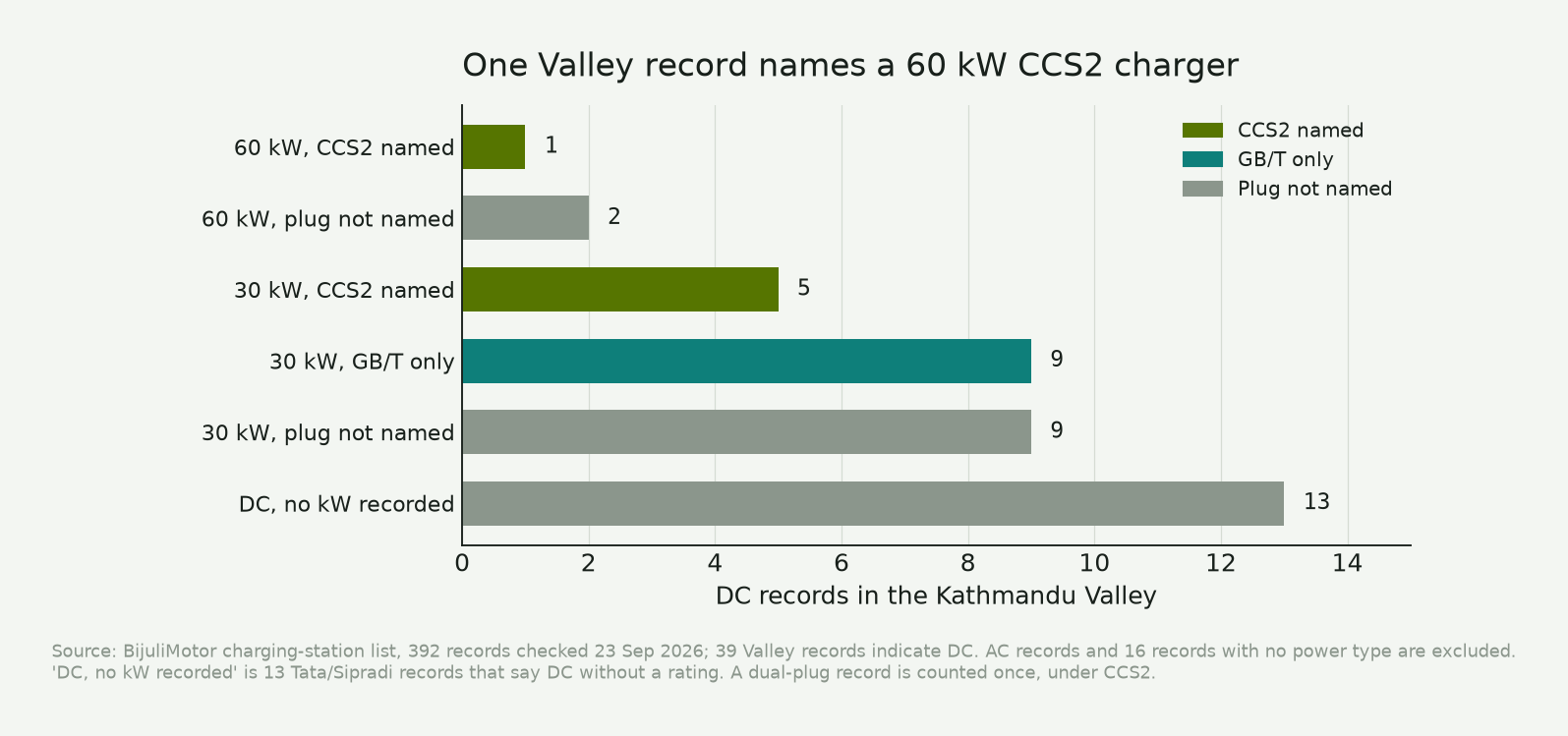
Six Valley records name CCS2. Five are 30 kW and one is 60 kW. Three of the five also have GB/T units at the same site.
| Site | Area | Operator | Power | Phone |
|---|---|---|---|---|
| CG Motors, Naxal | Naxal | CG Motors | 60 kW CCS2 | 9820105055 |
| CG Motors, Bhaktapur | Bhaktapur | CG Motors | 30 kW CCS2, plus 3 GB/T | 9801091901 |
| CG Motors, Hattiban | Hattiban, Lalitpur | CG Motors | 30 kW CCS2, plus 1 GB/T | 9802326653 |
| CG Motors, Pahelopul | Pahelopul | CG Motors | 30 kW CCS2, plus 2 GB/T | 9851129081 |
| NEA, Matatirtha | Matatirtha | NEA | 30 kW CCS2 | Not listed |
| MG Service Center | Kusunti, Lalitpur | MG | 30 kW CCS2 | 14514033 |
If your car has a CCS2 inlet, these six records are the only ones in the list that name your plug. If it has a GB/T inlet, the nine below are yours. If you do not know which inlet your car has, check the car or read the connector guide before you plan a stop.
The CG sites that list both plugs give the same 30 kW rating for each. The record does not say whether the CCS2 side gets the full 30 kW when a GB/T car is also charging. Ask.
The GB/T-only sites
All nine are 30 kW. Seven are CG Motors workshops or showrooms. Two are Thee Digo sites, in Naxal and Pepsicola.
| Site | Area | Operator | Power | Phone |
|---|---|---|---|---|
| CG Motors, Gangabu | Gangabu | CG Motors | 30 kW GB/T | 9851075116 |
| CG Motors, Nalinchwok | Nalinchwok, Bhaktapur | CG Motors | 30 kW GB/T | 9841028754 |
| CG Motors, Koteshwor | Koteshwor | CG Motors | 30 kW GB/T, 3 units | Not listed |
| CG Motors, Maharaj Gunj | Maharajgunj | CG Motors | 30 kW GB/T | Not listed |
| CG Motors, Kapan | Kapan | CG Motors | 30 kW GB/T | Not listed |
| CG Motors, Sobhabhagwati | Sobhabhagwati | CG Motors | 30 kW GB/T | 9851002956 |
| CG Motors, Basundhara | Basundhara | CG Motors | 30 kW GB/T | 9868199829 |
| Thee Digo, Naagpokhari | Naxal | Thee Digo | 30 kW GB/T | 014529051 |
| Thee Digo, Pepsicola | Pepsicola | Thee Digo | 30 kW GB/T | 9802333423 |
A GB/T-only site is useful only if your car has that inlet or the operator has a working adapter. The list does not say whether any site keeps one. Do not assume a garage will lend you an adapter for a car it did not sell.
Where the DC records sit
The 39 DC records split into a small group that names a plug and rating, and a larger group that leaves one or both blank. The chart shows the six CCS2 records, the nine GB/T-only records, and the records that leave the plug or the rating blank.
The BYD sites with no plug in the record
The Cimex records give a DC rating but no connector for every one of their Valley sites. Nine are 30 kW and two are 60 kW. Cimex's own API returns dc-fast and a power value, but no connector field. EV Nepal's Kathmandu page lists CCS2 at the BYD sites it carries. That is a second directory. Cimex has not confirmed it.
| Site | Area | Power | Cimex equipment | Phone |
|---|---|---|---|---|
| City Square Mall | Kathmandu | 60 kW | 1 dual-gun unit | 9801180294 |
| See Car, Gairidhara (60 kW) | Gairidhara | 60 kW | 1 single gun | 9765377480 |
| BYD Park, Naxal | Naxal | 30 kW | 1 single gun | 9801353743 |
| BYD City Store, Soalteemode | Soalteemode | 30 kW | 1 single gun | 9801188666 |
| Eco Auto Trading, Anamnagar | Anamnagar | 30 kW | 1 single gun | 9708072578 |
| Hotel Grandview, Mitrapark | Mitrapark | 30 kW | 1 single gun | 9849568176 |
| Pali By The Bakery Cafe | Maharajgunj | 30 kW | 1 single gun | 9802379502 |
| BYD Lalitpur Showroom | Pulchowk Road, Lalitpur | 30 kW | 1 single gun | 9801981537 |
| BYD Bhaktapur Showroom | Sallaghari, Bhaktapur | 30 kW | 1 single gun | 9866497201 |
| See Car, Gairidhara (30 kW) | Gairidhara | 30 kW | 2 single guns | 9765377480 |
| Kathmandu University | Dhulikhel, outside the Valley | 30 kW | 1 single gun | 9802379502 |
Dhulikhel is outside the Valley. It is in the 80 because the station name contains "Kathmandu University". The 80 count follows the site's filter: Kathmandu, Lalitpur or Bhaktapur in the address or station name. That filter also misses hotels at Nagarkot, which is in Bhaktapur district but does not name the district in the address.
The equipment column comes from Cimex's API, which lists gun type and number of chargers. Most of these sites have one single-gun unit. City Square has a dual-gun unit, and See Car's 30 kW site has two single-gun units. A single-gun site has no second bay if the first car is still charging.
Two lists disagree about the fast end
EV Nepal's Kathmandu page lists 120 kW CCS2 equipment at four NEA sites: Balkhu, Ratnapark, Samakhushi and the Nepal Police Club. It also lists 60 kW at OOPS in Pipalbot and ElectriVa in Gyaneshwor. The BijuliMotor list has no 120 kW record anywhere in Nepal and one 80 kW record, a GB/T unit at CG Motors Ratamate Jhangholi in Sindhuli.
| Site | Area | Equipment listed by EV Nepal |
|---|---|---|
| NEA, Balkhu (Sajha Petrol Pump) | Balkhu | CCS2 120 kW, GB/T 120 kW |
| NEA, Nepal Police Club | Kathmandu | CCS2 120 kW, two units |
| NEA, Ratnapark | Durbar Marg | CCS2 120 kW, two units |
| NEA, Samakhushi | Samakhushi | CCS2 120 kW |
| ElectriVa, Gyaneshwor | Gyaneshwor | CCS2 120 kW and 60 kW |
| OOPS Charging Station | Pipalbot | CCS2 60 kW, four units |
The table lists the fast equipment only; some of the same entries also include slower units. These are directory claims from a different compilation, checked on 23 October 2026. We could not verify them with NEA. Its consumer tariff page loads without a rate table, and the public-charging amendment page offered a PDF that did not open in this run. Treat the 120 kW figure as unconfirmed until the operator says it.
If such a site is working and your car accepts more than 60 kW, it changes the fastest stop in the Valley. The Atto 1 in the worked example stops at 30 kW, so it would not use the extra headroom. The NEA homepage links a charging-station app for Android and iOS, which may show live status. We did not test the app.
What a session costs
The list has no tariff field. Cimex's API has no price field. The CG Motors directory returned an error, and Sipradi's charging page loaded without any charger or price detail. No operator page we reached in this run published a per-kWh price for a Kathmandu site. Ask the site what it costs, and ask exactly what the meter counts.
Four questions cover most of it. Is the price per kWh or per minute? Is there an idle fee after charging finishes? Is there a parking fee? Is there a minimum charge? A per-minute price can look cheap at a fast charger and expensive at a slow one.
The worked example below assumes Rs 20 per kWh. Treat it as an assumption until an operator quotes you a price. It also uses the site's ownership calculator assumption of 6 km per kWh, which is 16.7 kWh per 100 km. At those two numbers, 100 km costs about Rs 333.
| Worked example | Atto 1 (30.08 kWh) | Nexon EV (45 kWh) |
|---|---|---|
| Energy in a 10-80% window | 21.06 kWh | 31.5 kWh |
| Cost at an assumed Rs 20/kWh | Rs 421 | Rs 630 |
| Time at a 30 kW charger | 42 min | 63 min |
| Time at a 60 kW charger | 42 min, car limit 30 kW | 32 min |
At a flat per-kWh price, battery size sets the difference between the two cars, and charger speed does not change it. A per-minute tariff changes that. The Nexon pays for 32 minutes at a 60 kW site; the Atto 1 pays for 42 minutes whatever the charger badge says.
To compare a per-minute price with a per-kWh one, convert it. A 30 kW charger adds about half a kWh a minute, so Rs 10 a minute works out to about Rs 20 per kWh. A 60 kW charger adds about one kWh a minute, so the same rate works out to about Rs 10 per kWh, but only if your car can take the full 60 kW. The charging bill guide sets out the other lines that can appear on a receipt.
How long a stop takes
A 10-80% window is the usual public-charging advice because the last 20% is slow. The window is 70% of the battery. In the Atto 1 that is 21.06 kWh; in the Nexon 31.5 kWh. At a constant 30 kW, the stops take 42 minutes and 63 minutes. The Nexon at 60 kW takes 32 minutes. The Atto 1 stays at 42 minutes because its DC limit is 30 kW.
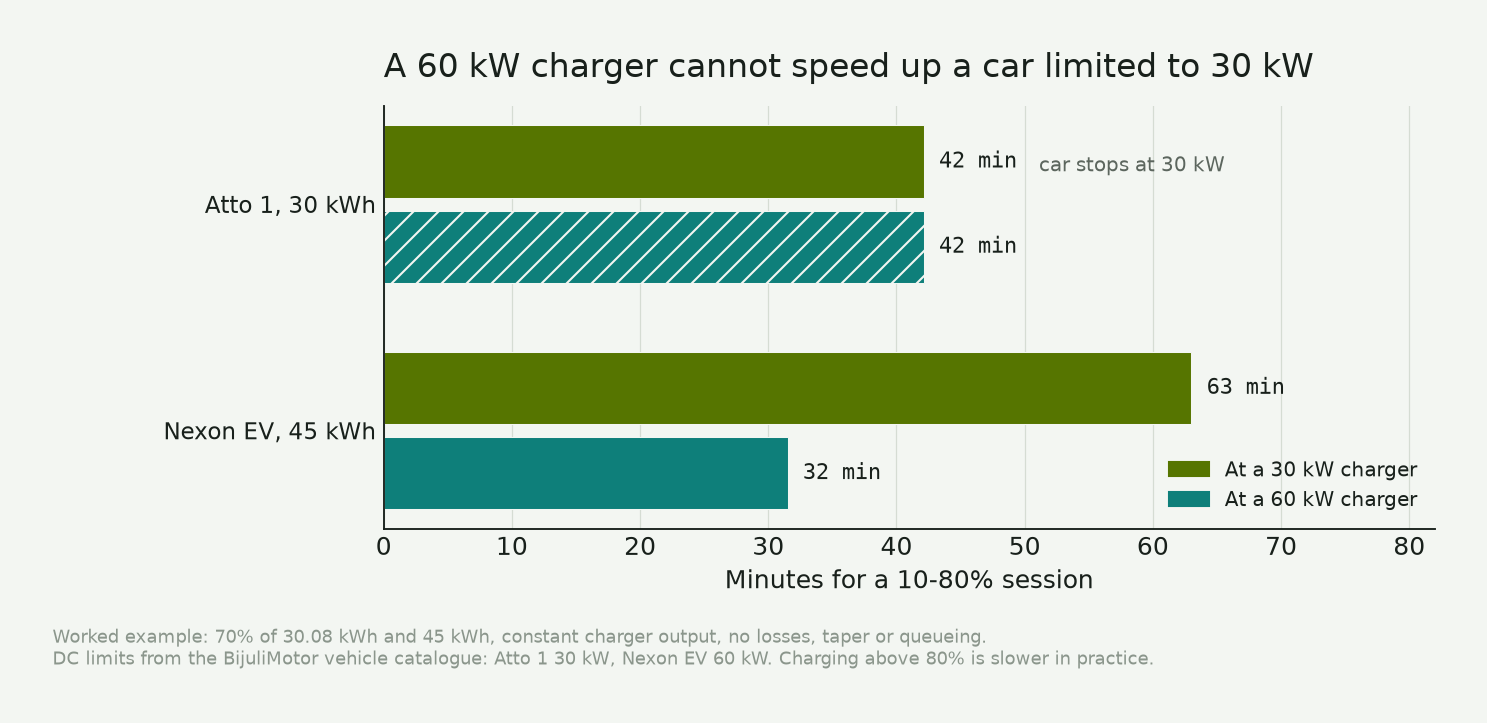
These come from arithmetic. Nobody timed them at a charger. Charging tapers, the charger may share power between bays, and a hot or cold battery can slow down. Add travel, payment and queue time. A 30 kW session that looks like 42 minutes in the table can take an hour from the office door and back.
A week without a home charger
Start with the weekly energy before you look at stations. A 40 km weekday round trip uses 6.7 kWh at the site's 6 km per kWh assumption. Five weekdays use 33.3 kWh. In the Atto 1, a 10-80% session adds 21.06 kWh, which covers about three of those days. One weekly session is not enough; two are, with a little left over.
At a 30 kW charger, each session is 42 minutes of charging, plus the drive and any wait. Two sessions a week is about 84 minutes at the charger before travel. If your only site is a single-gun unit, add the risk that another car is there when you arrive.
Commuting 40 km a day
Find a DC site near the office or on the way home so charging fits a trip you already make. A 30 kW site suits a meeting or a long lunch better than a 20-minute errand. Charge on the two days that fit your week, and keep the battery above the reserve you need for the next morning. If the car sits at home all day, an AC bay at a hotel or restaurant can work during a long stay, but the list gives no AC power rating. Ask how much range an hour adds.
No parking at home
Use one DC site you have tested and one backup that does not share the same power supply or the same restriction. Test the backup while you still have charge, before the day the first site fails. Save both phone numbers. The list gives a phone number for fewer than half of the 80 Valley records; for the rest you will need the operator's main line or a visit.
The apartment charging guide covers the case where the building has a bay but the committee has not agreed to a charger. If your building will not allow one, the public routine is the whole plan.
Leaving the Valley for the weekend
Charge before you leave rather than at the first highway stop. The full list has sites at Bhaktapur, Dhulikhel and Naubise, but this guide's counts stop at the Valley boundary. Plan the first stop and a backup, and check the route against a real car with the trip planner. A full battery and one confirmed stop are worth more than a long list of pins.
Queues, access and hours
The list records none of the three things that decide whether a stop works tonight: opening hours, access rules and payment method. It also has no queue counts. We do not rank sites by waiting time because we have no dated observations.
The records do show bay count at the Cimex sites. Most have one single-gun unit. City Square has a dual-gun unit, and See Car's 30 kW site has two single-gun units. A single-gun site has no second bay. That is a structural reason to have a backup. It says nothing about a particular evening. The queue guide explains why public charging bunches up.
Access is the other unknown. Six Valley Tata DC records include "XpresT Only" in the station name, which reads as a restricted network. Several CG and Cimex sites are at showrooms or workshops. A charger at a dealership may be for that brand's cars, for service visits, or open to anyone. The list does not say. Ask when you call.
Hours matter more in the Valley than on a highway. A mall charger may follow mall hours, a workshop charger may close in the evening, and a hotel bay may be for guests. None of that is in the list. After heavy rain, check access before driving. A basement bay can flood, and a restored road does not prove the electrical installation is safe.
What to ask when you call
- Is the charger working today, and which plug does it have?
- What power does that plug deliver to my car?
- What are the hours, and who is allowed to use it?
- How do I pay, and is there an idle or parking fee?
- Is there a second bay if this one is occupied?
The national charging guide has a longer checklist for a site you have never visited. The map shows the same records as the list above, so it inherits the same gaps. Use it to find a name and a phone number, then call.
Questions drivers ask
How many EV charging stations are in Kathmandu?
The BijuliMotor list has 80 records that match Kathmandu, Lalitpur or Bhaktapur in the address or station name, but that is a record count. It does not count working chargers. Only 15 name a connector and 26 give a kW figure. Other directories list sites that are not in this list, including the 120 kW NEA sites above.
Can I charge a Tata at a BYD site?
Check the plug first. The BYD sites do not name a connector in the BijuliMotor list, and EV Nepal lists CCS2 at them. If your Tata has a CCS2 inlet, the plug should fit. Access and payment are separate questions. Call the site and ask whether a non-BYD car can charge.
What does public charging cost per kWh?
We could not confirm a per-kWh price from any operator for a Kathmandu site. The list has no tariff field, Cimex's API has no price, the CG Motors page returned an error, and the Sipradi page had no charger detail. Ask before you charge. At an assumed Rs 20 per kWh, a 21 kWh session costs about Rs 421.
Do I need an app?
NEA's homepage links a charging-station app for Android and iOS. The other operators in this list did not publish an app we could verify. Ask when you call.
Which charger is fastest?
In the BijuliMotor list, CG Motors Naxal is the only 60 kW CCS2 record. Five other CCS2 records are 30 kW. EV Nepal's Kathmandu page lists 120 kW CCS2 at NEA sites, but we could not verify those with NEA. Your car's DC limit decides what you can use: the Atto 1 stops at 30 kW.
Can I rely on public charging with no home charger?
Yes, if you can reach two sites and charge during a long stop. A 40 km weekday commute needs about 33 kWh a week; a 30 kWh car's 10-80% window adds 21 kWh, so plan two sessions a week. If your week is longer, or your only site is single-gun, the routine is less reliable.
Sources and checks
- Charging records: BijuliMotor charging list, 392 records checked 23 September 2026, filtered to 80 by address or station name. A record is a directory entry. It cannot tell you whether a charger is free right now. The map uses the same list.
- Cimex: Cimex charging-station API, 51 records, checked 23 October 2026. It gives power, gun type and number of chargers, but no connector or price.
- Second directory: EV Nepal's Kathmandu charging list, checked 23 October 2026. Used only for the 120 kW table and the CCS2 note. Not independently verified.
- NEA: NEA homepage, checked 23 October 2026. It links the charging-station app for Android and iOS, and a consumer tariff page. The tariff page loaded without a rate table, and the public-charging amendment page offered a PDF that did not open, so no NEA public-charging price is quoted.
- Operator pages: the CG Motors charging directory returned HTTP 522 on 23 October 2026, and the Sipradi charging page returned HTTP 200 with no charger or price detail. No hours, access rule or tariff was confirmed from either.
- Vehicles: BYD Atto 1 Dynamic, 30.08 kWh and a 30 kW DC limit; Tata Nexon EV, 45 kWh and a 60 kW DC limit. Both from the BijuliMotor vehicle catalogue.
- Consumption: 6 km per kWh, from the site's ownership calculator (
OWNERSHIP_ASSUMPTIONS.evEfficiency). Tariff: Rs 20 per kWh, a labelled assumption. Get a quote from the operator before you rely on it. - Every station row: record checked 23 September 2026. Access, hours, payment and price were not verified.