
Overnight EV charging: check the timer before going to bed
A saved schedule is not a completed charge. Nepal's NEA rate does not fall at night, so a timer only moves the hours. Check days, overlap and outages.
If the car sat plugged in all night and gained almost nothing, the timer or the supply stopped the session. The price of electricity played no part. On a 15 amp single-phase connection, NEA's domestic tariff sets the energy charge at Rs 4 a unit for the first 20 units and Rs 11 above 250 units, with the price set by the month's total rather than the hour (NEA consumer tariff sheet, checked 28 October 2026). In the sheet I read, the time-of-day section covers industry, commercial, transport and similar categories; it does not list households. An overnight schedule therefore does not buy cheaper units in Nepal. It only decides when the charging happens.
A missed charge can come from an instruction that did not run. The car itself may be fine. The causes to rule out are a schedule saved for another day, two controls waiting for each other, or a supply cut.
Where the schedule can live
A charge can be timed by the car, the wallbox, an app or a building management system. More than one may be active. If the car and the wallbox hold different windows, the car charges only in the hours the two windows share.
Find out which device holds the schedule and what it controls. A departure setting and a start time are different events, so check which one the screen schedules.
| Setting to record | What to confirm |
|---|---|
| Device holding the schedule | Car, wallbox, app or building system |
| Time setting | Start time, end time or departure time |
| Selected days | Once, weekdays, weekends or a repeat pattern |
| Clock | Time and time zone on the controlling device |
| Charge target | Limit set in the car or the app |
| Other active controls | A second schedule or a current limit |
Do not switch off a safety control to simplify the timetable. If two devices disagree, ask the supplier for a supported configuration and a demonstration. A screenshot from another car may show a different software version.
What the owner's manuals say
The manuals I could read do not support the idea that every Nepal EV has an in-car timer. Of the four models checked, one documents a charge schedule. Both Tata manuals describe charging that starts when the connector is locked and the supply is on. The MG4 handbook has no scheduled-charging menu.
| Model (Nepal variants) | Where the manual puts the schedule | Start or departure | Day selection | After a supply cut |
|---|---|---|---|---|
| BYD Atto 3 (49.92 or 60.48 kWh) | Car screen: New Energy → Charging Setting, called "smart charging" | The manual describes setting it during charging; no departure setting is described | Not described | Not described |
| Tata Nexon EV (45 kWh) | No charge schedule in the current manual | Charging starts when the connector is locked and the supply is on. The iRA.ev app sets fast and slow charge limits. Start time is outside its settings. | None | Not described |
| Tata Punch EV (32 or 40 kWh) | No charge schedule in the October 2026 manual | "Normally the charging gets started automatically" | None | Not described |
| MG4 (51 or 64 kWh) | No scheduled-charging menu in the handbook I read | No start-time setting described | None | Not described |
Sources: BYD ATTO 3 owner's manual, Tata Nexon.ev manual, Tata Punch.ev manual, MG4 owner's handbook. All checked 28 October 2026. Battery capacities are from the BijuliMotor vehicle catalogue, checked 23 September 2026. These are global, Indian or Australian editions; a Nepal car may run a different software build, so confirm the menu on your own screen.
The BYD wording has a trap of its own. The same manual uses "smart charging" for a 12 V battery maintenance function that runs when the car is parked. The schedule is the one under New Energy → Charging Setting. The maintenance routine is a separate function.
Where the car has no schedule, the timer has to live outside it: in the wallbox, in a socket timer, or in the building supply. A dead session then points at the wallbox or the supply.
The overlap trap
Two saved windows can cancel most of each other. Suppose the car allows 11 pm to 3 am and the wallbox allows 2 am to 6 am. Both screens say the schedule is saved. The shared window is 2 am to 3 am, which is one hour. The owner entered four hours.
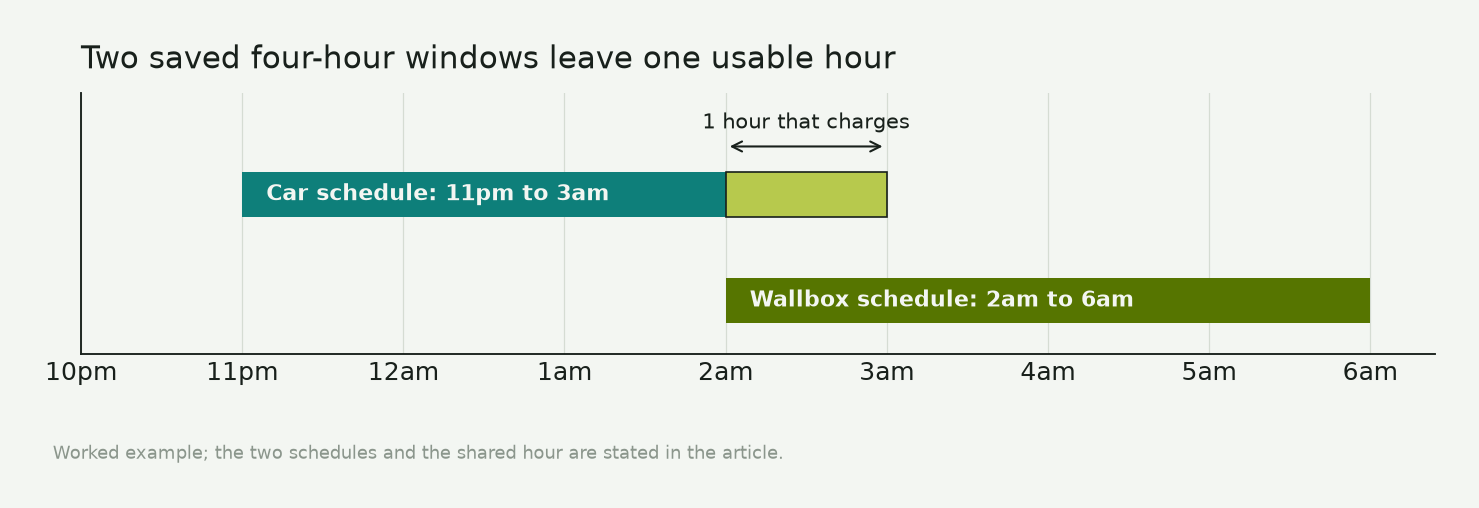
Put both devices on the same window, or let only one of them decide. If the car has no timer, run the wallbox. If both have timers, set the same start and end on both, then confirm on the car that charging begins.
Work backwards from departure
A car that returns at 9 pm and leaves at 5 am gives eight hours on paper. Parking and dinner take some of it, and the car may leave earlier than planned. The useful figure is the energy that has to be in the battery by departure. The number of hours implied by the word "overnight" can mislead you.
Assumption: a 14 kWh top-up measured at the supply, delivered at constant power with no interruption. The table is arithmetic based on those assumptions. No measurement was taken.
| Available window | Average supply power needed |
|---|---|
| 2 hours | 7.0 kW |
| 4 hours | 3.5 kW |
| 7 hours | 2.0 kW |
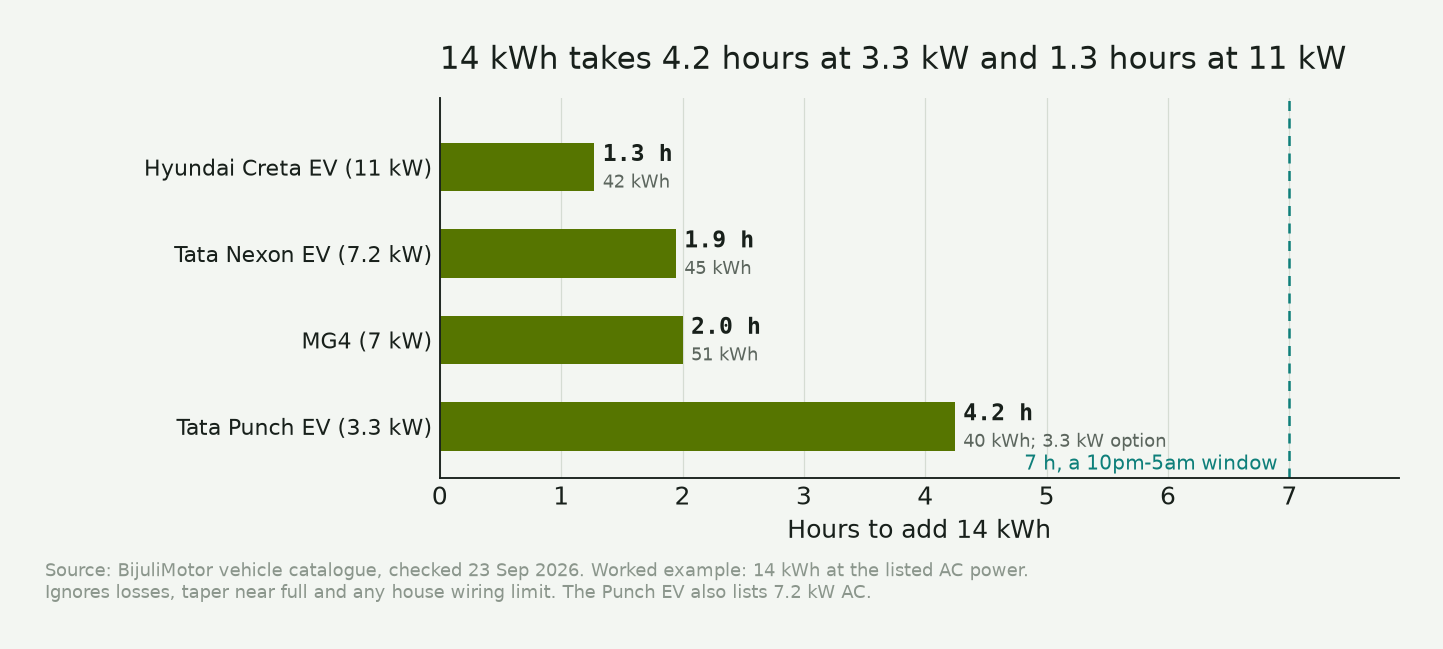
The car's onboard charger sets the ceiling. Tata lists 3.3 kW and 7.2 kW of AC charging for the Punch EV and Tiago EV, and 7.2 kW for the Nexon EV. MG lists 7 kW for the MG4, and Hyundai lists 11 kW for the Creta EV (BijuliMotor vehicle catalogue, checked 23 September 2026). At the Punch EV's 3.3 kW, 14 kWh takes about 4.2 hours; at the Nexon EV's 7.2 kW it takes about 1.9.
Supply energy and energy stored are different figures. Some of the 14 kWh is lost as heat in the charger and the battery, and charging slows near full. Treat the table as a planning guide, then read the car's own energy display after a session.
A timer also does not create capacity. If the window is too short, the choices are an earlier start, a lower target or another charging opportunity. Do not raise the charger or circuit setting beyond what the installer approved. If the connection itself is the limit, the connection upgrade guide covers the application.
What follows a power cut
A charger can come back on after an outage without resuming the session. Whether it resumes depends on the unit's settings and firmware, and on whether the session needs authorisation. Ask the installer what the unit does when the supply returns, and whether the car or an app has to restart it.
Alfen's AHP firmware 2.4.0 release notes, dated 20 February 2026, list a fix for "fixed cable charging stations may not continue charging after recovering from a power outage" (Alfen knowledge base, checked 28 October 2026). That applies to the Alfen AHP units named in the note. Other wallboxes may behave differently. I could not confirm which wallbox brands are installed in Nepal homes.
Internet loss is a separate question from electricity loss. A schedule stored in the car or the wallbox can survive a dropped connection. A command sent from a phone cannot. Ask which functions work offline.
NEA publishes a maintenance shutdown schedule with the distribution centre, feeder, area and times (NEA maintenance schedule, checked 28 October 2026). For an unplanned cut, the NEA FAQ says to call the hotline on 1150 or the local distribution centre (NEA FAQ, checked 28 October 2026). NEA also runs a complaint portal for a written report. A planned shutdown and a blown circuit need different follow-up.
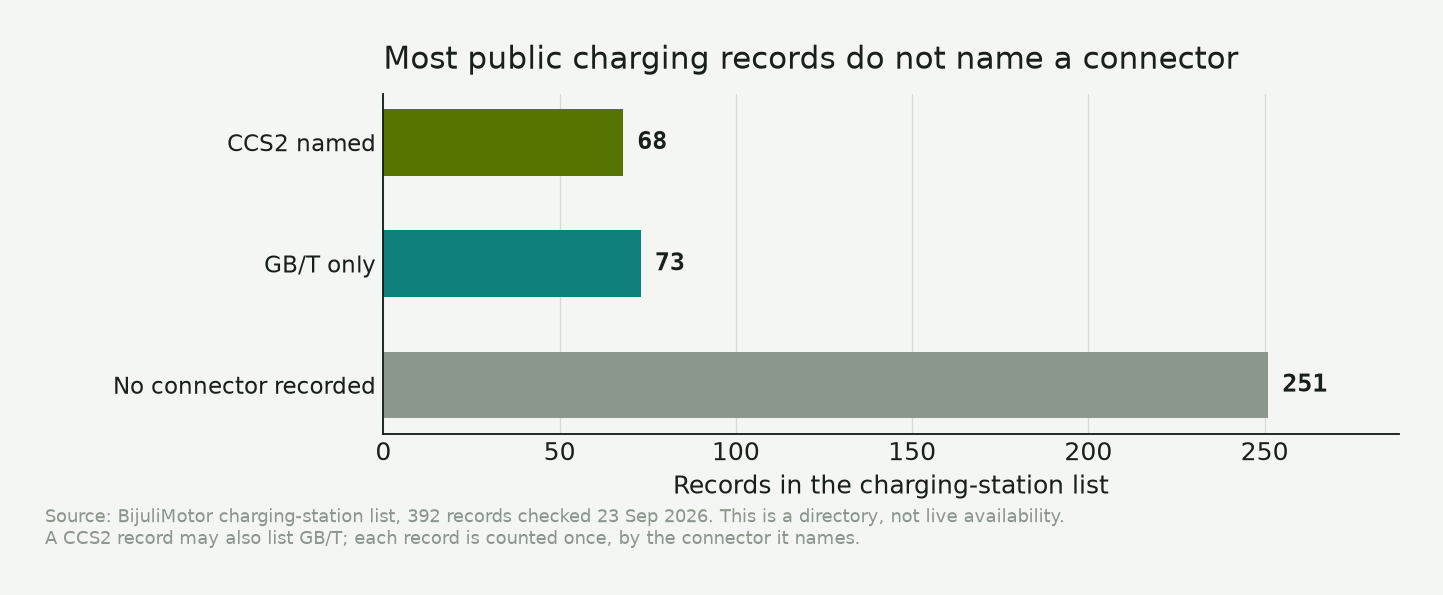
If the night cannot be recovered, a public charger is the fallback. The national list holds 392 records; 251 do not name a connector, 73 name GB/T only and 68 name CCS2 (charging-station list; directory checked 23 September 2026). The list is a directory. It cannot tell you whether a charger is free right now. Check the plug and call the operator before driving. The charging-plugs guide explains which connector your car uses.
The night-before check
Test the routine on an ordinary evening, while you can watch it. Plug in at the usual time, watch the first start and write down what happened.
| Record | Why |
|---|---|
| Time connected | Shows the window that actually happened, which may differ from the intended one |
| Device holding the schedule | Car, wallbox or app |
| Start and end times, and days | Catches a weekday or weekend mismatch |
| State of charge at plug-in | Gives the energy added |
| Charge target | Shows whether the car stopped early |
| Actual start time | Proves the instruction ran |
| Energy delivered | The number that matters in the morning |
| Any interruption or error | Evidence for the installer |
| State of charge at departure | Confirms the result |
Repeat the test on a weekday and at the weekend if the schedule treats them differently. Do not cut the mains to test recovery. Ask the installer how an acceptance test should be done, and keep the fault log if a session fails. The first-month measurement guide shows how to read the meter against the car's own figures. Before a long session in a closed garage, read the garage fire guide.
Handing the routine to another driver
A shared car often has one person who understands the timer. Write the ordinary procedure on paper: where the schedule lives, how to start a charge immediately and who to call. Use the app's sharing feature rather than passing around a password. The connected-car app guide covers what to change when a car changes hands.
Check the settings again after a software update, a new wallbox or a change in departure time. An old screenshot shows what was selected at that time. It cannot tell you what the car will do tonight.
Before an early trip, check the charge the car achieved and keep an alternative. The useful morning result is energy in the car. A notification that a schedule was saved tells you less.
Questions owners ask
Why did my EV not charge on its timer? The schedule may have run on another day, two devices may have been waiting for each other, or the supply may have gone off. Check the day selection first, then the overlap, then the charger's behaviour after an outage.
Does the timer survive a power cut? It can fail after a power cut. Alfen's AHP 2.4.0 notes describe a fix for fixed-cable units that did not resume after an outage. Ask the installer about your model, and check the car in the morning rather than trusting the app.
Should I use the car timer or the charger timer? Use whichever device holds a schedule. Of the four manuals checked here, only the BYD Atto 3 documents an in-car charge schedule. The Tata manuals describe charging that starts when the connector is locked; the MG4 handbook has no charge schedule.
Does night charging save money in Nepal? No. Night units cost the same on a single-phase domestic connection. NEA's domestic tariff is set by the month's unit total, and the time-of-day rates in the same sheet apply to other categories. A timer changes when the charging happens. The rate you pay stays the same. The home charging guide explains the connection and billing side.
Sources and checks
- NEA consumer tariff sheet (domestic slabs; time-of-day categories): nea.org.np consumer tariff rates, checked 28 October 2026.
- NEA maintenance shutdown schedule: nea.org.np/maintenance, checked 28 October 2026.
- NEA outage reporting (hotline 1150, distribution centre, complaint portal): NEA FAQ, checked 28 October 2026.
- BYD ATTO 3 owner's manual (New Energy → Charging Setting): byd.com PDF, checked 28 October 2026.
- Tata Nexon.ev and Punch.ev owner's manuals: Nexon.ev and Punch.ev, checked 28 October 2026.
- MG4 owner's handbook: mgmotor.com.au PDF, checked 28 October 2026.
- Alfen AHP firmware 2.4.0 release notes: Alfen knowledge base, checked 28 October 2026.
- AC charging power and battery capacity: BijuliMotor vehicle catalogue, checked 23 September 2026.
- Connector counts: BijuliMotor charging-station list, 392 records, checked 23 September 2026. A directory. It cannot show live availability.
- The 14 kWh example, the two-window example and the hours in the chart are worked examples with the assumptions stated above.