
EV app access: what to change when a car changes hands
Selling or buying a connected EV in Nepal? What the distributors publish about the app account, remote access and vehicle data, checked brand by brand.
Handing over the keys does not hand over the app account. The BijuliMotor catalogue lists 172 current EV variants with a price. The key in your hand starts the car. The phone app can also find it, read its charge and work a door lock, and that access sits somewhere else. We checked what BYD, MG, Tata and Hyundai publish in Nepal about the account on 28 October 2026. Only one names a usable route to request your data. None publishes a step-by-step way to remove the previous owner.
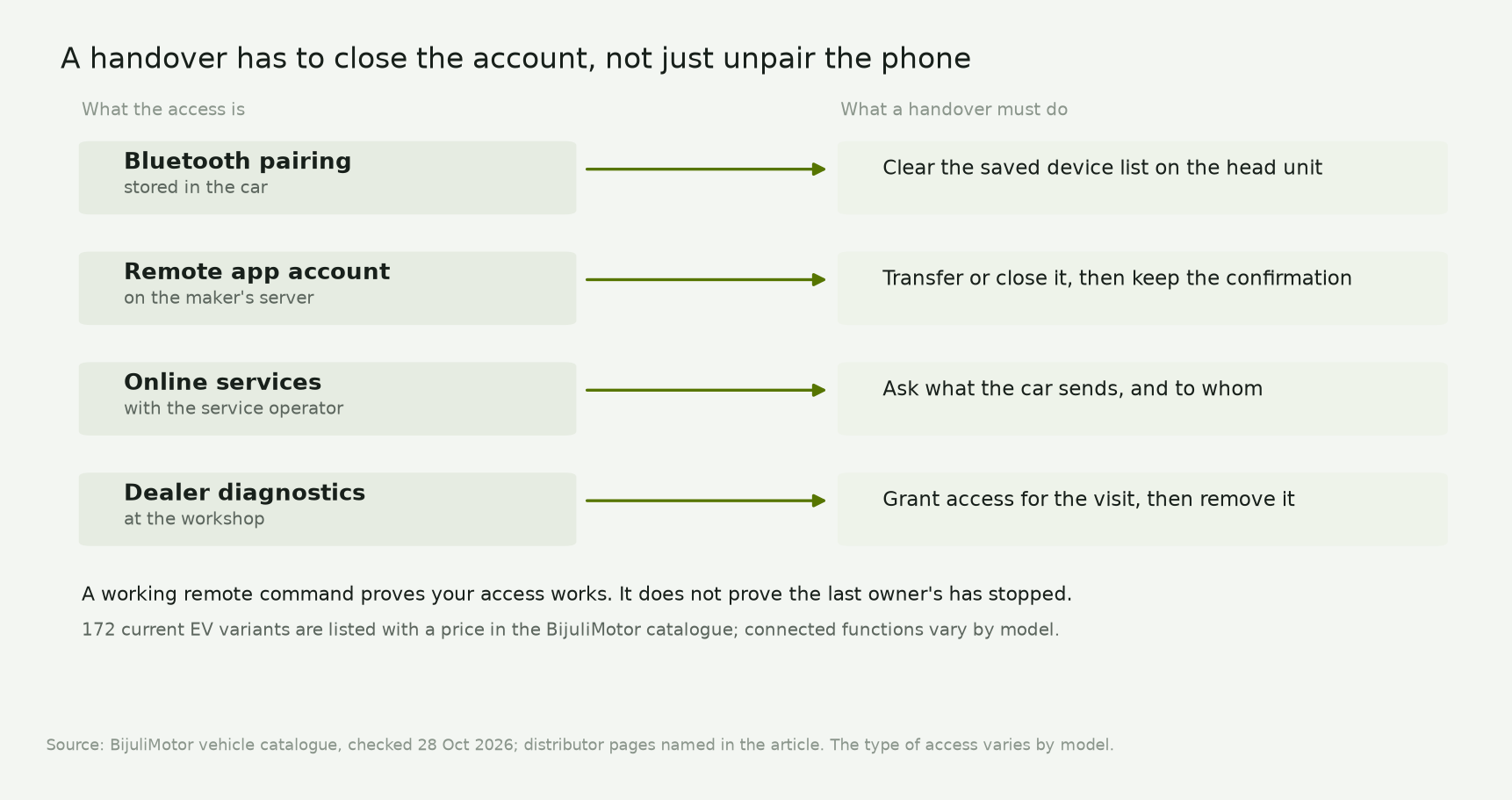
Four kinds of access on one car
| Access | What it can do | Where it lives |
|---|---|---|
| Bluetooth pairing | Calls, audio, contacts cached in the head unit | The car |
| Remote app account | Door lock control, locate, charge status, cabin pre-cooling | The maker's server |
| Online services | Navigation, traffic, voice commands, some updates | The service operator |
| Dealer diagnostics | Fault codes, software flashing, service history | The workshop |
Clearing the Bluetooth list does not close the account on the server. The pairing sits in the car and you can clear it yourself; the account sits with the operator, who has to close it. A working remote command proves that your access works. It does not prove that the last owner's access has stopped. Ask for the second answer in writing.
What the Nepal sites publish
We looked for three things on each distributor's site: whether the brand names a connected app in Nepal, whether it explains how to remove an old account, and whether it gives a route to ask for your data. Brands commonly name a connected app. None explains how to remove an old account, and only one gives a route to ask for your data.
| Brand (app) | Connected feature named | Removal or transfer step | Data request route |
|---|---|---|---|
| BYD (BYD app) | Data-privacy page describes app and vehicle controls | Not published | Email, reply within 15 workdays |
| MG (i-SMART) | "i-SMART with 55+ connected features" on the Comet EV Excite | Not published | Not published |
| Tata (ZConnect, iRA.ev) | App listing describes remote door locking, lights and pre-cooling; the Nepal EV pages do not name it | Not published | Not published |
| Hyundai (Bluelink) | IONIQ 5 page says "in-car connectivity"; Bluelink is not named | Not for the car account | Policy exists, contact is a placeholder |
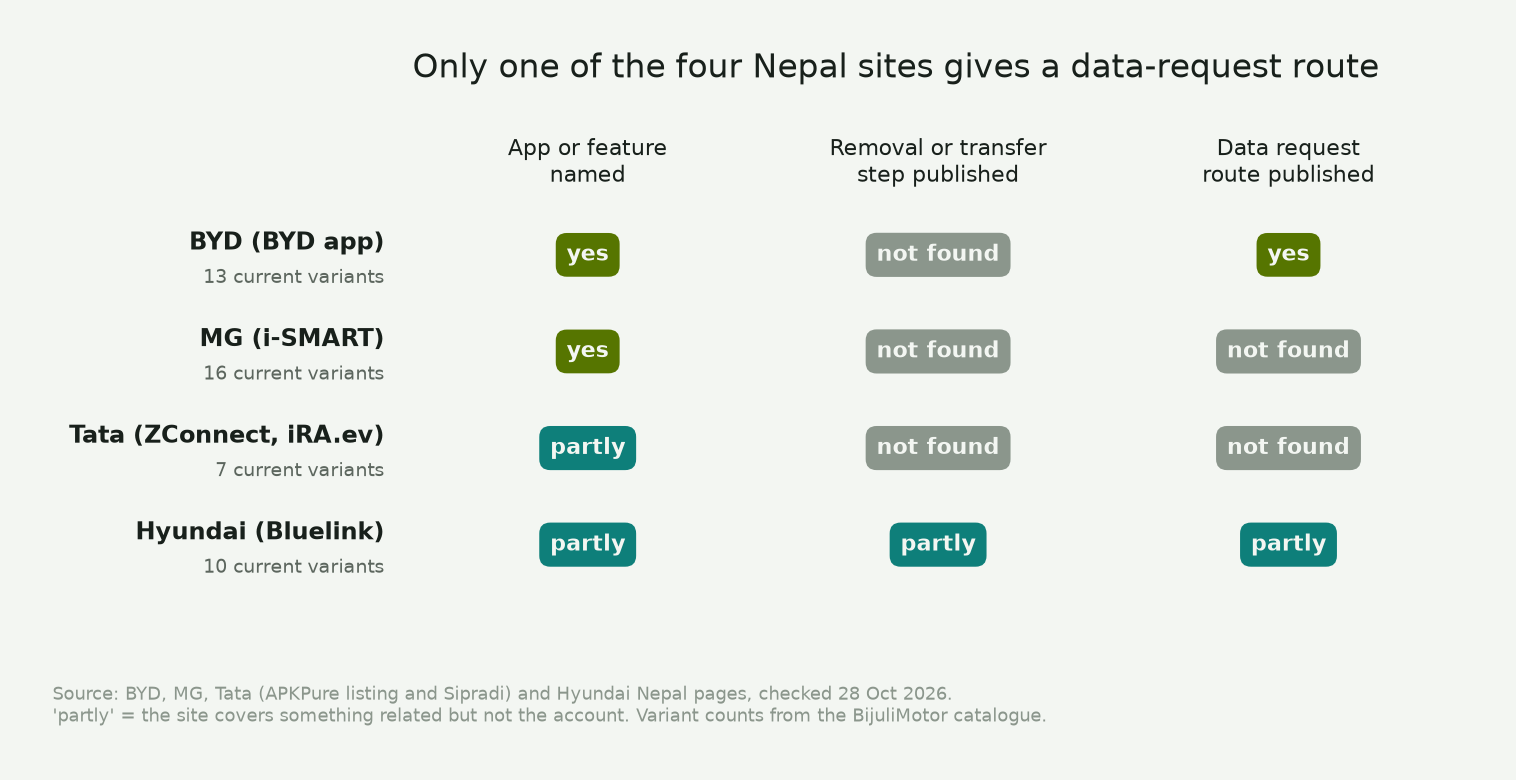
BYD's Nepal privacy policy is the only one of the four that names a request route. It lists access, correction and deletion, offers an email address, and says it replies to a request within 15 workdays. It keeps personal data for one year after the relationship ends and one year and six months after an enquiry, and stores it in a data centre in Singapore (byd.com/np/privacy, checked 28 October 2026). The same policy says it does not cover authorised retailers or third parties such as insurers, so the car's app data can sit with a company other than the one whose page you are reading.
MG's Nepal site advertises i-SMART as a feature of the Comet EV Excite (mgmotor.com.np, checked 28 October 2026). It does not give an account-transfer step or a data contact. Tata's ZConnect listing describes remote door locking, lights and cabin pre-cooling (APKPure's copy of the listing, checked 28 October 2026), but Sipradi's Nepal passenger pages do not name the app, and a newer iRA.ev app exists for other models. Which one runs on a Nepal car is not published.
Hyundai's Nepal feature list for the IONIQ 5 has an "Infotainment and Connectivity" section with Android Auto, Bluetooth and voice recognition, and it does not name Bluelink (laxmihyundai.com, checked 28 October 2026). Its service app lists an "Ownership Transfer Request" (Smart Care page, same date), which moves service records only. It leaves remote access where it is. Hyundai's website privacy policy is governed by Nepali law, but its published contact address is a placeholder. These are the pages we could reach. A dealer may hold information the website does not.
The law behind a deletion request
Nepal's Privacy Act, 2075 (2018) says personal data may be collected only with consent and used only for the purpose it was collected (section 12, English text via ADB, checked 28 October 2026). That gives you four questions to put to the distributor or the app operator in writing: who holds the data, what it is used for, how long it is kept, and how to have it deleted. Keep the reply with the sale papers.
A website privacy policy usually covers the website alone. It may say nothing about the app, the car's own systems or a charging network. Ask separately for the app notice and the in-vehicle notice. BYD's policy, for example, is written to cover the byd.com/np website and points readers to the manual for the specific vehicle.
Taking delivery of a new car
Ask whether the car was registered to a demonstration or dealership account before delivery. If it was, get the approved transfer or unbind done at the showroom, with the confirmation in your name. Set the primary account with your own phone number and email, then check the recovery address is one you control. A dealer can explain the app. A dealer should never need your email password or a one-time code sent to your phone.
Review the paired phone list and remove anything you did not add. Note the app version and the software version, then look at the car with the dealer's demonstration screens cleared. The new-car delivery checklist covers the rest of the handover, from documents to tyre dates.
Buying a used connected EV
Put the account in the sale agreement. The clause that works reads: the seller confirms remote access has been transferred or revoked, and the buyer will verify with the distributor before final payment. Ask the seller to show the unbind in the app. A lock command that happens to work from their phone proves little. A command that works tells you they still have access.
Keep the service history with the car and remove only the personal parts. If the car came through a different import channel, check the region, language, network and subscription before you pay extra for connected features. The used-EV battery report guide explains what a health-percentage screen does and does not prove, and the battery warranty guide explains why cover may not move to a second owner. If the distributor changes hands after you buy, ask who now holds the app account and the warranty. The dealer-change guide covers that route.
Lending the car and workshop visits
If the system supports guest or limited roles, use them instead of handing over your main password. A workshop needs a diagnostic connection of its own. Do not give it your personal login. Note any temporary authorisation you give and remove it when the work is done. If a garage offers to install an unofficial app to turn on a feature, ask the distributor first; a promised feature can change how the car is supported. The same caution applies to a longer loan or a rental, which the renting guide treats as a contract question.
Treat an update as an appointment
Some cars update over the air, and some updates need parked time, a charge level or a workshop visit. Which updates reach a Nepal car is not published, so ask the dealer. Choose a day when you do not need the car, keep the support number to hand, and write down the software version and any existing fault before you start. After it finishes, check the ordinary functions while parked. A new interface is not a reason to try driver-assistance features on a public road.
A handover checklist
- Account: the primary user is your phone and your email.
- Recovery: the backup address is current.
- Paired phones: only the ones you added remain.
- Destinations and contacts: cleared on the car if the system stores them.
- Charging and payment accounts: these belong to you and stay with you when the car goes.
- Old access: a written reply that the previous account was unbound.
- Service records: moved with the car and kept.
- Support: the distributor's number, and the app and software versions noted.
When you sell, work through the same list in reverse. Keep the proof that your own access has ended.
Questions people ask
How do I remove the previous owner from my EV app? Ask the distributor or the app operator to remove it. Deleting a Bluetooth name does not close the account. None of the four Nepal sites we checked publishes the step, so ask in writing and keep the reply.
Can the dealer see where my car is? A workshop with diagnostic access can read fault and service data. Whether it can see live location depends on the system and the roles it grants, which is not published for Nepal cars. Ask what the diagnostic session collects.
Does a factory reset delete the account? Not necessarily. A reset usually clears the car's own settings. The server account is a separate thing and needs the operator to close it.
What if the app does not work in Nepal? Some remote functions depend on a local network service that may not be offered here, and we could not confirm which ones work. Plan around the public network instead. The charging-stations directory lists 392 records, but it is a record of sites and cannot show live availability, so call ahead. Match it against your own car on the EV price list.
Sources and checks
- Catalogue scale: BijuliMotor vehicle catalogue, 172 current variants with a price; BYD 13, MG 16, Tata 7 and Hyundai 10 of them.
- BYD: Nepal privacy policy (rights, 15-workday reply, one-year retention, Singapore data centre, website scope) and data-privacy page (app and vehicle controls), checked 28 October 2026.
- MG: Comet EV page, "i-SMART with 55+ connected features" (manufacturer's figure), checked 28 October 2026.
- Tata: ZConnect listing mirrored on APKPure for the app's remote functions, and Sipradi's Tata cars site for the Nepal model list, checked 28 October 2026. Tata's own app store pages could not be reached.
- Hyundai: Laxmi Hyundai Smart Care app page, privacy policy and IONIQ 5 features page, checked 28 October 2026.
- Law: Privacy Act, 2075 (2018), section 12, English text via ADB Law and Policy Reform.
- Charging: BijuliMotor charging-station list, 392 records checked 23 September 2026. This is a directory. It cannot show whether a bay is free right now.
- The sites we checked do not publish which remote features are enabled on Nepal cars, which app applies to each model, or any account-transfer step. Confirm with your distributor.