
LFP or NMC battery? What the choice means for a Nepal buyer
70 of 167 current Nepal EV variants do not name a battery chemistry. See which models list LFP or NMC, what it changes in the cold, and what to ask.
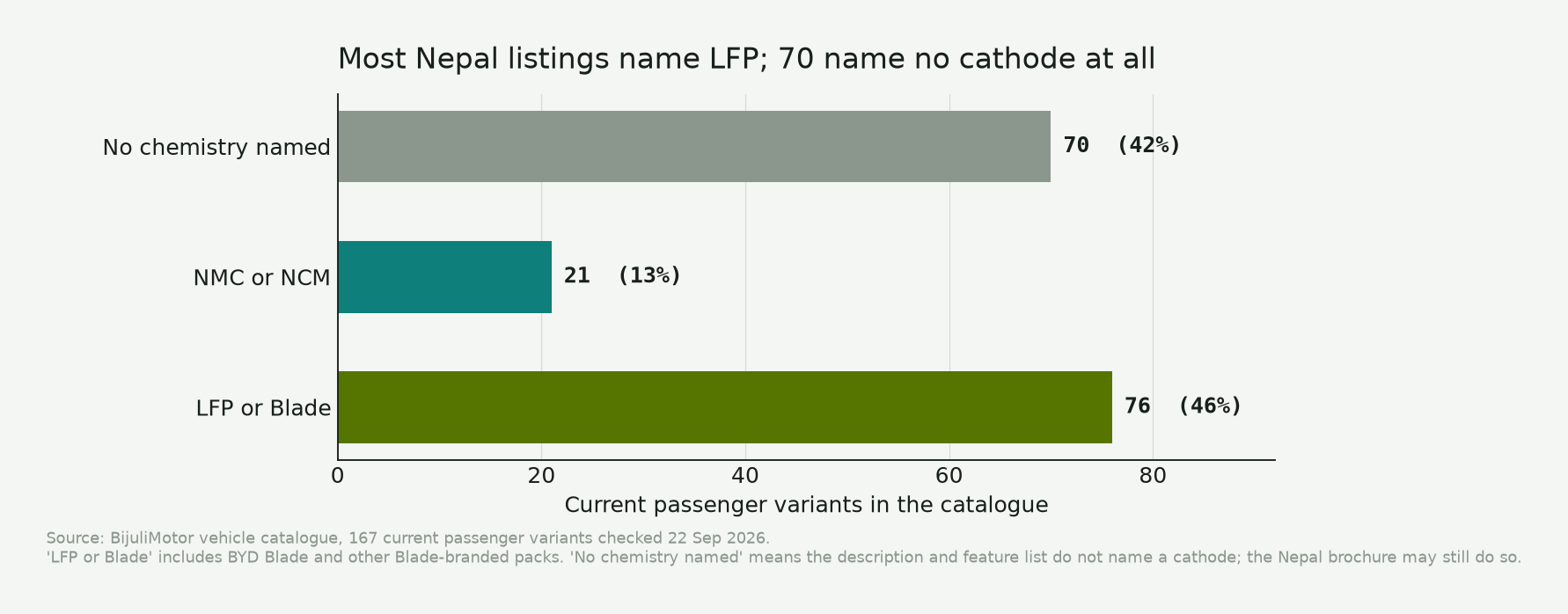
Only 21 of the 167 current passenger variants in the BijuliMotor catalogue name an NMC or NCM battery. Another 76 name LFP or a Blade pack, and 70 name no cathode chemistry at all. The letters on the brochure are therefore a starting point for your questions. They cannot decide the purchase on their own. The pack, cooling, software, warranty and the dealer behind the car decide more of what you will live with.
Chemistry still matters. It changes how much energy fits in a given weight, how the car behaves in the cold, and how the maker writes the charging instructions. What it cannot do is tell you whether a particular Nepal car has a battery heater, a liquid-cooled pack or a warranty that covers capacity loss.
What LFP and NMC mean
LFP means lithium iron phosphate. NMC, also written NCM, means lithium nickel manganese cobalt oxide. Both names describe the cathode, the positive electrode. Both are lithium-ion batteries, so an advertisement that contrasts "LFP" with "lithium-ion" is mixing two categories.
Blade describes how the pack is built. It does not name a cathode chemistry. BYD says its Blade Battery "is based on lithium iron phosphate chemistry" and is clear of nickel and cobalt (BYD Blade Battery page, checked 2 November 2026). That supports the LFP label on a BYD Blade pack. It does not establish the pack generation, capacity, cooling or warranty of the car in a Nepal showroom.
CATL makes the same distinction in its technology pages. It quotes 265 Wh/kg for an NMC Qilin battery and 205 Wh/kg for an LFP Qilin battery (CATL innovative technology page, checked 2 November 2026). Those are manufacturer figures for named designs. They apply to those named designs. They say nothing about a particular Nepal trim.
What the Nepal listings actually say
This count covers the current passenger records in the BijuliMotor vehicle catalogue and their description and feature text. 76 name LFP or a Blade pack, 21 name NMC or NCM, and 70 name no cathode chemistry. The catalogue is a secondary listing. It is not a distributor's own brochure. A missing chemistry line means the listing is silent. It does not mean the car has no chemistry.
The table below uses one current variant per model, chosen to cover the price bands and the three chemistry states. It is a starting list. The catalogue holds more trims than this.
| Model and current variant | Price | Pack | Chemistry as listed | Where the chemistry claim comes from |
|---|---|---|---|---|
| MG Comet Pace | Rs 18,75,000 | 17.3 kWh | Not stated | MG Nepal page: prismatic cell, liquid cooled; no cathode named |
| Wuling Mini EV Standard | Rs 19,99,000 | 16.2 kWh | LFP | Catalogue |
| Tata Tiago EV Pure +24 | Rs 28,99,000 | 24 kWh | Not stated | Catalogue and Sipradi listing: capacity only |
| BYD Atto 1 Dynamic | Rs 30,75,000 | 30.08 kWh | LFP (Blade) | Catalogue; BYD says Blade is LFP |
| Leapmotor T03 Standard | Rs 31,99,000 | 37.3 kWh | LFP | Catalogue |
| Proton e.MAS 5 Prime | Rs 32,99,000 | 30 kWh | LFP (CATL) | Catalogue |
| Tata Punch EV Smart +32 | Rs 33,98,933 | 32 kWh | LFP | Catalogue |
| Citroen eC3 Shine | Rs 35,99,000 | 29.2 kWh | Not stated | Catalogue: lithium-ion pack, no cathode named |
| BYD Dolphin Standard | Rs 41,15,000 | 44.9 kWh | LFP (Blade) | Catalogue |
| MG Windsor Excite | Rs 41,49,000 | 38 kWh | LFP | MG Nepal specification page |
| Tata Nexon Standard | Rs 42,49,000 | 45 kWh | Not stated | Catalogue and Sipradi listing: capacity only |
| Suzuki e-Vitara Delta | Rs 48,99,000 | 49 kWh | LFP | Catalogue |
| MG S5 Deluxe (49 kWh) | Rs 50,99,000 | 49 kWh | LFP (CATL) | Catalogue |
| Mahindra XUV400 EL PRO | Rs 52,50,000 | 39.4 kWh | Not stated | Catalogue |
| Hyundai Creta EV Smart | Rs 54,96,000 | 42 kWh | NMC | Catalogue; Hyundai page says liquid-cooled lithium-ion only |
| OMODA E5 Single Tone | Rs 54,99,000 | 61 kWh | LFP | Catalogue |
| Tata Curvv EV, 55 kWh | Rs 58,99,000 | 55 kWh | Not stated | Catalogue and Sipradi listing: capacity only |
| BYD Atto 3 Advance | Rs 62,90,000 | 49.92 kWh | LFP (Blade) | Catalogue |
| Deepal S05 Max | Rs 62,99,000 | 56.1 kWh | LFP | Catalogue |
| Hyundai Kona GLS | Rs 64,96,000 | 39.2 kWh | Not stated | Catalogue: lithium-ion polymer |
| Mahindra XEV9e Pack 2 | Rs 69,00,000 | 59 kWh | LFP | Catalogue |
| Deepal L07 Standard | Rs 69,99,000 | 66.8 kWh | NMC | Catalogue |
| BYD Sealion 7 Standard | Rs 92,99,999 | 71.8 kWh | LFP (Blade) | Catalogue |
| Kia EV6 Standard | Rs 1,25,90,000 | 77.4 kWh | NCM | Catalogue |
Sources: BijuliMotor vehicle catalogue, current records checked 22 September 2026; MG Nepal and Hyundai Nepal pages checked 2 November 2026. Prices are catalogue MRPs. Treat them as a guide and ask the showroom for a quotation. The kWh figure is the catalogue's battery capacity. It does not say whether the number is gross or usable.
LFP appears across the price range. In this table it runs from Rs 19,99,000 for the Wuling Mini EV to Rs 92,99,999 for the BYD Sealion 7. The NMC rows run from Rs 54,96,000 for the Hyundai Creta EV to Rs 1,25,90,000 for the Kia EV6. The "not stated" rows come from Tata, MG, Hyundai, Mahindra and Citroen, so the gap is not one brand's habit.
The Tata case is worth knowing. Sipradi's current pages for the Tiago, Nexon and Curvv give battery capacity and price but do not name the cathode chemistry (Sipradi vehicle listing, checked 2 November 2026). The Punch EV is the exception in the catalogue, which names LFP. That does not prove the other Tata packs are not LFP. It means the Nepal listing does not give you the answer.
MG shows the opposite. The Nepal Comet page calls the pack "prismatic cell, liquid cooled" but does not name LFP or NMC (MG Comet page, checked 2 November 2026). The Windsor page states "38 kWh LFP" directly (MG Windsor page, checked 2 November 2026). The same dealer gives two different levels of disclosure for these cars.
Hyundai's Nepal page stops short. The catalogue record for the Creta EV says NMC. Hyundai Nepal's specification page says "liquid cooled Lithium Ion battery pack" and gives 42 kWh, without naming the cathode (Hyundai Creta EV specification, checked 2 November 2026). If you want the NMC claim confirmed, ask for the brochure page that says it.
What chemistry changes
Energy density and weight
The CATL figures show the usual trade-off. An NMC Qilin pack is quoted at 265 Wh/kg and an LFP Qilin pack at 205 Wh/kg. Put those into a worked example.
Assumption: a 60 kWh pack made only of cells, with the same cell-level energy density as the CATL figures and no enclosure, cooling plate, wiring or fasteners. At 205 Wh/kg the cells weigh about 293 kg. At 265 Wh/kg they weigh about 226 kg. The difference is about 66 kg.
That is a real engineering difference, and it is why NMC has been used where a maker wants more energy in a small or light car. It is not a prediction that one complete car is 66 kg lighter. Enclosure, cooling, protection and the rest of the vehicle can wipe out the cell-level advantage.
Usable energy and range
A quoted battery capacity may be gross or usable. Gross includes energy the car may keep outside the driver's operating window. Ask which number appears in the brochure and which one governs the range calculation.
This worked example uses arithmetic only. Pack A has 50 kWh usable and the car uses 15 kWh/100 km. Pack B has 55 kWh usable and the car uses 17 kWh/100 km. Pack A's simple full-energy calculation is 50 ÷ 0.15 = 333 km. Pack B's is 55 ÷ 0.17 = 324 km. Both packs could use either chemistry. The arithmetic uses usable energy and consumption. The cathode label does not enter the calculation.
Charging speed and the charger you will actually use
A peak kW figure is tied to a charger, a temperature and a state of charge. The shape of the charging curve matters more. So does the public network.
The BijuliMotor charging list has 392 records. 68 name a CCS2 connector with a DC rating. 49 of those are 30 kW and 19 are 60 kW. No record gives a CCS2 unit more than 60 kW (charging-station directory, records checked 23 September 2026). A record such as "60 kW GB/T, 30 kW CCS2" is counted as a 30 kW CCS2 site here, because the rating is tied to the plug it names.
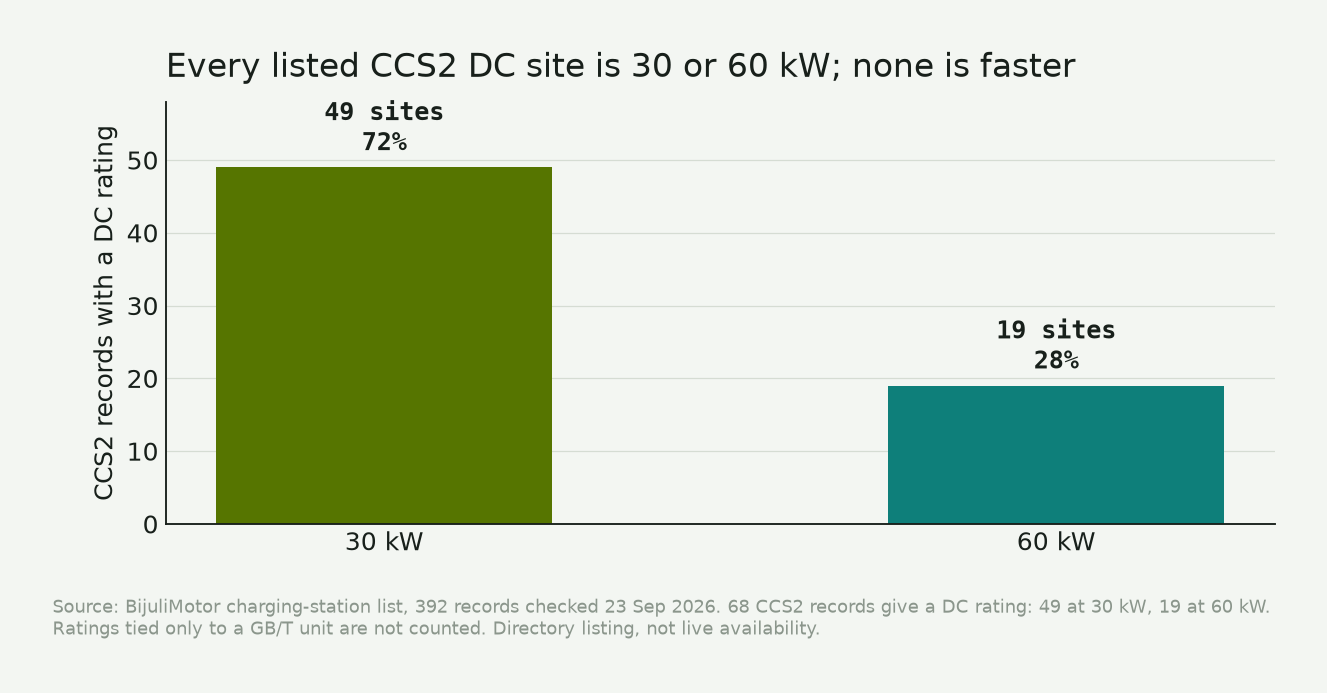
Worked example: a 50 kWh pack charged from 10% to 80% needs 35 kWh. At a steady 30 kW that takes 1.17 hours, or about 70 minutes. At a steady 60 kW it takes 35 minutes. Both figures ignore charging losses, taper and the time spent plugging in. They also assume the car accepts the full charger output.
On this network, a car with an illustrative 150 kW peak and a car with a 60 kW peak can leave the same 30 kW site at the same time. The faster hardware matters only at a charger that can supply it. That is why a high peak on the brochure is a weak reason to choose one car over another.
LFP and NMC both taper as the pack fills. LFP's flatter voltage curve can make the state of charge harder to estimate near the ends. Ask whether the manual asks for a periodic full charge to balance the cells. Some LFP cars do, others do not. Do not apply a universal 80% or 100% rule from the chemistry name. The fast-charging guide explains why the last part of a session slows.
Cold mornings in Kathmandu and the hills
Kathmandu's January mean daily minimum is 2.8°C, and the record low is -3.5°C, based on 1991-2020 normals from the World Meteorological Organization and Nepal's Department of Hydrology and Meteorology (Kathmandu climate table, checked 2 November 2026).
At 2.8°C a pack that has sat outside overnight is cold. It is not frozen. Expect less regenerative braking and possibly slower DC charging until the pack warms. The size of the effect varies by pack, heater and software, and the Nepal listing rarely gives it.
A cold pack makes the state-of-charge estimate less reliable, which is another reason to leave a margin on a winter trip.
Ask the dealer whether the car has a battery heater or can precondition the pack before a DC stop. Ask what the manual says about charging below 0°C. If the car has no heater, charge after driving while the pack is still warm, and park in a garage when you can. In hill towns the overnight temperature can be lower than in Kathmandu, so the same questions matter more.
Ageing and cycle life
A 2020 experimental study by Gailani and colleagues compared LFP cells from Sony and BYD with an NMC cell from Samsung. The NMC cell reached 80% state of health after 3,000 cycles at 35°C and 75% depth of discharge, which the authors describe as better cycle life than the LFP cells under the same conditions (arXiv:2007.01937, checked 2 November 2026).
That is one cell study. It cannot forecast how a car sold in Nepal will age. It does show why "LFP lasts longer" is too broad. A cycle count also needs the depth of discharge, temperature, charge rate and the capacity threshold used to end the test. A claim of "3,000 cycles" without those details is hard to apply to a family car.
A warranty is a contract. Laboratory results do not set its terms. Check the years, the kilometre limit, the capacity-loss threshold, the exclusions, the commercial-use rules and the service records that keep the cover valid. The battery warranty guide explains what those clauses usually say.
What chemistry does not change
Chemistry is one layer. Around the cells sit the module connections, the pack enclosure, the cooling system, the battery management system and the service contract. Two cars with the same cathode can behave differently because one has liquid cooling and a conservative BMS and the other has a sealed air-cooled pack. The reverse is also true.
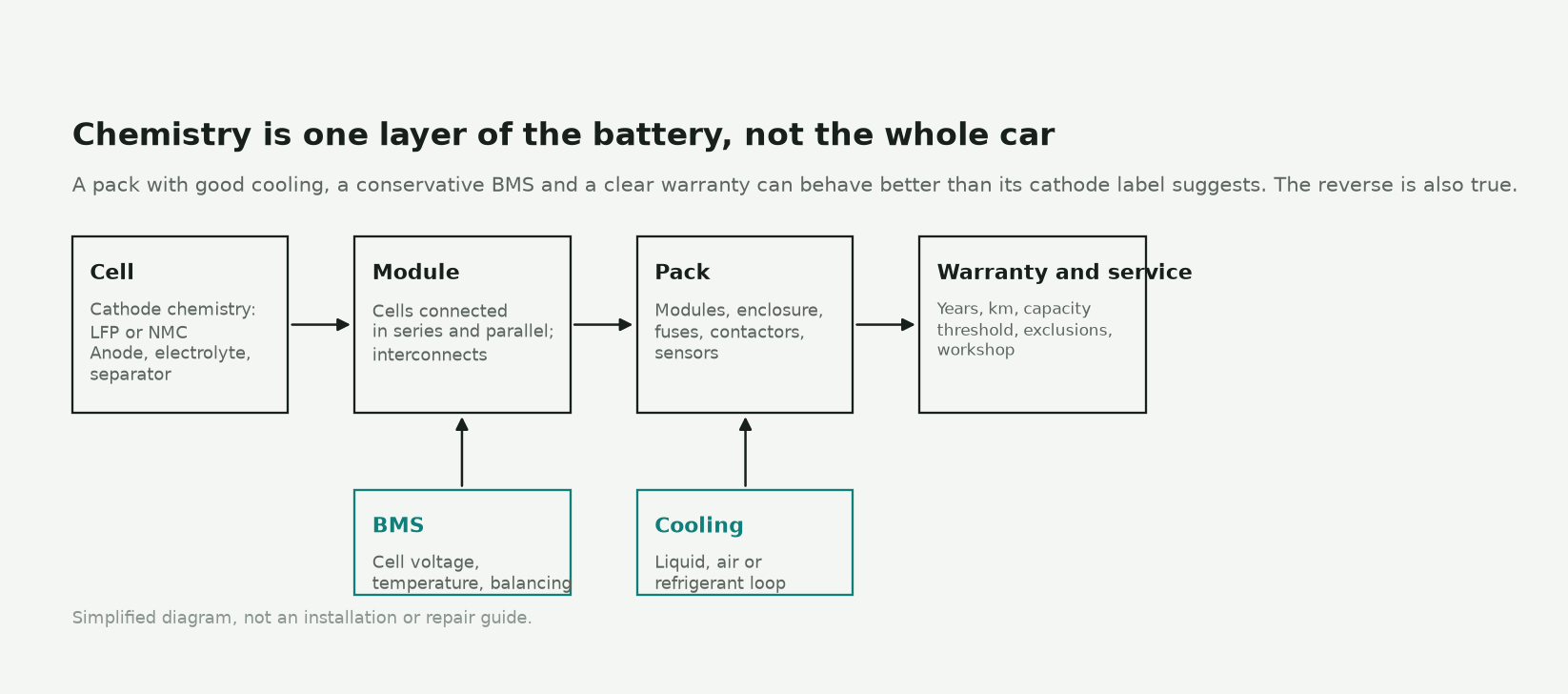
Cooling is worth asking about directly. A liquid-cooled pack is not automatically better, but it gives the BMS more room to manage repeated fast charging, a loaded climb or a hot day. The cooling guide explains what the label does and does not prove.
Warranty text is where the chemistry label fades fastest. The catalogue's feature list for the MG Windsor says lifetime warranty for the first owner on private registration, and 8 years or 160,000 km after an ownership change. The Tata Punch entry says 3 years or 125,000 km. The Hyundai Creta EV catalogue entry says 8 years or 160,000 km. Those lines do not say which component each term covers, and none of them states the capacity-loss threshold. Ask for the written booklet before you compare headline years.
Service is the other practical test. The catalogue names Cimex for BYD, Sipradi for Tata, GO Automobiles and Paramount for MG, Laxmi for Hyundai, Continental for Kia, Shangrila for Citroen, Agni for Mahindra and MAW Vriddhi for Deepal. A dealer name is not proof that every workshop can test a high-voltage pack. Ask which workshop can run a battery health test, what equipment it uses, and how long a replacement pack takes to arrive.
A showroom checklist
- Ask for the chemistry and the pack generation in writing for the exact variant. "Blade" on its own is not enough. Ask whether the pack is LFP and which Blade generation it is.
- Ask for both gross and usable battery capacity. The catalogue gives one number. The brochure may give another, and the range calculation may use the usable figure.
- Ask about cooling and heating: liquid, air or refrigerant, and whether the car has a battery heater or preconditioning.
- Ask for the DC peak and the 10-80% time. Then compare that with the chargers on your regular route. The charging-station directory is a list. It cannot show live availability, so call the operator before you rely on a site.
- Ask for the warranty booklet: years, kilometres, capacity threshold, exclusions, transfer to a second owner and commercial-use terms.
- Ask which workshop can test the pack and what a replacement costs. A service centre that handles tyres and brakes may not be equipped for high-voltage work.
- Read the manual sections on the daily charge target, periodic full charge, long-term storage and charging in cold weather.
- Drive the car loaded on a road you know. Check the ramp into your parking, the boot with your usual luggage and the charging access at home. The test-drive route guide has a checklist for all three.
Safety boundary
BYD says the Blade Battery passes a nail penetration test and is clear of nickel and cobalt. That is a manufacturer's test under laboratory conditions. It does not guarantee a car after a crash. CATL says its NMC chemistry uses a temperature-resistant cathode and a self-stabilising system. Those are also manufacturer claims.
Neither chemistry makes a damaged pack safe. If you see smoke, hear hissing, smell electrolyte or have driven through flood water, stop charging, keep people away and call the dealer and the emergency services. Do not drive a car with a damaged underbody to a charger. The flood guide and the garage fire guide set out what to do next.
Questions buyers ask
Is LFP better than NMC? Neither is better in every car. LFP avoids nickel and cobalt, and BYD describes its Blade chemistry as more stable. NMC packs more energy into a given weight on the CATL figures above. The pack, cooling, BMS and warranty decide how those trade-offs reach you.
Does LFP last longer? Not automatically. In the Gailani study the NMC cell lasted better under the tested conditions. Cycle life depends on depth of discharge, temperature, charge rate and the capacity threshold used to end the test.
Can I charge an LFP car to 100% every day? Only if the manual says so. Some LFP cars allow a daily 100% charge and ask for a periodic full charge to balance the cells. Others set a lower daily target. Do not apply a universal rule from the chemistry name.
Which Nepal cars use LFP? The table above lists 24 current models across the price bands. 76 of the 167 current passenger variants name LFP or a Blade pack in the catalogue. BYD's Blade cars, the Tata Punch EV, MG Windsor, MG S5, Suzuki e-Vitara, Deepal, Leapmotor, OMODA and Proton are in that group. Check the exact variant before you rely on it.
Is NMC unsafe? There is no blanket safety verdict from the chemistry name. NMC packs can be designed with thermal barriers, cooling and early warning. LFP packs can still fail. Damage, flooding and bad charging matter more than the label.
Does chemistry affect cold-weather range? Both chemistries lose range in the cold. The amount depends on the pack, heater, software and how you drive. The chemistry label does not tell you whether the car has a battery heater.
What should I ask the dealer? Use the eight questions in the showroom checklist above, and ask for the answers in writing for the exact variant.
Sources and checks
- Prices, battery capacity, dealer names and the chemistry text for each model: BijuliMotor vehicle catalogue, current records checked 22 September 2026. The same data is browsable on the EV price list.
- Charger counts: BijuliMotor charging-station list, 392 records checked 23 September 2026. A record's DC rating is counted only against the connector it names.
- BYD Blade chemistry: BYD Blade Battery page, checked 2 November 2026.
- CATL energy density: CATL innovative technology page, checked 2 November 2026.
- LFP and NMC ageing: Gailani et al., arXiv:2007.01937, checked 2 November 2026.
- MG Comet and Windsor packs: MG Comet page and MG Windsor page, checked 2 November 2026.
- Hyundai Creta Electric pack description: Hyundai Nepal specification page, checked 2 November 2026.
- Tata capacity-only listings: Sipradi vehicle listing, checked 2 November 2026.
- Kathmandu temperature normals: Kathmandu climate table, citing the World Meteorological Organization and Nepal's Department of Hydrology and Meteorology, checked 2 November 2026.
- Cimex's Nepal pages and Citroen's Nepal site did not load during this check. No chemistry claim above relies on them.