
Why your EV's range drops while it is parked
A parked EV can lose kilometres on the dashboard without losing battery capacity. What the Tata, BYD and MG manuals say, and what to write down.
Suppose you park with 180 km showing. When you return, the display says 165 km. The 40 kWh Tata Punch EV in our catalogue has a 325 km claim, and at an assumed 16 kWh/100 km that 15 km drop is about 2.4 kWh, or 6% of the pack. That is a real amount of energy. It is not proof that 15 km of battery capacity has disappeared.
The kilometres on the dashboard are a forecast. The car estimates how much charge is left, multiplies by the energy it thinks it can use, then divides by a consumption figure. Any of those three can move while the car sits. The percentage can move too, because it is also an estimate.
The manuals for three cars sold in Nepal describe this differently enough that the first step is to know which display you are looking at.
What the dashboard is telling you
| Display | What it is | What it does not tell you |
|---|---|---|
| State of charge, SOC | The battery management system's estimate of charge inside the managed operating window | How much original capacity is left after years of use |
| Estimated range | Stored energy divided by an assumed consumption figure | A guaranteed distance on the next hill route |
| Consumption | Energy used over a defined driving interval | Every unit you pay for at the meter, because charging loses some energy |
A range number on its own is hard to interpret. Two screenshots from different mornings may use different consumption assumptions, different drive modes or different display settings. Record the percentage, the range, the mode and the trip average together.
Three cars, three display behaviours
We read the Punch EV manual distributed by Sipradi, BYD's Atto 3 owner's manual and the MG Windsor EV owner's manual. The Punch manual is the Nepal distributor's copy. The BYD and MG manuals are global or India editions, so the software in a Nepal car may differ. Ask the service centre to confirm the menu on your own car.
| Model | What the manual says about the range figure |
|---|---|
| Tata Punch EV | The distance-to-empty figure is tentative and updated by the system from the drive route, driving pattern and usage history over past drives. Tata recommends keeping a 20 km buffer. At 20 km the display shows RECHARGE. Range is shown with the ignition on and off. |
| BYD Atto 3 | Standard mode uses a comprehensive working-condition test result. Dynamic mode uses available battery power and current average energy consumption. In Dynamic, the range at full charge changes with the previous trip, and the air conditioner and drive mode adjust it. |
| MG Windsor | One estimated range is shown from the remaining SOC. The manual calls it tentative and lists slope, driving habits, temperature and air conditioning as influences. It also recommends a 20 km buffer. The SOC bar is green from 20% to 100% and red below 20%. |
The BYD manual has the most direct explanation of a drop while parked. It describes a smart charging function that tops up the 12V battery from the high-voltage pack when the ignition is off and the low-voltage battery falls below a set level. The manual says it is normal for SOC and driving range to fall when the car is switched on after an idle period, because energy has moved from the traction battery to the 12V battery (BYD Atto 3 owner's manual, pages 89 to 92, checked 2 November 2026).
Neither the Tata nor the MG manual describes the same ignition-off 12V top-up from the traction pack. The manual does not document it for those models, so we cannot say it never happens.
Why the estimate can fall while the car sits
The charge estimate can be revised. The battery management system uses current, voltage and temperature measurements. When the pack cools, those inputs change, so the SOC estimate can be revised. A 2024 paper by Yi and colleagues explains that LFP cells have a flat open-circuit-voltage curve over part of their range, which makes voltage a weak guide to charge, and proposes a compensation method for measurement bias (arXiv:2401.08136, checked 2 November 2026). That explains why the estimate can move. It does not tell you how to repair a car in Nepal.
The consumption assumption can change. The range figure divides stored energy by a number that represents recent driving. A week of short, cold, stop-start trips can raise that number. So can leaving the heater or air conditioner on, or selecting a different drive mode. The displayed kilometres then fall even if the SOC has not moved.
The display mode or trip average can change. BYD's Standard and Dynamic modes use different bases. If someone changes the mode, or resets the trip meter that feeds the average, the next range figure is not comparable with the last one. The setting is remembered by the car, so the change may have happened days earlier.
Energy can actually leave the pack. BYD documents 12V support. Other parked loads may exist on other models, but we did not find them described in the three manuals. If the SOC falls as well as the range, treat it as energy use or a revised charge estimate until the service centre says otherwise.
The first check is the percentage. If the SOC stayed at 62% and the range fell from 180 km to 165 km, the car changed its consumption assumption or its display mode. If the SOC fell from 62% to 56%, energy left the pack or the charge estimate was revised. Write down both numbers before you do anything else.
Long-term capacity loss is a separate question. A 15 km change over one night is too small and too short to measure it. A health check needs a controlled test. Two dashboard photographs cannot replace that test. Our guide to a used EV battery health report explains what that test can and cannot show.
A percentage is not a distance
Ten percent on the dashboard is not a fixed number of kilometres. It is a share of the pack, and packs differ. This table uses the battery capacity and claimed range listed in the BijuliMotor catalogue. It is arithmetic on the claim. Your own driving will differ.
| Model | Listed battery | Claimed range | Energy in 10% | Claimed km per 10% |
|---|---|---|---|---|
| Tata Tiago EV Pure +24 | 24 kWh | 205 km | 2.4 kWh | 20.5 km |
| Tata Punch EV, 40 kWh pack | 40 kWh | 325 km | 4.0 kWh | 32.5 km |
| Tata Nexon EV | 45 kWh | 325 km | 4.5 kWh | 32.5 km |
| BYD Atto 3 Advance | 49.92 kWh | 345 km | 4.99 kWh | 34.5 km |
| MG4 Comfort | 51 kWh | 350 km | 5.1 kWh | 35 km |
| MG S5 Luxury (62 kWh) | 62 kWh | 430 km | 6.2 kWh | 43 km |
| MG Windsor Commute | 38 kWh | 332 km | 3.8 kWh | 33.2 km |
| BYD Atto 1 Dynamic | 30.08 kWh | 230 km | 3.01 kWh | 23 km |
Source: BijuliMotor vehicle catalogue, checked 2 November 2026. The range figures mix WLTP, Nepal market testing and manufacturer-published claims, so the last column cannot support a like-for-like efficiency comparison. Read what WLTP and ARAI figures mean in Nepal before using one car's claim against another's.
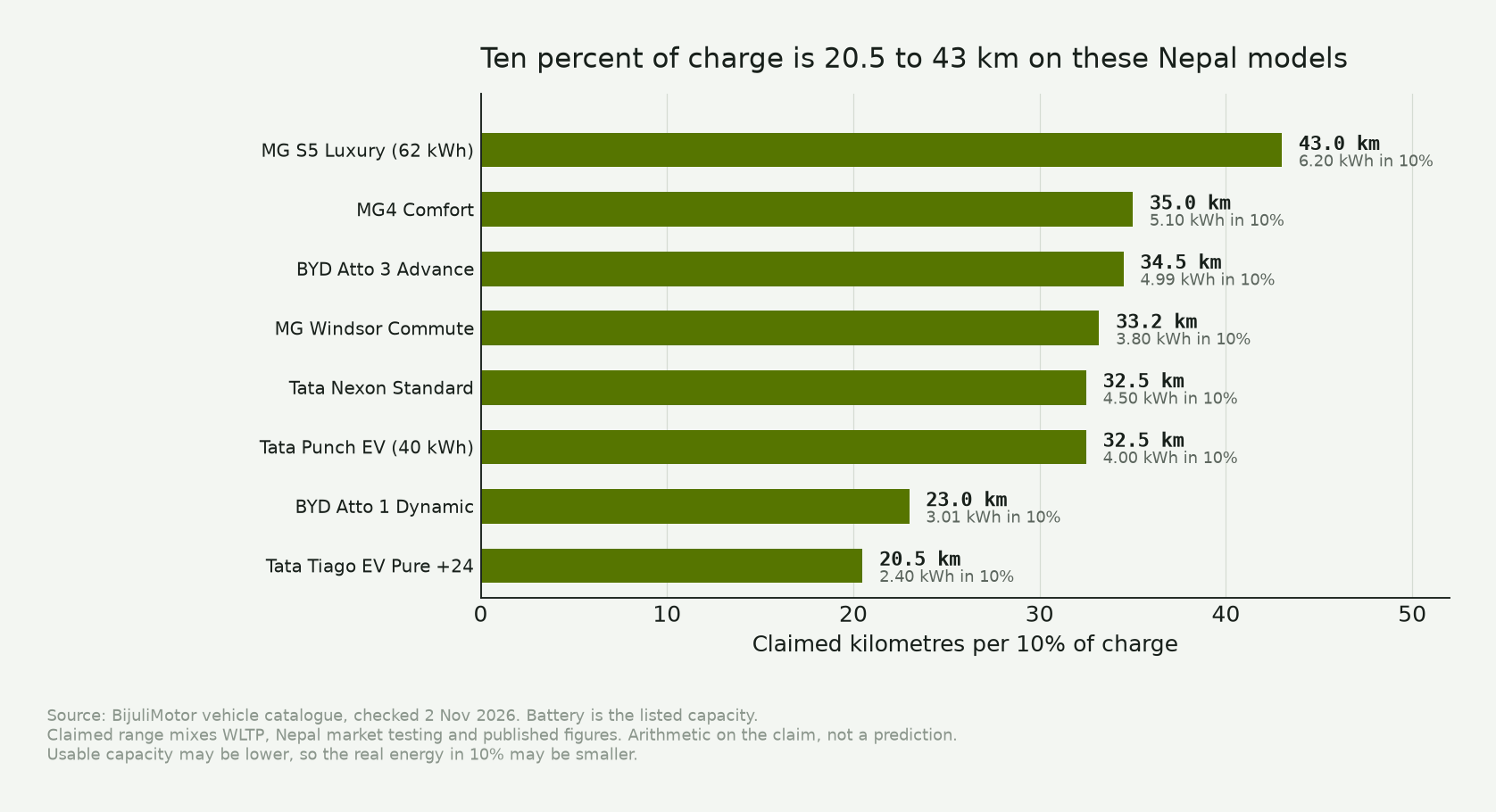
The same 10% is 2.4 kWh in a Tiago EV and 6.2 kWh in an MG S5 with the 62 kWh pack. It is 4.0 kWh in the Punch EV. That is why a percentage drop that looks small can mean different distances in different cars. The consumption figure behind your range is also an estimate. If you want to replace it with your own measurement, the first-month consumption guide shows what to record at the meter.
What a 15 km drop means in energy
Work in energy rather than kilometres. A 15 km revision is a few kWh. It is nowhere near 15 kWh. The table uses the same 40 kWh starting point and adds the energy behind a 15 km change.
Assumption: 40 kWh of usable energy is left, equal to the listed pack size of the Punch EV (40 kWh). The real usable figure may be lower, so these are upper bounds. Consumption is an assumption. Only your own measurement can confirm it.
| Assumed consumption | Range from 40 kWh | Energy in 15 km | Share of the 40 kWh pack |
|---|---|---|---|
| 12 kWh/100 km | 333 km | 1.8 kWh | 4.5% |
| 14 kWh/100 km | 286 km | 2.1 kWh | 5.3% |
| 17 kWh/100 km | 235 km | 2.55 kWh | 6.4% |
| 20 kWh/100 km | 200 km | 3.0 kWh | 7.5% |
| 21 kWh/100 km | 190 km | 3.15 kWh | 7.9% |
Fifteen kilowatt-hours would be 37.5% of a 40 kWh pack. A drop that big would move the percentage bar by about 38 points, so the SOC would show it too. That is the scale to keep in mind when a display moves by 15 km.
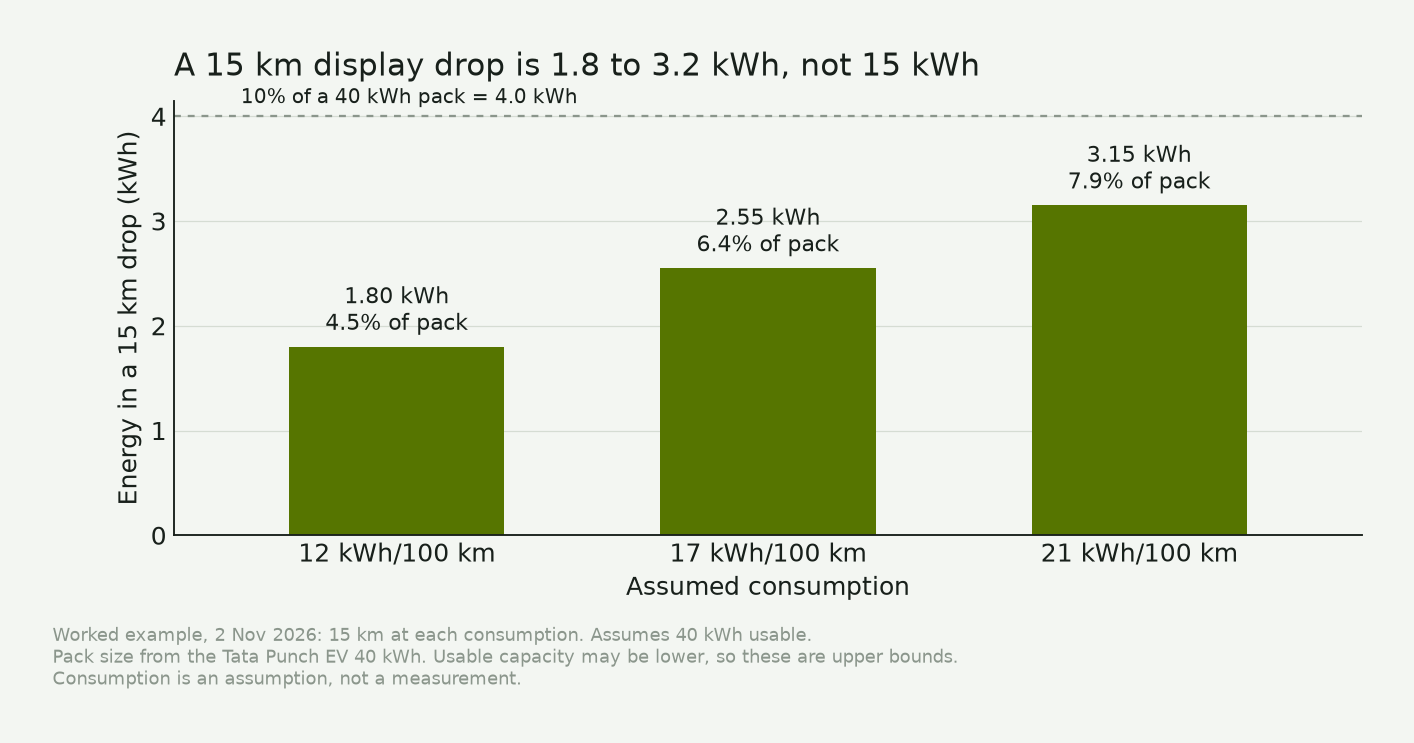
At 17 kWh/100 km, 40 kWh gives 235 km. Fifteen kilometres uses 2.55 kWh, which is 6.4% of the pack. If the SOC fell by 6 percentage points and the range fell by 15 km, the two numbers are roughly consistent. If the SOC did not move, the range change came from the consumption assumption or the display mode.
Keep a log a technician can use
One screenshot is weak evidence. A short record with the same fields each time is more useful. Copy this into a notebook or a note on your phone.
| Field | What to record |
|---|---|
| Date and time | When you parked and when you returned |
| Place | Home, office, basement, roadside. Note sun or shade if the car sat outside |
| SOC | Percentage when parked and when you returned |
| Range | Kilometres when parked and when you returned |
| Distance driven | Kilometres since the last charge, from the trip meter |
| Display mode | Standard, Dynamic or whatever your car calls it. Note the trip average if shown |
| Temperature | Outside temperature at both ends if the car displays it |
| Accessories | Heater, air conditioner, demister or anything left on |
| Charging | Whether the car was plugged in, and to what |
| Warnings | Any message, light or charging fault |
| Notes | Whether anyone changed a setting or reset the trip |
Record the first entry before you switch the car off, while it is parked safely. Take a photograph of the screen as a backup, but write the numbers down as well. On return, record the second entry before you drive away.
Do this three times under similar conditions. Three similar entries are stronger evidence than two screenshots from different seasons. If the drop only happens after a particular charger, in one parking spot or on cold mornings, the log will show that pattern. Take the log to the service centre and ask them to keep a copy.
When to book service
Book a visit if the SOC and range both fall repeatedly by a large amount under similar conditions, if a warning appears, if charging stops unexpectedly, or if the car has had an impact. Do not wait for more data when there is a warning or a charging fault.
If the range at 100% keeps falling over months, ask for a capacity test rather than another look at the dashboard. BYD's maintenance table lists a battery pack capacity test and calibration every six months or 72,000 km (BYD Atto 3 owner's manual, page 159, checked 2 November 2026). Other brands may use a different interval, so ask for the schedule for your model.
Ask the service centre to say whether the finding concerns the charge estimate, the consumption calculation or the pack capacity. Those lead to different actions. A range screenshot alone cannot prove that the pack must be replaced. It also cannot prove that nothing is wrong.
The charging routine that keeps the estimate honest
Two of the three manuals tie a full charge to SOC calibration and cell balancing.
The Tata Punch EV manual says that after every four fast charging cycles, you should slow or home charge to 100%. It also says that at least once a month, or after every four fast or opportunity charging cycles, whichever comes first, one slow or AC charge to 100% is required for SOC calibration and cell balancing. Balancing and calibration happen above 90%, which is why charging slows there. The manual asks you to let the session reach 100% before stopping (Punch EV owner manual, pages 49 to 51, checked 2 November 2026).
The MG Windsor manual gives a similar instruction: slow AC charging to 100% at least once every 15 days or after every four fast DC or opportunity charging cycles, whichever is earlier, for SOC calibration and cell balancing (MG Windsor EV owner's manual, pages 76 to 77, checked 2 November 2026).
The BYD manual does not give the same interval in the sections we read. It does say that at low temperatures the SOC may quickly jump to 100% when charging, and that range is shorter at low temperatures (BYD Atto 3 owner's manual, page 93, checked 2 November 2026). That is one reason a winter morning can look different from a summer one. The heater and demisting guide covers the energy side of cold-weather driving.
Do not run the battery near empty to teach the display its range. The Punch manual shows RECHARGE at 20 km, and the MG manual warns against driving below 10% SOC. Do not disconnect the 12V battery, clear fault codes or use unapproved diagnostic software to reset a reading. Those actions can remove the evidence a technician needs and create new faults. The 12V battery guide explains why a car with charge can still fail to start.
If a model-specific procedure requires service involvement, arrange it. Ask which manual section applies and whether there are prerequisites. A social media screenshot cannot support a battery procedure.
Plan the next trip with a reserve
Both the Tata and MG manuals recommend a 20 km buffer. At 14 to 20 kWh/100 km, 20 km is 2.8 to 4.0 kWh, or 7% to 10% of a 40 kWh pack. That is a sensible reserve for the distance estimate. It cannot guarantee that a charger will be working.
The BijuliMotor charging list has 392 records, checked 23 September 2026. Of those, 80 are in the Kathmandu Valley. The rest are spread across the country. The list is a directory. It cannot tell you whether a charger is free right now. Call the operator before you rely on a site, and know where the next compatible charger is. The charging-stations tool lets you check the record and the plug type.
For a route, the Trip Planner can organise the distance and suggested stops. It cannot certify that a charger is working and it cannot diagnose a battery warning. Use it with the directory and the car's own instructions.
Questions owners ask
Is a 15 km drop while parked normal? It can be. On a 40 kWh pack, 15 km is about 2.1 to 3.0 kWh at 14 to 20 kWh/100 km, or 5% to 8% of the pack. Check whether the SOC moved. If it did not, the range forecast changed. If it did, energy left the pack or the charge estimate was revised.
Why does my BYD show a different range at 100% each time? If Dynamic mode is selected, the manual says the full-charge range varies with the previous trip's energy consumption and is adjusted for the air conditioner and drive mode. Standard mode uses the test-cycle result. Pick one mode and keep it while you log a problem.
Should I drive it to empty to recalibrate the display? No. The Tata manual shows RECHARGE at 20 km and the MG manual warns against going below 10% SOC. The calibration routine in both manuals uses a slow charge to 100%. Neither manual asks for a deep discharge.
Does the percentage show battery health? Not directly. SOC is the charge inside the managed window. Health is a capacity measurement. A used EV battery health report is the right test for a car you are buying or a pack you suspect.
How much does cold weather take off the range? The manuals say low temperature reduces available power and range, and the heater adds load. We could not find a Nepal-specific measured percentage for a particular model, so we will not invent one. Log the temperature with the SOC and range, and compare like with like.
Sources and checks
- Tata Punch EV display behaviour, 20 km buffer, RECHARGE warning and charging calibration: Punch EV owner manual distributed by Sipradi, PDF pages 48, 49 to 51, 86 to 87 and 109, checked 2 November 2026.
- BYD Atto 3 Standard and Dynamic range modes, 12V smart charging and cold-weather note: BYD Atto 3 owner's manual, PDF pages 89 to 93 and 159, checked 2 November 2026.
- MG Windsor range display, SOC bar, 20 km buffer, charging calibration and 10% warning: MG Windsor EV owner's manual, PDF pages 64, 76 to 77 and 176 to 178, checked 2 November 2026.
- LFP state-of-charge estimation: Yi and colleagues, Bias-Compensated State of Charge and State of Health Joint Estimation for Lithium Iron Phosphate Batteries, arXiv:2401.08136v2, checked 2 November 2026.
- Vehicle battery and range figures: BijuliMotor vehicle catalogue, checked 2 November 2026.
- Charging counts: BijuliMotor charging-station list, 392 records, checked 23 September 2026. A record's connector is counted only where the record names it.
- The 15 km energy examples and the 10% table are arithmetic on those figures, with the assumptions stated in the text and chart footers.