
NEA load upgrade for an EV charger: form, fee, timeline
Read your NEA bill, add up the charger current, file Schedule 17, and keep NEA's Rs 10 form fee separate from the electrician's quote.
Procedure checked 2 November 2026 against NEA's published regulations, citizen charter and tariff schedule.
NEA's published charge for the meter capacity increase itself is Rs 0. The printed application form costs Rs 10 at the counter. The part that usually costs real money is the wiring inside your property, and sometimes the meter, cable or transformer work that the inspection turns up.
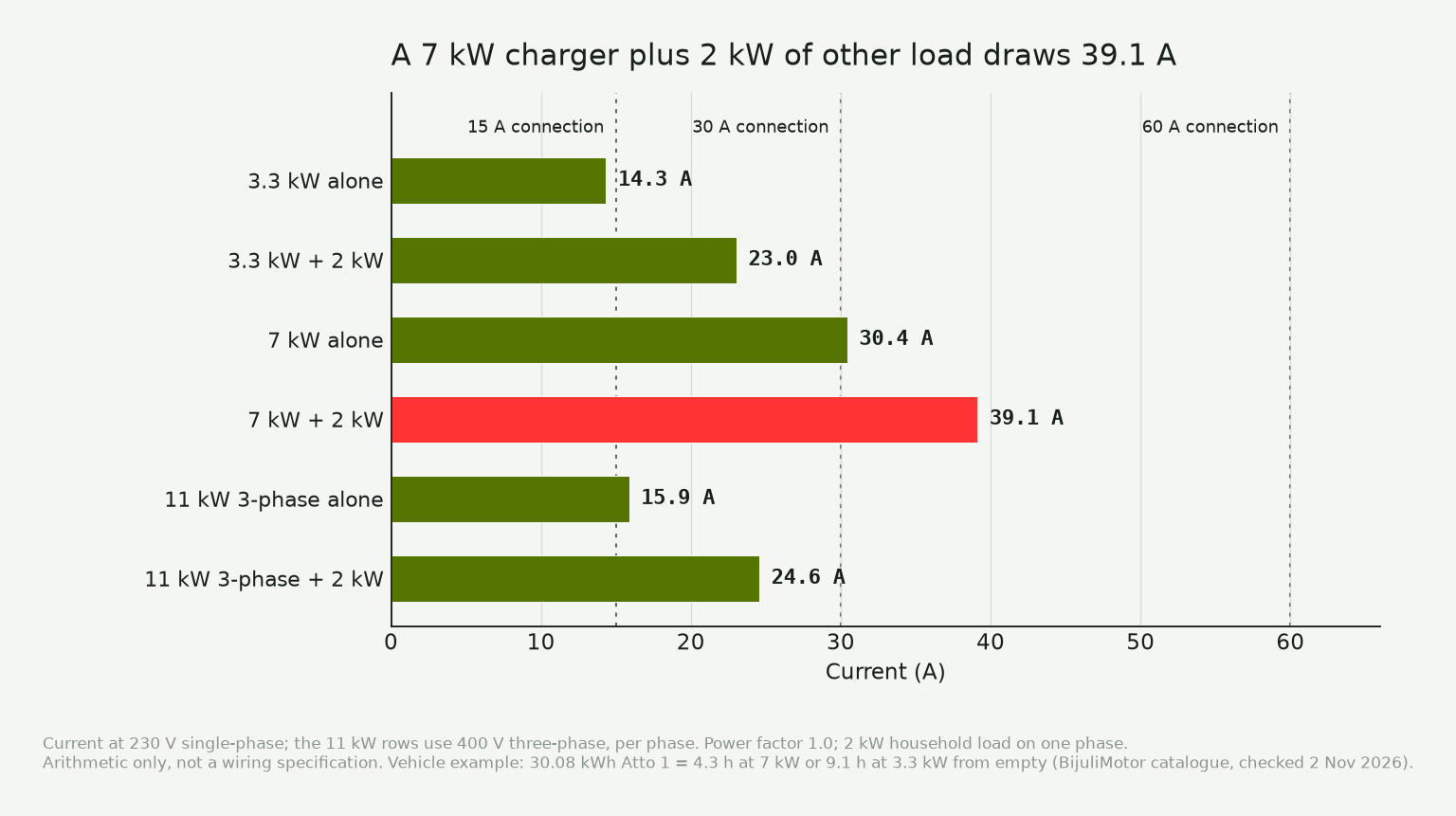
That is the short answer for a Nepal homeowner planning a wallbox. The longer answer depends on what your existing connection can already carry. A 15 A single-phase connection supplies about 3.45 kVA at 230 V. Add a 7 kW charger and 2 kW of ordinary household load and the current sum is about 39 A, well above the 15 A you have.
Three approvals can be involved in a charging project: NEA's supply approval, permission for work on the building, and the electrical installation itself. The NEA part is the form, the fee, the inspection, the service standard, and the split between NEA's charges and an electrician's quote.
What your bill already tells you
Find a recent bill and the consumer card that came with the meter. You need four things from them:
- the consumer number
- the name on the account
- the approved load in amperes, and whether the supply is single-phase or three-phase
- the meter type, especially whether it is a whole-current meter or a CT meter
The approved load is the figure NEA will compare with your application. Do not guess it from the size of the meter box or from the main breaker. If the bill does not show it, call the distribution centre that covers your address and ask for the approved load and phase. NEA publishes the contact numbers for every distribution centre, including the Kathmandu Valley offices (NEA contact list, checked 2 Nov 2026).
A tenant who pays the bill is not automatically the person who can change the connection. NEA installs a line in the name of the property owner, and the application is signed by that person or an authorised representative (Electricity Distribution Regulations 2078, Regulation 3(2), checked 2 Nov 2026). If you rent, the practical path is to prepare the load list and the quote, then ask the account holder to sign the form.
Do the current sum before you call NEA
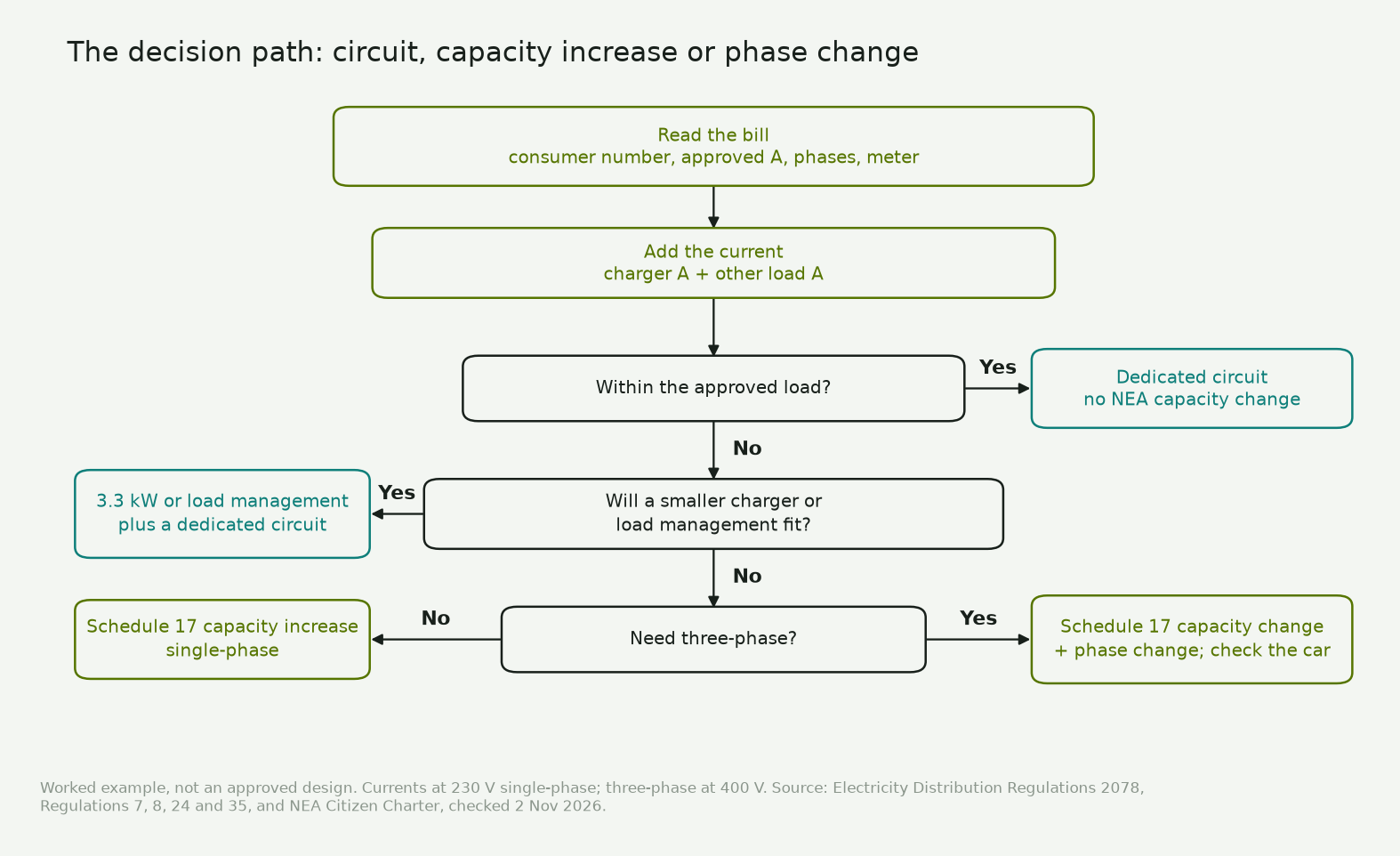
The arithmetic is simple, and it tells you whether the conversation is about a circuit, a capacity increase or a phase change.
Take a house with a 15 A single-phase connection. At 230 V, the approved load is:
15 A × 230 V = 3,450 VA, or about 3.45 kVA.
Now add a 7 kW charger and 2 kW of other household load running at the same time:
7,000 W ÷ 230 V = 30.4 A
2,000 W ÷ 230 V = 8.7 A
30.4 A + 8.7 A = 39.1 A
A 15 A connection cannot carry 39 A. Neither can a 30 A connection, and NEA's regulation allows only a 32 A main breaker on a 30 A single-phase connection (Regulation 24(12)(a)). The 7 kW charger alone is already at 30.4 A, so the 2 kW of other load is what pushes the installation past the limit.
The same sum for common charger sizes:
| Charger | Current at 230 V, single-phase | With 2 kW of other load |
|---|---|---|
| 3.3 kW | 14.3 A | 23.0 A |
| 7 kW | 30.4 A | 39.1 A |
| 11 kW, three-phase at 400 V | 15.9 A per phase | 24.6 A on the loaded phase |
| 22 kW, three-phase at 400 V | 31.7 A per phase | 40.4 A on the loaded phase |
Treat these as current sums for comparison. They do not set the approved load. The table assumes a power factor of 1, which is close enough for a modern charger but not a design calculation. Cable size, breaker type, earthing and the route from the meter to the parking space are for a licensed electrician to design.
The 3.3 kW row matters most on a 15 A connection. It draws 14.3 A, leaving less than 2 A for lights, a fridge or a fan. In practice, even the smallest wallbox usually means a 30 A connection, a dedicated circuit with load management, or a decision to charge only at night when other loads are off. The home-charging guide covers the energy side and the monthly bill. The current sum decides the connection side.
Which change you actually need
NEA approves a capacity in amperes or kVA. The electrician designs the circuit. Those are different jobs, and mixing them up can lead to paying for a capacity increase you did not need.
Use this table to frame the conversation. It is not an approved design.
| Existing connection | Charger | Other load | Current sum | Likely action |
|---|---|---|---|---|
| 15 A single-phase | 3.3 kW | 2 kW | 23.0 A | Capacity increase to 30 A, plus a dedicated circuit |
| 15 A single-phase | 7 kW | 2 kW | 39.1 A | Capacity increase to 60 A, or a 3.3 kW charger with load management |
| 30 A single-phase | 3.3 kW | 2 kW | 23.0 A | Dedicated circuit; no capacity change if the other load is controlled |
| 30 A single-phase | 7 kW | 2 kW | 39.1 A | Capacity increase to 60 A, or load management |
| 60 A single-phase | 7 kW | 2 kW | 39.1 A | Dedicated circuit; no capacity change |
| 60 A three-phase | 11 kW | 2 kW | 24.6 A on one phase | Dedicated three-phase circuit; check the car's onboard charger |
Four outcomes are possible:
A dedicated circuit is enough when the approved load already covers the charger plus the other loads. The work is inside the property: cable, breaker, isolator, earthing and a charger point. NEA does not need to change the meter, but the electrician still has to work to the approved load.
A capacity increase is the usual answer when the current sum exceeds the approved amperes. The form is Schedule 17, discussed below. NEA may change the meter, and for a larger load it may fit a CT meter. The connection stays single-phase unless you ask for something else.
A phase change is a bigger job. Single-phase to three-phase means a different meter, a different service cable and a supply that can carry more current. NEA handles it through the same capacity-change application and inspection, because the form asks for amperes or kVA and the inspection report records the existing and required phases. Ask for the phase change in writing on the form or in a covering letter. The printed form has no separate tick box for it. Before paying for three-phase, check that the car's onboard charger can use it. A three-phase supply will not make a car charge faster if the car only accepts single-phase AC. The onboard charger guide explains that limit.
A separate connection is possible, but it is rarely the cheapest route. NEA's regulation allows more than one meter on the same property when the process is followed (Regulation 8(4)). A second meter means another application, another service cable and another account to keep track of. For a separate flat or a shop with its own account it can make sense. For one house with one car, increasing the existing meter is usually simpler.
The charger itself is allowed. Regulation 18(1) permits a private charging station in a home, office or company. The public-station standards do not apply to a private unit. Regulation 19(14) still requires an NSP tie-up, a connection to a network service provider, for private charging infrastructure. The text does not distinguish a 3.3 kW home wallbox from a commercial depot, so ask the distribution centre whether that clause applies to a single home charger.
There is also a ceiling. NEA will approve only up to 100 kVA from its transformer in one house compound (Regulation 7(2)). A 60 A single-phase meter is about 13.8 kVA, and a 60 A three-phase meter is about 41.6 kVA, so most home charging projects stay well below the ceiling. A 60 A three-phase meter is above the 25 kVA threshold at which NEA requires a demand meter (Regulation 8(6)); ask how that affects the monthly bill before you choose it.
The form: Schedule 17
The application is Schedule 17 of the Electricity Distribution Regulations 2078. Its Nepali title is "विद्युत क्षमता परिवर्तनको लागि आवेदन फारम", which translates as an application form for change of electricity capacity. Regulation 35(1) is the provision that requires it.
The form asks for:
- consumer number and address
- the existing approved load in amperes or kVA
- the requested load in amperes or kVA
- a list of household appliances and their total watts
- a list of motors, with their capacity and number
- the previous month's maximum demand, if the connection has a demand meter
- the consumer category
- the applicant's signature and the account holder's details
The lower half of the form is for NEA's office. The ledger section confirms that the previous bill is paid. The meter section records the existing meter capacity, company, ampere rating, meter number, phase and year of manufacture. The inspection section records the existing and required meter capacity, phases, wire size and approved load. The inspection report is built into the form.
The citizen charter's item 8 lists two things to bring: the Schedule 17 form and proof that the bill is paid (NEA Citizen Charter, checked 2 Nov 2026). Take the ownership or tenancy papers as well if the account is not in your name, because NEA connects in the property owner's name. For an apartment, take a letter from the management committee if the connection or the parking area is shared.
Submit it at the new consumer service desk of your distribution centre. The charter names that desk for this service. If you are in Kathmandu Valley, the main offices and their published numbers include:
| Distribution centre | Published number |
|---|---|
| Ratnapark | 9851273711 |
| Baneshwor | 9851313322 |
| Kuleshwor | 9851058800 |
| Maharajgunj | 9851242695 |
| Pulchowk | 9851273712 |
| Lagankhel | 9851273713 |
| Bhaktapur | 9851273714 |
| Kirtipur | 9851219671 |
These numbers come from NEA's contact page for the Bagmati Provincial Office (NEA Kathmandu contacts, checked 2 Nov 2026). Numbers and office chiefs change, so check the page before you travel. Outside the valley, use the same contact list to find your provincial office and distribution centre.
What NEA charges
The consumer tariff schedule and the citizen charter both list a charge of Rs 0 for increasing meter capacity. The printed form is Rs 10 at the counter.
| Item | Published amount | Where it is listed |
|---|---|---|
| Schedule 17 form, bought at the counter | Rs 10 | Consumer tariff schedule, item 1(c); Citizen Charter, item 8 |
| Capacity increase, single-phase | Rs 0 | Consumer tariff schedule, item 6.1(a); Citizen Charter, item 8 |
| Capacity increase, three-phase | Rs 0 | Consumer tariff schedule, item 6.2(a); Citizen Charter, item 8 |
| Capacity decrease, single-phase | Rs 300 | Consumer tariff schedule, item 6.1(b) |
| Capacity decrease, three-phase | Rs 500 | Consumer tariff schedule, item 6.2(b) |
| Second wiring inspection, household up to 30 A | Rs 50 | Distribution Regulations, Schedule 12, item 3(a) |
| Meter test, single-phase | Rs 500, plus Rs 10 registration | Consumer tariff schedule, item 10; Citizen Charter, item 4 |
The tariff schedule is the NEA consumer tariff schedule (PDF, checked 2 Nov 2026). The citizen charter says its listed fees do not include VAT. If the counter applies 13% VAT to the Rs 10 form, the total is Rs 11.30. The Rs 0 capacity-increase line stays at Rs 0.
The Rs 0 is not the whole cost. Regulation 35(1) says the customer bears the fee for the capacity change and all material costs. Regulation 35(2) says that if the meter or CT/PT has to be replaced to carry the higher load, NEA charges for the replacement. The published schedule does not give a price for that replacement, because it depends on the meter and the site. Ask the distribution centre for the estimate in writing before you pay.
A deposit can appear as a separate line. Regulation 5(3) allows NEA to take a deposit when the work involves construction, and the amount is set by the office rather than printed in the consumer tariff schedule. If the counter asks for one, get the receipt and ask which rule the amount comes from.
Line and transformer work is a separate question. Regulation 11 says NEA bears the cost of extending its system within 1 km of an existing line, but the applicant bears the prescribed cost of the connection from the existing system to the house. Beyond 1 km, NEA may bear up to 25% of the line cost if the work is financially and technically suitable. The applicant can also build the line to NEA's standard. If NEA builds it on a rechargeable basis, the citizen charter lists a 10% service charge; if the customer builds it, the charter lists a 1.5% supervision fee.
These provisions do not sit together neatly for a load increase. Regulation 35 says the customer bears the material cost; Regulation 11 says NEA does reinforcement work such as adding phases to an existing line. In practice, the split depends on what the inspection finds. Ask for a written estimate that separates NEA's scope from yours. Do not accept a contractor's guess as NEA's quotation.
How long it takes
NEA's citizen charter sets a service standard of 3 days for a meter capacity change. The same entry covers single-phase and three-phase whole-current meters, and three-phase CT meters. That is the clock NEA sets for its own side of the work. It does not promise that the electrician will be free next week.
The charter lists 5 days for the larger jobs that may come out of the inspection: low-voltage line extension, adding a phase, or upgrading the transformer. For 30 A and three-phase requests, the charter adds that the work depends on the capacity of the installed transformer. That is the clause that decides whether your job is a meter swap or a network job.
Two other things can move the date. The charter says NEA will tell the applicant if budget or construction materials are not available and the work cannot be finished in the stated period. And the private wiring has to be ready before the meter can be commissioned. If you are building a new parking circuit, get the electrician's date before you book the car delivery.
If the date slips, keep the application receipt and ask for the inspection report and estimate in writing. The receipt is your proof of the date you applied. The inspection report tells you whether the delay is a meter, a transformer or your own wiring. For supply outages, NEA's hotline is 1150; use the distribution centre for application status (NEA FAQ, checked 2 Nov 2026).
Who pays for what: a quote template
A single total called "load upgrade" hides which party is promising what. Ask for the quote in lines, and keep NEA's charges separate from the electrician's.
| Line | Who quotes | What to ask |
|---|---|---|
| Schedule 17 form | NEA | Rs 10 at the counter; get the receipt |
| Capacity increase fee | NEA | Rs 0; check that the receipt shows the new approved load |
| Meter or CT/PT replacement | NEA | Is it needed? What is the written estimate? |
| Line or transformer work | NEA | Is it NEA's scope or mine? Which regulation applies? |
| Electrician's labour | Installer | Licensed? Does it include commissioning and a test sheet? |
| Cable, conduit, breaker, isolator, earth | Installer | Sizes shown on a drawing and priced item by item |
| Charger and mounting | Supplier | Model, kW, connector, warranty and whether the car accepts it |
| Civil work and reinstatement | Contractor | Who restores walls, floors and the parking surface? |
| Earthing test | Installer | The measured result, written into the handover |
| Second meter, if any | NEA and installer | The extra monthly bill and why a second meter is needed |
Keep the installer's estimate apart from NEA's quotation. NEA's estimate comes from its inspection and its schedule. If the two are added together in one column, you cannot tell which number will change when the inspection finds something.
If you rent, or the meter is in someone else's name
The account holder signs. A tenant can do the load calculation, collect the appliance list and get the electrician's quote, but the application needs the person or organisation that owns the connection. If the account is in a landlord's name, ask the landlord to sign the Schedule 17 form or to give written authority to the person who will deal with NEA.
Write down four things before the cable goes in:
- who pays for the application, meter work and private circuit
- who owns the charger and whether it can be removed when the tenancy ends
- who restores walls, floors and the parking surface
- what happens to the connection if the tenant leaves
In an apartment, separate the flat's account from the common-area account. The person who approves a cable route through the basement may not be the person who can change the flat's supply. NEA's Schedule 32 allows separate meters for apartment units when the management committee and the distribution centre complete the process, including the transformer arrangement (Distribution Regulations, Schedule 32). A charger in a shared parking bay may need its own connection or a committee agreement. The apartment charging guide covers the building side.
After approval: what to check
When the meter is changed, check that the approved load on the bill or consumer card matches the application. Check the phase and meter type as well. If the meter was replaced, ask for the meter number and the seal record.
On the private side, check that the charger has a dedicated circuit from the distribution board, a breaker and isolator sized for the cable, and a working earth. The electrician should charge the car, show the current the charger is drawing, and give you the earth test result. Keep the application receipt, the NEA estimate, the paid receipts, the meter change record, the electrician's test sheet and the charger manual together.
Do not treat a bigger breaker as a fix for tripping. The regulation sets breaker limits for each connection size: 6 A on a 5 A connection, 16 A on a 15 A connection and 32 A on a 30 A connection (Regulation 24(12)(a)). If the charger trips, the cause may be the charger setting, the cable, the earth or another load. Raising the breaker hides the symptom and leaves the cable unprotected. The garage fire-preparedness guide covers the safety routine.
If the connection has a demand meter, watch the approved load. Using more than 20% above it triggers a demand charge on the full load and a 25% penalty on the excess demand (Regulation 24(12)(c)). A charger that is fine in winter can push a house over the limit when the water heater and the air conditioner run together.
If the upgrade takes longer than promised
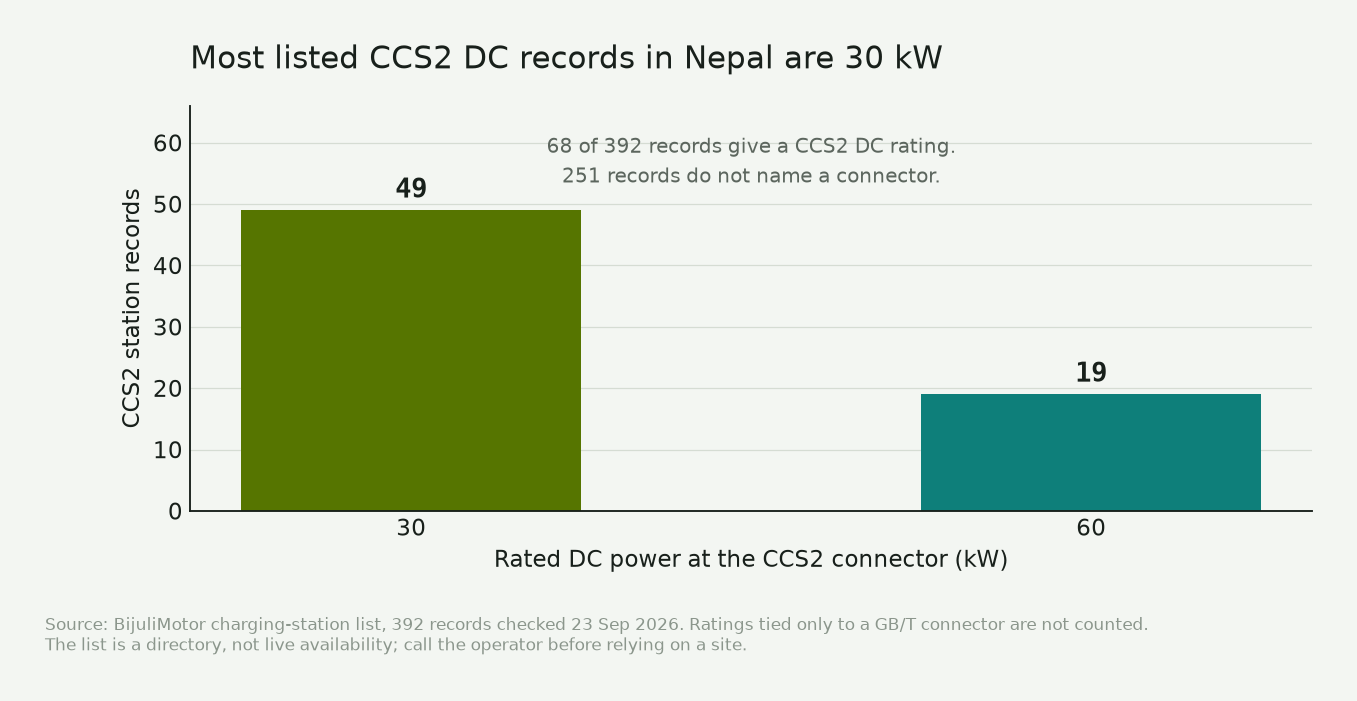
Public charging works as a fallback. It cannot replace a home circuit. BijuliMotor's charging-station list has 392 records checked on 23 September 2026. Of those, 68 records give a DC rating for a CCS2 connector: 49 records at 30 kW and 19 records at 60 kW. The rest include GB/T sites, AC sites and records that do not name a connector. The list is a directory and cannot show live availability, so call the operator before you rely on a site.
A 30.08 kWh BYD Atto 1 takes about 4.3 hours from empty at 7 kW (30.08 ÷ 7 = 4.3). At 3.3 kW it takes about 9.1 hours (30.08 ÷ 3.3 = 9.1). Both figures ignore charging losses and any taper at the end, and the car may accept less than the wallbox rating. The gap between 4.3 and 9.1 hours is the practical reason charger size matters.
An extension lead cannot do the job of a dedicated circuit. It does not change the approved load, it is easy to overload, and a coiled lead can get hot. If the wallbox is not ready, use a public charger or a properly installed portable charger on a dedicated circuit, not a household extension reel. The overnight charging guide has the timer routine for using off-peak hours once the circuit is in.
FAQ
How much does an NEA load upgrade cost?
The published NEA charges are Rs 10 for the printed Schedule 17 form at the counter and Rs 0 to increase meter capacity. Meter or CT/PT replacement, cable, the private circuit and any line work are extra. Ask the distribution centre for the meter estimate and the electrician for a separate quote.
How long does it take?
NEA's citizen charter sets 3 days for a meter capacity change and 5 days for low-voltage line extension, phase addition or transformer upgrade. The 30 A and three-phase cases depend on the installed transformer. Material availability and the private wiring can add time.
Can I just use an extension lead?
No. An extension lead does not increase the approved load, and a 7 kW charger draws about 30.4 A, which is more than a household lead is designed to carry. Use a dedicated circuit installed by a licensed electrician.
Do I need three-phase for a 7 kW charger?
No. A 7 kW charger draws about 30.4 A at 230 V single-phase. Three-phase becomes useful at 11 kW and above, but only if the car's onboard charger accepts three-phase. Check the car before you pay for a phase change.
Who applies, the owner or the tenant?
The account holder or property owner signs the Schedule 17 form. A tenant can prepare the load list and the quote, but needs the owner's signature or written authority. In an apartment, the management committee may also need to approve the cable route or the common-area connection.
Sources and checks
- NEA Electricity Distribution Regulations 2078, with amendments, PDF, checked 2 Nov 2026. Used for Regulations 3, 5, 7, 8, 11, 18, 19, 24 and 35, and Schedules 12, 17 and 32.
- NEA Citizen Charter, PDF, checked 2 Nov 2026. Used for the Schedule 17 document list, the Rs 10 form fee, the Rs 0 capacity-increase fee, the 3-day and 5-day service standards, and the 1.5% and 10% supervision/service charges.
- NEA consumer tariff schedule, PDF, checked 2 Nov 2026. Used for the application-form fee, the capacity-increase and decrease fees, and the meter-test fees.
- NEA consumer FAQ, checked 2 Nov 2026. Used for the 1150 hotline and the general new-connection document list.
- NEA contact list for distribution centres and Bagmati Provincial Office contacts, checked 2 Nov 2026. Used for the Kathmandu Valley phone numbers.
- BijuliMotor vehicle catalogue, record
byd-atto-1-standard-range-dynamic, 30.08 kWh battery. Used for the charging-time example. - BijuliMotor charging-station list, 392 records checked 23 Sep 2026. Used for the public-charging counts. The list is a directory of charging records. It cannot show whether a charger is free right now.