
Accessible EV charging in Nepal: what to ask first
Nepal's 392-record charging list has no access details. The 2013 disability directive sets parking and ramp dimensions. Use this checklist before you go.
Nepal's charging-station list has 392 records. Not one of them says whether the bay is step-free, how wide it is, whether the charger controls can be reached from a wheelchair, or whether a toilet is open. The list records plugs and power. It says nothing about access.
A charger can work and still be unusable: a raised kerb, a heavy cable or an unreadable payment screen can stop the trip. For a driver with a disability, an older passenger or someone recovering from an injury, those details decide whether the stop works.
BijuliMotor does not certify any station and has not surveyed these sites. It gives the Nepal rules that apply and the questions to ask.
What the list records
The charging directory is a directory. It cannot show live availability. It also has no access survey. These are the fields that matter before a trip:
| What the record shows | Kathmandu Valley (80 records) | All Nepal (392 records) |
|---|---|---|
| A phone number | 35 | 189 |
| An exact location flag | 49 | 163 |
| A named connector | 15 | 141 |
| Step-free access, bay width, toilet or staffed hours | 0 | 0 |
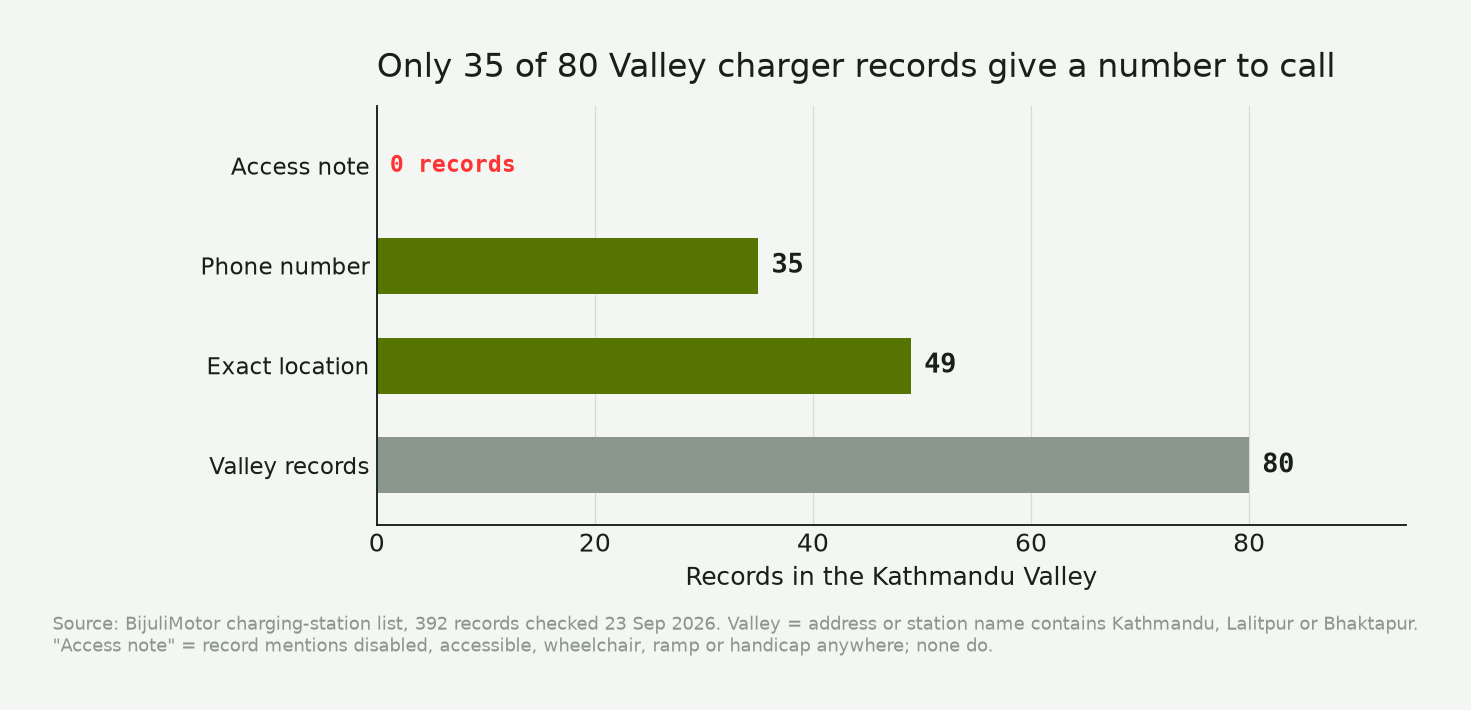
The Valley figure covers records whose address or station name mentions Kathmandu, Lalitpur or Bhaktapur. No record mentions disabled access, a wheelchair, a ramp or an accessible bay anywhere in its text.
Only 35 Valley entries include a phone number, and 31 have only an approximate pin. You may reach the street and still not know which bay the record meant. Ask for a landmark and a bay number as well as the station name.
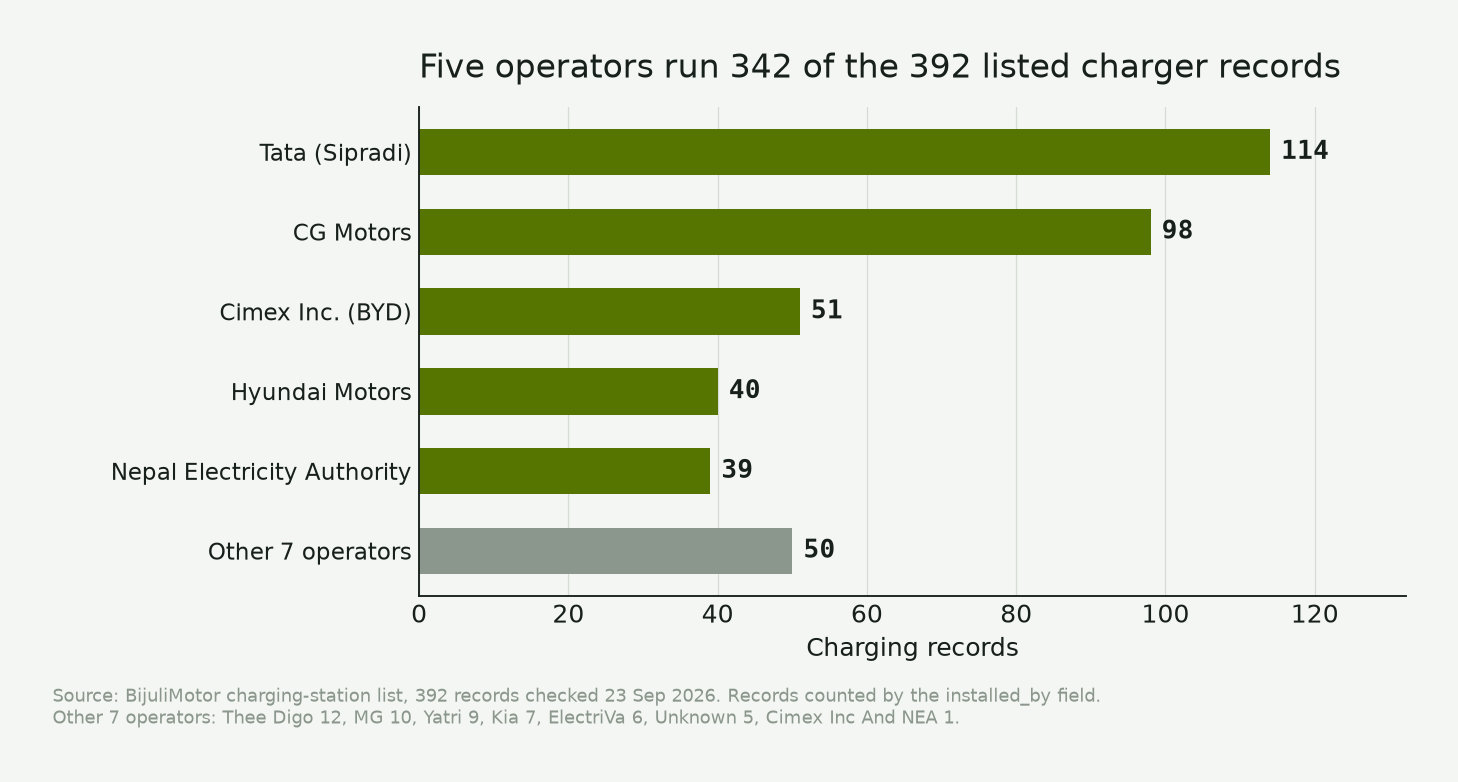
Five operators account for 342 of the 392 entries: 114 from Tata (Sipradi), 98 from CG Motors, 51 from Cimex (BYD), 40 from Hyundai Motors and 39 from the Nepal Electricity Authority. The other 50 entries are split across seven operators, including five entries with no operator named.
The Nepal rules that do apply
The closest legal standard is the Accessible Physical Structure and Communication Service Directive for People with Disabilities, 2013. Nepal's Cabinet approved it on 17 February 2013. The English text is hosted by the National Federation of the Disabled, Nepal (NFDN).
It sets minimum dimensions for parking, ramps, doors, corridors, toilets and sidewalks:
| Element | Requirement in the 2013 directive | What it means at a charging stop |
|---|---|---|
| Accessible parking spaces | At least 1 in every 10 parking lanes, marked with the international accessibility symbol | A site with 10 marked parking lanes needs one accessible space |
| Car parking bay | 96 in wide by 188 in long (2,438 by 4,775 mm) | About 2.4 m by 4.8 m |
| Space between vehicles | At least 60 in (1,524 mm) | Room to open a door and move a wheelchair between cars |
| Ramp | 1:15 for new buildings, 1:8 to 1:12 for retrofit; 915 mm wide; 9 m maximum run; 915 by 1,524 mm landing | A raised forecourt needs a ramp. A kerb will not do. |
| Door | 813 mm clear width; no more than 5 lb opening force; handle 1,067 to 1,219 mm high | A toilet or payment kiosk door |
| Corridor | 1,800 mm wide | Passing space inside a building |
| Toilet | 1,524 by 915 mm outside an outward-opening door; 813 by 1,295 mm inside; commode no higher than 483 mm | If a toilet is part of the stop |
| Sidewalk | 1,800 mm wide | The route from the road to the site |
The directive covers buildings, roads, bus parks and parking. It does not cover EV chargers. A charging bay is a parking space while the car is plugged in, so section 26 is the closest rule. Whether a private operator must apply it to an EV bay is not settled. Ask which standard they used.
The parking rule is less generous than EV-specific guidance from the United States. The US Access Board's Design Recommendations for Accessible Electric Vehicle Charging Stations, last updated on 17 July 2023, suggests a charging space at least 11 ft by 20 ft (3,353 by 6,096 mm) with a 5 ft (1,524 mm) access aisle. It also recommends operable parts between 15 and 48 in (381 and 1,219 mm) above the ground, with a clear floor space of 30 by 48 in (762 by 1,219 mm) and no more than 5 lb of force.
Those recommendations are for US sites. They are not Nepali law, but they cover the parts the 2013 directive leaves out: the charger, cable and payment screen.
Nepal is still writing its own charging-station rules. The National Transport Policy 2083, approved on 9 July 2026, told the Ministry of Physical Infrastructure and Transport to prepare national guidelines within a year. A Meroauto report on 4 August 2026 says they will cover location, capacity, technical standards and safety. It does not mention accessibility. BijuliMotor could not find published guidelines on 1 November 2026.
Where the rules stop: the car and the cable
Charging inlets sit in different places, so the same charger can need a different parking position for a rear, front or side inlet. None of the 206 vehicle records in the BijuliMotor catalogue gives the inlet position. Check your own car before you rely on a short cable.
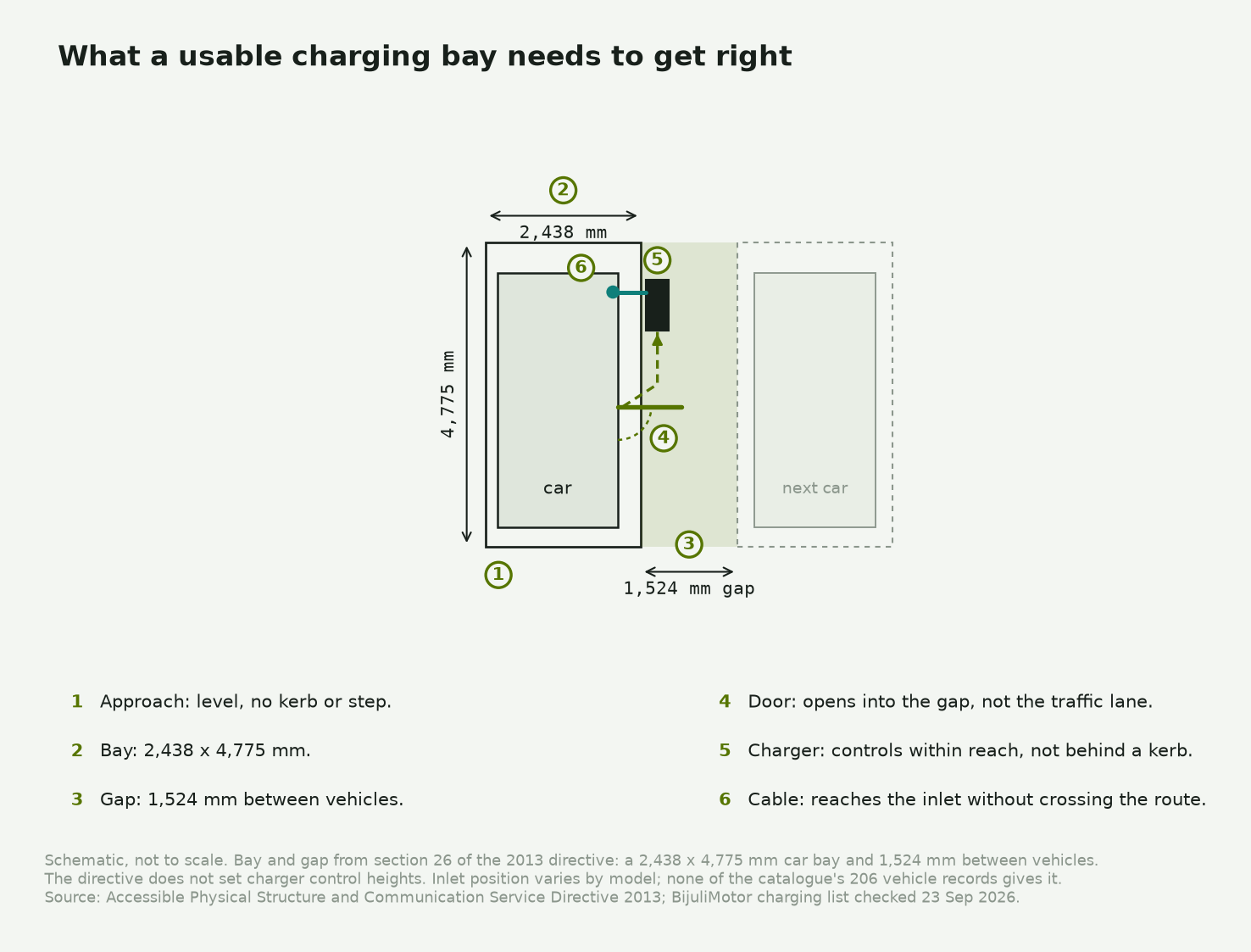
A short DC cable can decide more than the kW label. If the inlet is on the far side, you may have to reverse in, which can put the driver's door against a wall or the next car. Ask where the charger sits and whether the cable reaches both sides. The connector guide explains the plugs.
DC cables are thicker and heavier than AC cables. The US guidance says a connector should work without tight grasping, pinching or twisting. The 2013 directive has no cable rule. If you cannot lift it, ask whether staff can connect it and whether anyone is there.
The directive has no charger control height. The 30 in (762 mm) counter height in section 24 is for service counters. Ask the operator to measure the card reader and start button.
Payment and toilets are not recorded either. A site that takes cash at 2 pm may be app-only at 10 pm. The queues guide explains why a working charger can still have a line.
Three Kathmandu stops to call first
BijuliMotor has not visited these three Valley entries and does not recommend them. They come from different operators.
| Record | Listed equipment | Listed phone | What the list shows | First question |
|---|---|---|---|---|
| BYD Park, Naxal (Cimex) | 30 kW DC | 9801353743, 9761690277, 9745946309 | Exact location | Is the bay marked, and can a wheelchair user get from the driver's door to the charger without crossing the cable? |
| CG Motors, Naxal | 60 kW CCS2 | 9820105055 | Approximate location | Where exactly is the bay, and is the 60 kW CCS2 unit behind a kerb? |
| NEA, Matatirtha | 30 kW CCS2 | None in the record | Approximate location | Who manages the site, and is there a marked accessible bay? |
The NEA record has no phone number and only an approximate location, so the list cannot answer a single access question.
A phone checklist that produces useful answers
A generic "yes, accessible" may mean only that a car can enter the compound. Ask for the detail that changes your plan.
| Ask | A useful answer | Why it matters |
|---|---|---|
| Is there a marked accessible bay? | "Yes, bay 3, next to the charger, with the symbol" | A numbered bay is easier to find than "near the office" |
| How wide is the bay and the gap beside it? | At least 2,438 mm wide and 1,524 mm beside it | The 2013 parking dimensions; door swing and transfer need the gap |
| Is the charger on a kerb or step? | "No, it is level with the bay" | Even a low kerb can stop a wheelchair or a walker |
| Can you send a photo of the bay with a car charging? | A photo showing the door, cable and path | A photo of the cabinet alone hides the problem |
| How high are the controls and card reader? | A measured height, ideally 1,219 mm or lower (US guidance) | Reach from a seated position |
| How heavy is the cable, and is it on a retractor? | A weight, or "I do not know" | A heavy DC cable can decide the stop |
| Can I pay without the app? | "Yes, card or cash at the office" or "No" | App login, signal and screen-reader barriers |
| Is the toilet open during my charging time? | "Yes, until 8 pm" | A toilet label is not a guarantee |
| Who can help if the cable is stuck? | A name, number and hours | Staffed hours change |
Ask for the answer in writing if the trip depends on it.
A companion can make a trip easier, but the site should work without one. The Kathmandu charging guide covers city stops, and the public-charger check explains how to confirm a charger is working. Use the trip planner to line up an alternative stop.
For operators: the cheap fixes first
Start with the 2013 parking rule: mark one bay in ten, keep it clear, and put the charger on the access-aisle side rather than behind a kerb. A painted symbol and a bollard cost far less than a new charger.
Publish a photo of the bay with a car in it, the bay dimensions, control height, payment methods, staffed hours and a phone number. A phone number is the cheapest access feature: 203 of the 392 entries have none.
Train staff to answer the checklist. If the site is unstaffed overnight, say so. Advertised help that ends at 6 pm creates a planning problem.
For new sites, use the US dimensions and the 2013 directive with a local access audit. NFDN's Checklist for Accessibility Audit, produced with Kathmandu Metropolitan City in 2018, is a broader site audit. It is not a charger checklist.
Questions drivers ask
Are any EV charging stations in Nepal wheelchair accessible?
BijuliMotor cannot confirm one. The 392-record list has no field for step-free access, bay width, toilet or staffed help, and no record mentions those words. Ask the operator and check the bay.
What does Nepal law require for accessible parking?
The 2013 directive requires at least one accessible space in every 10 parking lanes, a car bay 96 in by 188 in (2,438 by 4,775 mm), and 60 in (1,524 mm) between vehicles. It does not mention EV chargers.
How wide is an accessible EV charging bay in Nepal?
There is no EV-specific bay width in Nepali law that BijuliMotor could find. The parking rule gives 2,438 mm by 4,775 mm. US guidance recommends 3,353 mm by 6,096 mm plus a 1,524 mm aisle, but that is not Nepali law.
Sources and checks
- Charging counts, phone numbers, location flags and operator totals: BijuliMotor charging-station list, 392 records checked 23 September 2026. The list is a directory. It cannot show live availability.
- Accessible parking, ramp, door, corridor, toilet and sidewalk dimensions: Accessible Physical Structure and Communication Service Directive for People with Disabilities, 2013, approved 17 February 2013. Sections 8, 18 to 21, 24, 26, 31 and 32.
- Broader site-audit checklist: NFDN, Checklist for Accessibility Audit, first edition December 2018.
- EV charging space, access aisle, control height and cable force recommendations: US Access Board, Design Recommendations for Accessible Electric Vehicle Charging Stations, last updated 17 July 2023. This is US guidance. It is not Nepali law.
- National Transport Policy 2083 approval date: Meroauto, "Government introduces National Transport Policy", 29 July 2026. Charging-guideline scope: Meroauto, "National guidelines to shape Nepal's EV charging network", 4 August 2026. The guidelines themselves could not be found on 1 November 2026.
- Vehicle records: BijuliMotor vehicle catalogue, 206 records, checked 1 November 2026. None records the charging-inlet position.