
Kathmandu to Pokhara by EV: route, chargers and costs
The Prithvi Highway run is about 201 km from Kalanki. See segment distances, directory charging stops, two worked plans and the energy cost.
The Prithvi Highway run from Kalanki to Pokhara is about 201 km, according to OpenStreetMap routing checked on 23 October 2026. At 20 kWh per 100 km it needs 40.1 kWh. A 50 kWh car that leaves at 90% and keeps a 20% reserve has 35 kWh to use, so it needs one stop. At 16 kWh per 100 km the same car needs 32.1 kWh and can cross without stopping, with about 18 km to spare. A 30 kWh car is better with two stops, at Malekhu and Damauli.
Kalanki is where the highway leaves the Valley. From Ratna Park it is another 8.1 km in the same routing. The tables below use Kalanki as zero so the segments add up. If you are leaving with a low battery, the Kathmandu charging guide covers the Valley sites.
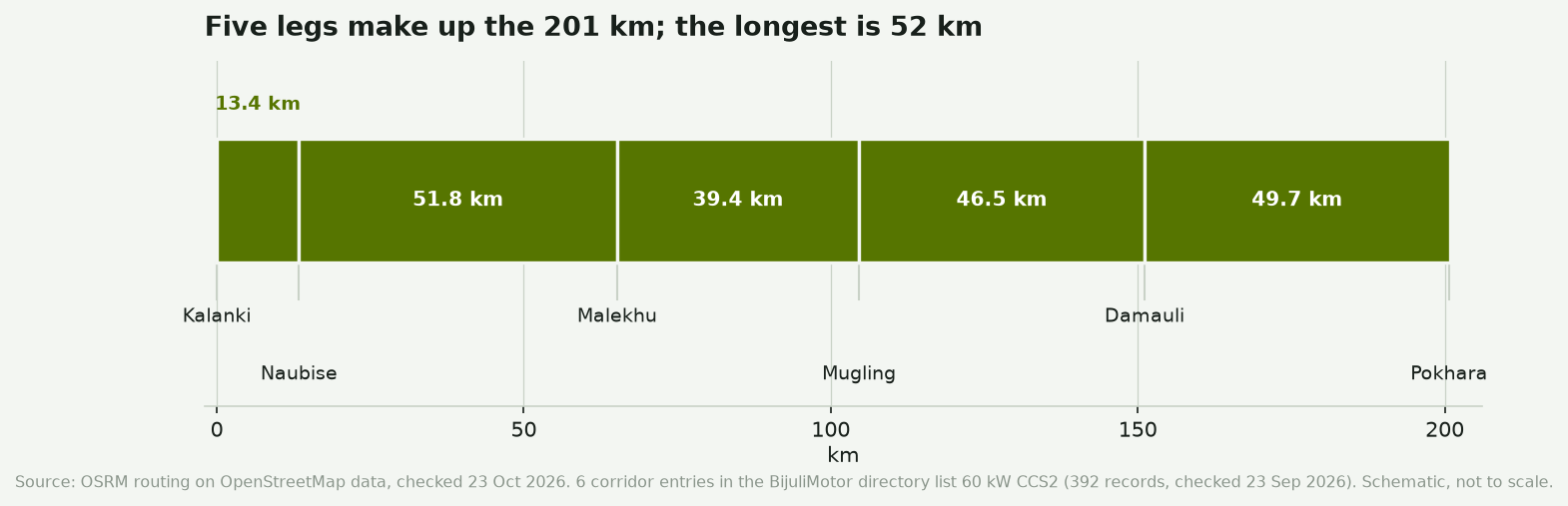
Five legs, 201 km
| Segment | Approx. km | Routing time |
|---|---|---|
| Kalanki to Naubise | 13.4 | 31 min |
| Naubise to Malekhu | 51.8 | 67 min |
| Malekhu to Mugling | 39.4 | 36 min |
| Mugling to Damauli | 46.5 | 40 min |
| Damauli to Pokhara | 49.7 | 40 min |
| Total | 200.7 | 3 h 34 |
The routing model assumes free flow. It does not know about a truck breakdown or a landslide. Treat the times as a lower bound. The distances are close enough for energy planning, though your odometer will read differently.
The longest leg is Naubise to Malekhu at 51.8 km. The Valley exit is the shortest at 13.4 km, but the model gives it 31 minutes, an average of 26 km/h. The Malekhu to Mugling leg runs at 66 km/h in the same model. Those averages describe the model. The road on the day can be slower.
Which cars can skip a stop
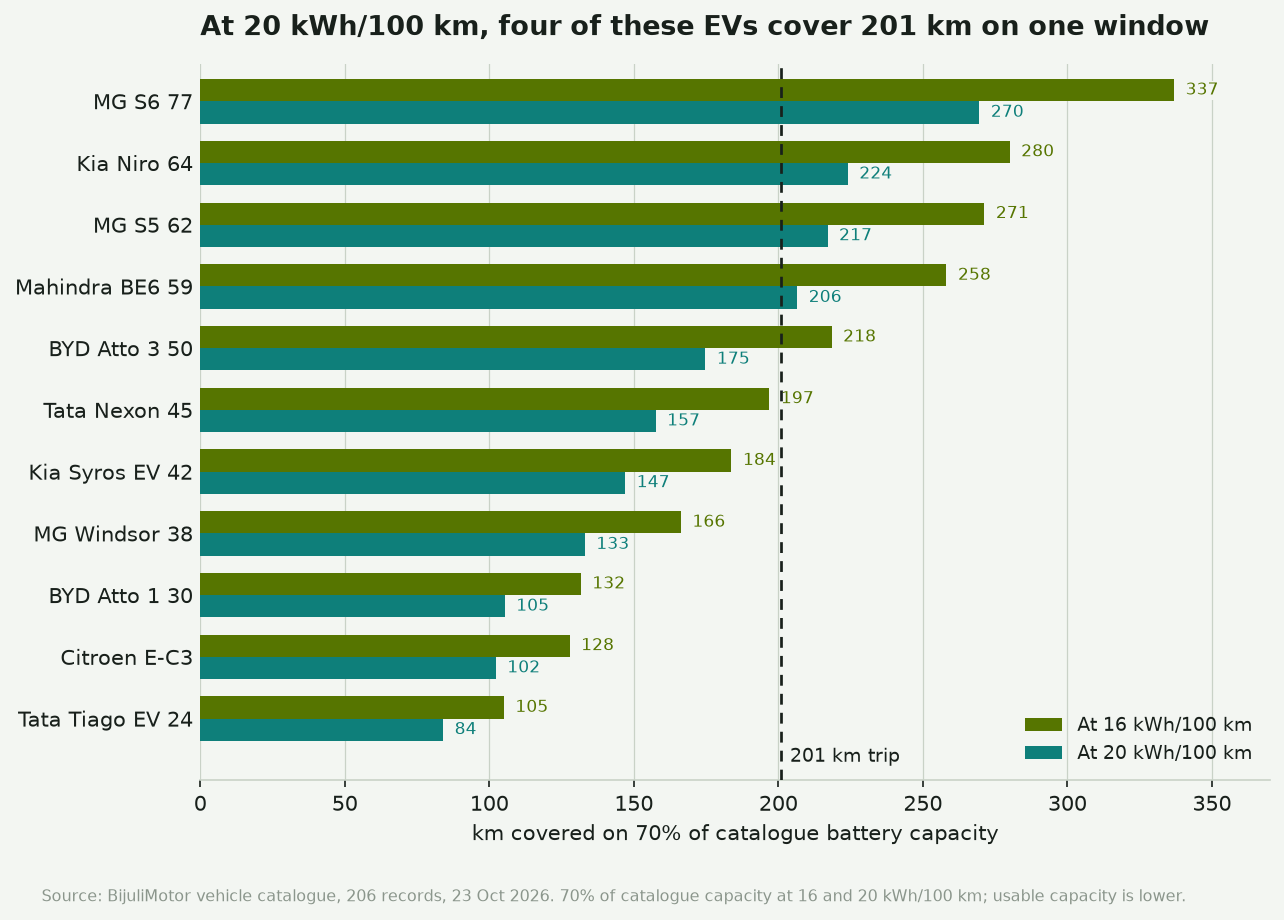
The comparison below uses 70% of the catalogue battery: 90% at departure minus a 20% reserve. It assumes 16 or 20 kWh per 100 km. Both consumption figures are assumptions. Neither was measured on this road. The battery column gives catalogue capacity, and usable capacity is lower. The car keeps a buffer, and an older battery holds less.
| Model | Catalogue battery | 70% window | Km at 16 kWh/100 km | Km at 20 kWh/100 km |
|---|---|---|---|---|
| Tata Tiago EV Pure +24 | 24 kWh | 16.8 kWh | 105 | 84 |
| Citroen E-C3 Live | 29.2 kWh | 20.4 kWh | 128 | 102 |
| BYD Atto 1 Dynamic | 30.08 kWh | 21.1 kWh | 132 | 105 |
| MG Windsor Excite | 38 kWh | 26.6 kWh | 166 | 133 |
| Kia Syros EV HTK | 42 kWh | 29.4 kWh | 184 | 147 |
| Tata Nexon Standard | 45 kWh | 31.5 kWh | 197 | 158 |
| BYD Atto 3 Advance | 49.92 kWh | 34.9 kWh | 218 | 175 |
| Mahindra BE6 Pack 1 | 59 kWh | 41.3 kWh | 258 | 206 |
| MG S5 Luxury (62 kWh) | 62 kWh | 43.4 kWh | 271 | 217 |
| Kia Niro Standard | 64 kWh | 44.8 kWh | 280 | 224 |
| MG S6 Standard | 77 kWh | 53.9 kWh | 337 | 270 |
Read the table against the gaps as well as the total. If you stop at Malekhu, the next leg to Pokhara is 136 km. If you stop at Kurintar, the first leg is 99 km and the second is 102 km. Damauli leaves 50 km to Pokhara but asks you to reach 151 km first.
A 30.08 kWh Atto 1 has 132 km at 16 kWh per 100 km. It can cover the 102 km from Kurintar to Pokhara, but not the 136 km from Malekhu to Pokhara. A 42 kWh Kia Syros has 147 km at 20 kWh per 100 km and can stop at Malekhu instead. The stop that suits you depends on where your window runs out. The car's brochure range tells you less.
At 20 kWh per 100 km, only the four largest batteries in this table cover the whole 201 km on one window. The 59 kWh BE6 clears it by 1.2 kWh, about 6 km, so wind or rain can turn it into a one-stop car. At 16 kWh per 100 km, the Atto 3 joins them. Use your own recent consumption if you have it. Why WLTP and ARAI range figures are not trip range explains the gap between the brochure and the road.
Charging stops in the directory
The BijuliMotor directory has 392 records, all checked on 23 September 2026. It is a directory. It cannot show live status. A record means someone listed the site. It does not confirm the unit is working, open to you or delivering its labelled power. Phone first. The charging map and this guide to checking a public charger explain what to ask.
Distances are approximate kilometres from the route table, with each site placed at its directory coordinates. A site inside town may add a kilometre or two. Phone numbers are as listed.
Valley exit and the first 80 km
| Stop (km from Kalanki) | Operator | Connector as listed | Power as listed | Phone |
|---|---|---|---|---|
| Himalayan Fresh Coffee, Naubise (13) | Tata (Sipradi) | not recorded | AC | not listed |
| Himalayan Coffee Point, Naubise (13) | Tata (Sipradi) | not recorded | AC | not listed |
| Yatri Burger House, Dharke (16) | Yatri | CCS2 / GB/T | 60 kW | not listed |
| CG Motors, Malekhu Rajdhani Hotel (65) | CG Motors | GB/T and CCS2 | 30 kW GB/T; 30 kW CCS2 | 9854040533 |
| ElectriVa, Benighat (75) | ElectriVa | CCS2 | 60 kW | 9851360847 |
| Yatri, Hills n Horizon Resort, Charaudi (78) | Yatri | CCS2 / GB/T | 60 kW | 010420029 |
The middle of the corridor
| Stop (km from Kalanki) | Operator | Connector as listed | Power as listed | Phone |
|---|---|---|---|---|
| Thee Digo, Darechowk, Kurintar (99) | Thee Digo | CCS2 / GB/T | 60 kW | 9801859655 |
| MG, Riverside Spring Resort, Kurintar (99) | MG | CCS2 | 30 kW | 9801801336 |
| Yak Brewing, Kurintar (99) | Cimex (BYD) | not recorded | 30 kW DC | 9801100993 |
| NEA, Kurintar (99) | NEA | not recorded | not recorded | not listed |
| NEA, Muglin (105) | NEA | not recorded | not recorded | not listed |
| Yatri, The Original Highway Restaurant, Damauli (151) | Yatri | CCS2 / GB/T | 60 kW | not listed |
| A-One Cafe, Damauli (151) | Cimex (BYD) | not recorded | 30 kW DC | 9816644275 |
Pokhara
| Stop (km from Kalanki) | Operator | Connector as listed | Power as listed | Phone |
|---|---|---|---|---|
| CG Motors, Pokhara (201) | CG Motors | GB/T and CCS2 | 30 kW GB/T; 30 kW CCS2; 60 kW CCS2 | 9856018789 |
| Sipradi, Buddha Chowk, Pokhara (201) | Tata (Sipradi) | not recorded | DC | not listed |
| Kia, Pokhara (201) | Kia | CCS2 | 30 kW | 061590232 |
| MG, Hotel Pauwa, Pokhara (201) | MG | CCS2 | 30 kW | 9857072513 |
| Waterfront Resort, Pokhara (201) | Cimex (BYD) | not recorded | DC | 9856033455 |
Two things in the table matter more than the headline power. A 60 kW label belongs to one connector: at CG Motors Pokhara the 60 kW unit is CCS2, while the GB/T unit is 30 kW. And "not recorded" is not the same as "no plug". It means the directory does not say. A site listed only as DC may still have the plug your car needs. The charging-plug guide explains the difference between CCS2, GB/T and the AC plugs.
The 60 kW CCS2 sites are Dharke, Benighat, Charaudi, Kurintar, Damauli and CG Motors in Pokhara. Using the listed coordinates, the longest gap between them is Dharke to Benighat, 59 km. If you plan to skip Dharke, leave with enough charge to cover 59 km and still keep your reserve. On the GB/T side, 60 kW is listed at Dharke, Charaudi, Kurintar and Damauli. Elsewhere the GB/T units are 30 kW.
Two worked plans
Both plans start at Kalanki with 90% and keep a 20% reserve. They assume the charger holds its listed power for the whole session, which it may not, and that you meet no queue. The "allow" time adds room for plugging in, payment and a short wait.
| Plan A: one stop | Plan B: two stops | |
|---|---|---|
| Car assumption | 50 kWh, 20 kWh/100 km | 30.08 kWh, 16 kWh/100 km |
| Energy at 90% | 45 kWh | 27.1 kWh |
| Stop 1 | Kurintar, 99 km | Malekhu, 65 km |
| Charge on arrival | 25.2 kWh (50%) | 16.7 kWh (55%) |
| Charge to | 80% (40 kWh) | 90% (27.1 kWh) |
| Energy added | 14.8 kWh | 10.4 kWh |
| Time at the charger | 15 min at 60 kW; allow 25 | 21 min at 30 kW; allow 30 |
| Stop 2 | none | Damauli, 151 km |
| Charge on arrival | - | 13.3 kWh (44%) |
| Charge to | - | 80% (24.1 kWh) |
| Energy added | - | 10.8 kWh |
| Time at the charger | - | 11 min at 60 kW; allow 20 |
| Arrive Pokhara | 19.7 kWh (39%) | 16.1 kWh (54%) |
| Energy bought | 14.8 kWh | 21.2 kWh |
| Cost at Rs 20/kWh | Rs 296 | Rs 423 |
| Driving time | 3 h 34 | 3 h 34 |
| With stops | about 4 h | about 4 h 25 |
Plan A is the quicker trip and the one most 50 kWh cars can copy. Plan B is for a small battery that stops at Malekhu: the 136 km from Malekhu to Pokhara is longer than its 132 km window, so it adds Damauli. Neither plan includes the 8.1 km from Ratna Park to Kalanki.
Every Rs 5 per kWh change in the public rate moves Plan A by Rs 74 and Plan B by Rs 106. A long queue can cost more time than a slower charger. The trip planner can run a first estimate with your own car and route. Check its answer against the consumption figures here.
Hotel charging in Pokhara
Six Pokhara hotels and resorts appear in the directory with a charger: Waterfront Resort, Pokhara Grande, Hotel Pauwa, Hotel Barahi, Dorje's Resort and Majeri Resort. Pauwa is the only one that records a connector, CCS2 at 30 kW. The others record no plug. Cimex's own station page, checked 23 October 2026, gives 60 kW DC at Waterfront and 30 kW at Pokhara Grande, but names no connector. None of the directory records says whether a non-guest can charge, what it costs or whether the bay is free overnight.
Ask five things before booking: the plug, the power, whether the charger is for guests only, the price, and whether you can leave the car connected after check-out. If the answers are vague, plan on a public site and treat the hotel charger as a bonus. The hotel charging guide has a longer list of questions.
Road status and the two detours
The Department of Roads publishes road notices and runs a road call centre on 9851416893, listed on its home page as a toll-free number (checked 23 October 2026). Its notice for a landslide at Krishna Bhir on the Prithvi Highway lists four ways into Kathmandu, including Tribhuvan Rajpath via Hetauda and the BP Highway via Bardibas. The notice is undated. Use it as a list of alternatives. It does not prove that the road is closed today.
| Route from Kalanki to Pokhara | Approx. km | Routing time |
|---|---|---|
| Prithvi Highway | 200.7 | 3 h 34 |
| Tribhuvan Rajpath via Hetauda | 313.5 | 5 h 04 |
| BP Highway via Bardibas | 531.4 | 6 h 56 |
These are OSRM routes through the named waypoints. The Department of Roads did not supply these distances. The BP Highway option is 531 km because it goes east to Bardibas before turning west. It is not a shortcut from Kathmandu to Pokhara.
Before a monsoon trip, check the Department of Roads notice page, the Department of Hydrology and Meteorology and BIPAD. The Krishna Bhir notice shows that one landslide can close the highway. The same rain can make the Hetauda detour slow. If you meet a flooded section, wait or turn back. A sealed battery is not a permit to cross water.
Carry the phone numbers on paper as well as in your phone. A charger in a weak-signal stretch is hard to call when you need to.
What the energy costs
| Consumption | Energy for 201 km | Public at Rs 20/kWh | Home at Rs 11/kWh |
|---|---|---|---|
| 16 kWh/100 km | 32.1 kWh | Rs 642 | Rs 353 |
| 20 kWh/100 km | 40.1 kWh | Rs 803 | Rs 442 |
| 24 kWh/100 km | 48.2 kWh | Rs 963 | Rs 530 |
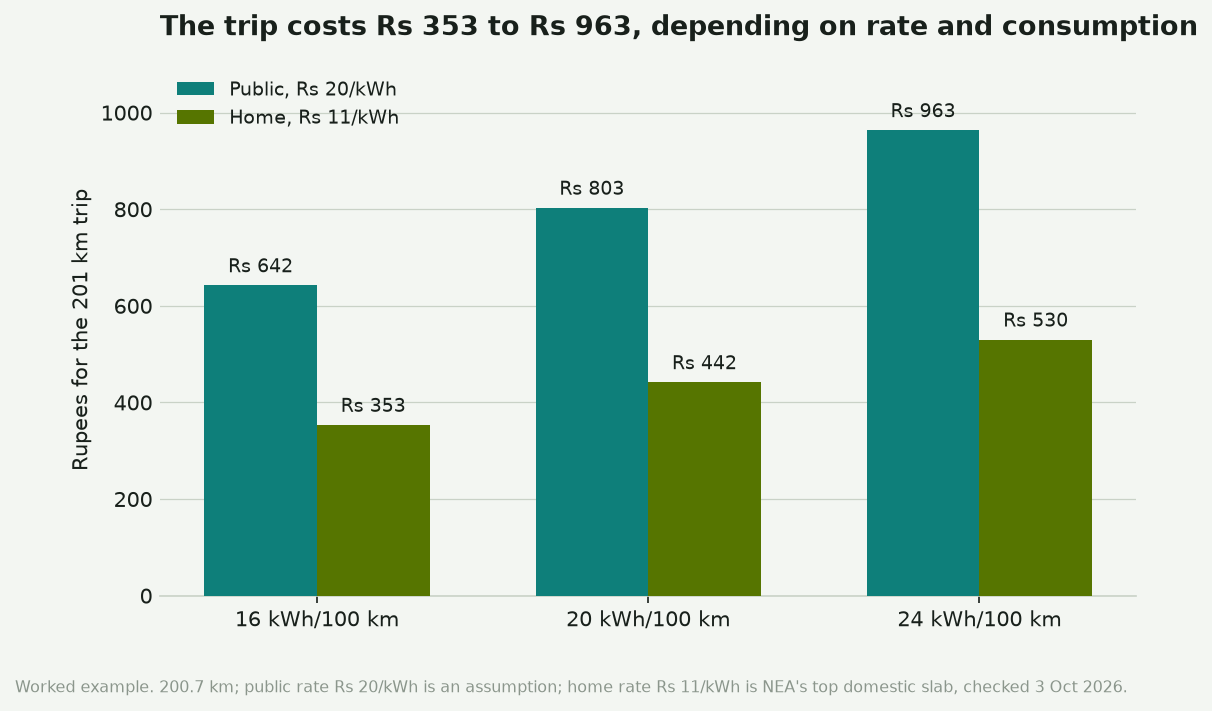
Assumption: Rs 20 per kWh at a public charger. Operators set their own price and may add parking, a session fee or a minimum charge, so the notice at the site beats this table. The home figure assumes Rs 11 per unit, the top slab in NEA's single-phase domestic tariff, as reproduced in BijuliMotor's home charging guide with the table checked on 3 October 2026. If your added units fall in a lower slab, your cost is lower.
The 16 kWh per 100 km trip costs Rs 353 at home and Rs 642 at a public charger. The difference is Rs 289: that is the premium for buying 32.1 kWh on the road instead of at home. The home units still cost Rs 353. These figures exclude a hotel charger, idle fees and the extra energy a detour uses.
FAQ
Can a BYD Atto 1 do Kathmandu to Pokhara?
Yes, with stops. The 30.08 kWh Dynamic has a 90% to 20% window of 21.1 kWh, or 132 km at 16 kWh per 100 km. The trip is 201 km. Stop at Malekhu (65 km) and Damauli (151 km), as in Plan B. At 20 kWh per 100 km its window is 105 km, so the same two stops still work but the margin is smaller.
Is one charging stop enough?
For a 50 kWh car at 20 kWh per 100 km, yes. Stop at Kurintar (99 km), charge to 80% and reach Pokhara with about 39%. A 62 kWh MG S5 has a 43.4 kWh window, enough for the whole trip at 20 kWh per 100 km but not at 24. A 30 kWh car needs care. At 20 kWh per 100 km it reaches Kurintar with about 24%, and an 80% charge there is not enough for the 102 km to Pokhara. Charge to 90%, which leaves roughly 4 km of margin, or use the two stops in Plan B.
Which charging stop is most reliable?
The directory does not record uptime, so no site can be called reliable from the data. Six corridor entries list 60 kW CCS2: Dharke, Benighat, Charaudi, Kurintar, Damauli and CG Motors in Pokhara. Call the operator on the day. A site with both CCS2 and GB/T gives you a second plug if the first is occupied.
Do I need a hotel booking to charge in Pokhara?
The directory does not say. It lists dealer sites at CG Motors, Sipradi and Kia, plus an NEA site at Malepatan, but none of the entries states its access rules. Hotel chargers may be for guests only. Ask before you book.
What if a charger is down?
Keep enough charge to reach the next listed site. The longest gap between listed 60 kW CCS2 sites is Dharke to Benighat at 59 km. From Kurintar, Damauli is 52 km and Pokhara is 102 km. If the Kurintar units are busy, Malekhu is 34 km behind you, which is why a little extra charge at the previous stop is worth more than arriving empty.
Sources and checks
- Distances and routing times: OSRM on OpenStreetMap data, checked 23 October 2026. The waypoints and each leg are recorded in
notes.md. - Charging records: BijuliMotor charging-station directory, 392 records all checked on 23 September 2026, available at /charging-stations. Power was counted against the connector named in each record. The highest number on the site was ignored.
- Cimex station API, checked 23 October 2026: https://cimex.com.np/api/client/charging-station. It gives 30 kW at Yak Brewing, A-One Cafe and Hotel Pokhara Grande, which matches the CSV. It gives 60 kW DC at Waterfront Resort, where the CSV records only DC. The table keeps the CSV text because the two sources disagree. Call the hotel to confirm.
- Department of Roads, https://dor.gov.np/ and its road notice https://dor.gov.np/uploads/ckfiles/files/Notice/road_Notice.pdf, checked 23 October 2026. The notice is undated and names Krishna Bhir. The call centre number and the toll-free label are from the home page.
- NEA domestic tariff: nea.org.np did not load from this connection on 23 October 2026. The slab table is taken from BijuliMotor's home charging guide, which cites the NEA consumer tariff PDF checked on 3 October 2026.
- Department of Hydrology and Meteorology, https://dhm.gov.np/, and BIPAD, https://bipad.gov.np/: both timed out on 23 October 2026. The links remain for readers to check directly.
- Vehicle capacities: BijuliMotor vehicle catalogue, 206 records. The battery figures are catalogue capacity. Usable capacity is lower.
Distances are routing estimates and will differ from your odometer. Charger details come from directory records. We did not check them live. Call before you rely on a site.