
Electric cars under Rs 30 lakh in Nepal: 17 listings
All 17 current passenger EV listings under Rs 30 lakh, with prices, battery sizes, range labels, charging limits and a worked first-year budget.
Seventeen current passenger electric cars are listed in Nepal at Rs 30 lakh or less. The cheapest is the Henrey Volts Model H at Rs 18,50,000; the dearest is the Tata Tiago EV Creative +24 at Rs 29,99,000. The count comes from the BijuliMotor catalogue, dealer-checked on 22 and 23 September 2026, and cross-checked against EV Nepal's live price list on 25 October 2026.
One car that once sat inside this budget is left out. The Proton e.MAS 5 Prime launched at Rs 29,99,000, but that was an introductory price for the first 100 buyers. Nepal Drives and Meroauto reported on 10 August 2026 that the offer had ended and the regular price is Rs 32,99,000. EV Nepal's live page showed the same Rs 32,99,000 on 25 and 28 October 2026, and the BijuliMotor catalogue was corrected to it on 28 October. That puts it above the ceiling, so it sits with the cars just above Rs 30 lakh and stays out of the 17.
The price in this article is the ex-showroom vehicle price. It does not include registration, insurance, road tax, charger installation or any dealer handling charge. Those costs decide whether a car near the top of the list fits a Rs 30 lakh cash budget.
How the list was built
The catalogue holds 206 vehicle records. Seventeen are current passenger variants with a price at or below Rs 30 lakh, and they form the tables below. The full catalogue has the records behind them.
Seven catalogue entries have no confirmed market status. They are listed separately, because an old price or a duplicate record is not a current listing.
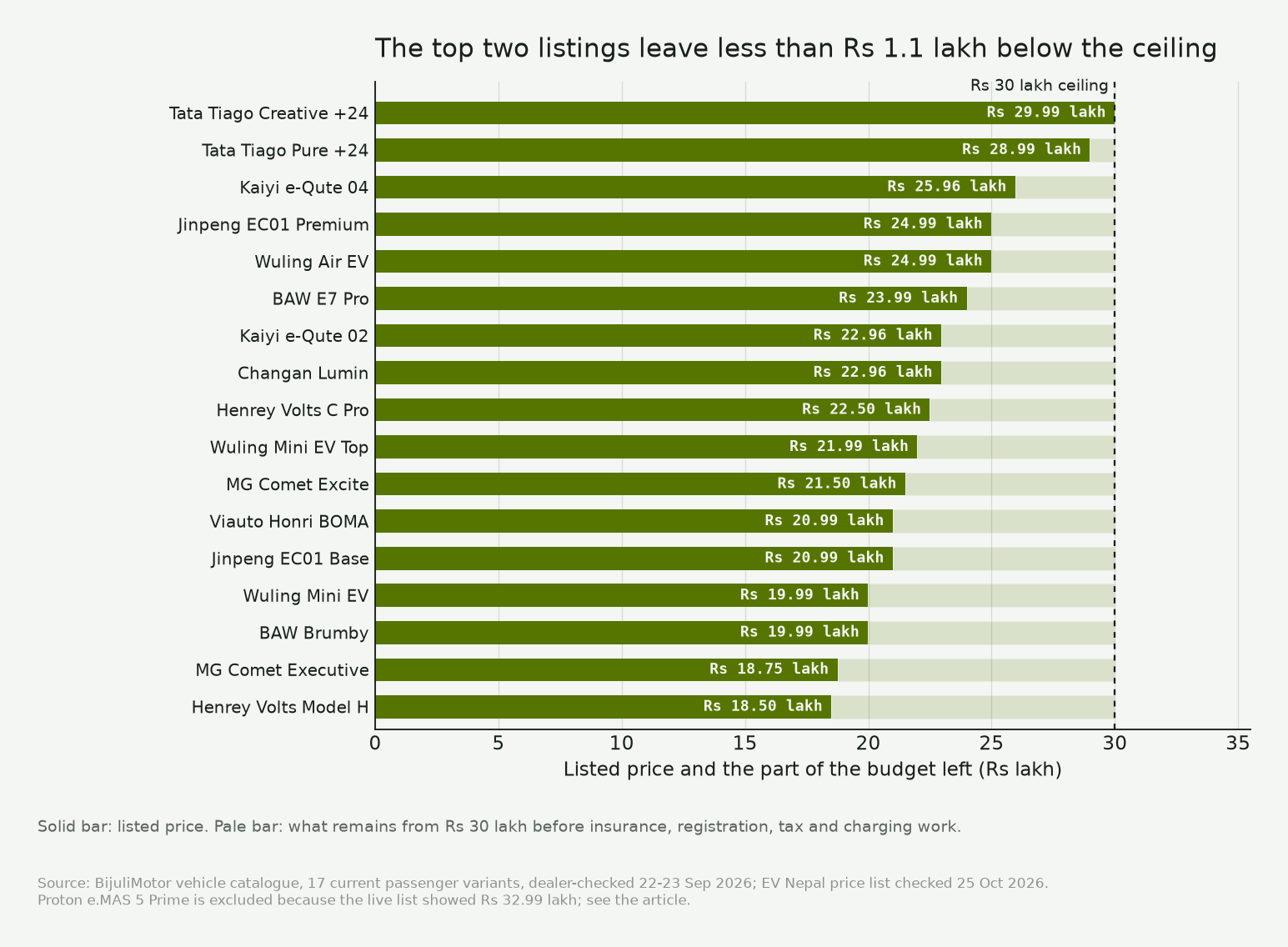
The bars show how much of the Rs 30 lakh ceiling each listed price uses. The pale section is what remains before insurance, tax and charging work.
Under Rs 20 lakh: four city cars
Four listings sit below Rs 20 lakh. All four are four-seat city cars with AC charging and modest power. The Wuling Mini EV Standard is the only one in this band with a stated DC fast-charge window, 30 to 80 percent in about 35 minutes. The other three list AC charging only.
| Model and trim | Price | Battery | Range | DC charging |
|---|---|---|---|---|
| Henrey Volts Model H | Rs 18,50,000 | 17 kWh | 200 km NEDC | None |
| MG Comet Executive | Rs 18,75,000 | 17.3 kWh | 230 km ARAI | None |
| BAW Brumby Standard | Rs 19,99,000 | 17.28 kWh | 205 km CLTC | None |
| Wuling Mini EV Standard | Rs 19,99,000 | 16.2 kWh | 201 km published | Yes, 30-80% in 35 min |
The Henrey is the cheapest way into the list, with a 17 kWh battery and a 200 km NEDC claim. The Comet's 230 km ARAI claim is a different test, so the two numbers are not a direct comparison.
Both Wuling Mini EV trims share the same 30 kW motor, and the Top's extra Rs 2 lakh buys a 25.1 kWh battery and a 301 km CLTC claim. That is a bigger battery for the money, but it is still a four-seat city car.
Rs 20 lakh to Rs 25 lakh: ten listings
Ten listings fill the Rs 20 lakh to Rs 25 lakh band. This is where battery size starts to separate cars that look similar. The Viauto Honri BOMA lists 29.9 kWh and a 300 km published range at Rs 20,99,000; the Jinpeng Lingbox EC01 Base lists 20.7 kWh and 240 km NEDC at the same price. Neither states a DC connector.
| Model and trim | Price | Battery | Range | DC charging |
|---|---|---|---|---|
| Jinpeng Lingbox EC01 Base | Rs 20,99,000 | 20.7 kWh | 240 km NEDC | Not stated |
| Viauto Honri BOMA Standard | Rs 20,99,000 | 29.9 kWh | 300 km published | Not stated |
| MG Comet Excite | Rs 21,50,000 | 17.3 kWh | 230 km ARAI | None |
| Wuling Mini EV Top | Rs 21,99,000 | 25.1 kWh | 301 km CLTC | Yes, 30-80% in 35 min |
| Henrey Volts Model C Pro | Rs 22,50,000 | 25 kWh | 300 km NEDC | Yes, 30 kW |
| Changan Lumin Standard | Rs 22,96,000 | 28.08 kWh | 301 km NEDC | Yes, 30-80% in 35 min |
| Kaiyi e-Qute 02 Standard | Rs 22,96,000 | 28.08 kWh | 300 km CLTC | Not stated |
| BAW E7 Pro Standard | Rs 23,99,000 | 22.29 kWh | 260 km CLTC | Yes, 10-80% in about 36 min |
| Wuling Air EV Standard Range | Rs 24,99,000 | 17.3 kWh | 200 km WLTP | None |
| Jinpeng Lingbox EC01 Premium | Rs 24,99,000 | 31.45 kWh | 340 km NEDC | Not stated |
The Henrey C Pro adds DC charging and a 25 kWh battery for Rs 22,50,000. The Changan Lumin at Rs 22,96,000 comes with DC charging and a 28.08 kWh battery. The Kaiyi e-Qute 02 uses the same 28.08 kWh battery and 300 km CLTC claim as the 04, but its page does not state DC charging. The BAW E7 Pro lists a 10 to 80 percent DC window of about 36 minutes.
The Wuling Air EV is the only car in this band with a WLTP range claim: 200 km from a 17.3 kWh battery. The Jinpeng EC01 Premium has the largest battery and the longest claim in the band, 31.45 kWh and 340 km NEDC, but it does not state a DC connector either.
Rs 25 lakh to Rs 30 lakh: three listings
Three listings sit above Rs 25 lakh. The Kaiyi e-Qute 04 has a confirmed five-seat cabin, and its 30 to 80 percent DC window is about 30 minutes. The two Tata Tiago trims are the most powerful cars in the list at 55 kW. They are also the only ones that name a CCS2 inlet.
| Model and trim | Price | Battery | Range | DC charging |
|---|---|---|---|---|
| Kaiyi e-Qute 04 Standard | Rs 25,96,000 | 28.08 kWh | 300 km CLTC | Yes, 30-80% in about 30 min |
| Tata Tiago EV Pure +24 | Rs 28,99,000 | 24 kWh | 205 km published | Yes, CCS2 30 kW |
| Tata Tiago EV Creative +24 | Rs 29,99,000 | 24 kWh | 205 km published | Yes, CCS2 30 kW |
Both Tiago EV trims use the same 24 kWh battery and 205 km figure, and the Creative +24 adds equipment for Rs 1,00,000 more. That is the smallest gap between two trims of the same model in the list, and it sits at the very top of the budget.
Prices and specifications: BijuliMotor catalogue, dealer-checked 22 and 23 September 2026; EV Nepal model pages and MG Nepal's Comet page, checked 25 October 2026.
Four current listings just above the ceiling
Four current listings sit just above Rs 30 lakh. The BYD Atto 1 Dynamic is the cheapest of them, at Rs 30,75,000. It has a 30.08 kWh battery, a 230 km WLTP claim and a 30 kW DC rating.
| Model and trim | Price | Battery | Range | Note |
|---|---|---|---|---|
| BYD Atto 1 Dynamic | Rs 30,75,000 | 30.08 kWh | 230 km WLTP | Five seats, 30 kW DC |
| Dongfeng Nammi Box E2 330 | Rs 30,99,000 | 31.4 kWh | 330 km CLTC | 330 km claim |
| Wuling Air EV Long Range | Rs 30,99,000 | 26.7 kWh | 300 km WLTP | Larger battery than the Standard Range |
| Leapmotor T03 | Rs 31,99,000 | 37.3 kWh | 265 km WLTP | 70 kW motor |
Prices and specifications: BijuliMotor catalogue and EV Nepal model pages, checked 25 October 2026.
The Proton e.MAS 5 Prime is the car most likely to be mistaken for an under-Rs-30-lakh option. Its Rs 29,99,000 was the introductory price that ended in August 2026. The regular price, now in the catalogue, is Rs 32,99,000, and EV Nepal's live page shows that figure with a 30 kWh battery and 225 km WLTP. Proton's Nepal site did not respond when checked.
The Atto 1 and Tiago comparison looks at the gap between those two. If these four are still too expensive, the guide to the next price band covers what more money buys.
Seven catalogue entries that are not current
None of the seven has a confirmed market status, so each one sits outside the 17 even when the listed price looks attractive. The table gives the reason each one is left out.
| Entry in the catalogue | Listed price | Why it is not in the 17 |
|---|---|---|
| Seres E1 Mid | Rs 16,49,000 | Market status unknown; no current dealer price confirmed |
| Henrey Mincar | Rs 19,95,000 | Market status unknown; the Henrey distributor appointment did not include it |
| Kaiyi e-Qute 02 | Rs 20,96,000 | Older 17.69 kWh record; the current 02 is the 28.08 kWh Standard at Rs 22,96,000 |
| Changan Lumin Standard Range | Rs 22,96,000 | Duplicate of the current Standard record at the same price |
| Tata Tiago EV XT | Rs 27,49,000 | Older 48 kW record; the current trims are Pure +24 and Creative +24 |
| BYD Atto 1 Standard Range Dynamic | Rs 28,95,000 | Older Dynamic record at Rs 28,95,000; the current Dynamic is Rs 30,75,000 |
| Tata Tigor EV XE | Rs 29,99,000 | Market status unknown; no current Nepal listing confirmed |
Source: BijuliMotor catalogue, market_status field, dealer-checked 22 and 23 September 2026.
Some of these are duplicates or older versions of current cars. Others have no current dealer price behind them. An unknown status means the catalogue could not confirm a current price. The car may still be available. If a showroom offers one, ask for the trim, battery size and build date, then compare it with the current listing.
Five range labels behind 17 numbers
The 17 range figures come from five labels: NEDC 5, CLTC 5, Published 4, ARAI 2, WLTP 1. The labels are not interchangeable. A 300 km NEDC claim and a 300 km WLTP claim describe different tests, and neither is a Kathmandu driving result.
NEDC and CLTC are lab cycles that tend to flatter a small car. ARAI is the Indian cycle. WLTP uses a longer, faster profile. Published means the catalogue has a kilometre figure but no test standard attached.
Two labels are disputed. EV Nepal labels the base Wuling Mini's range CLTC, while the catalogue records it as published. It calls the Henrey C Pro's 300 km CLTC, while the catalogue says NEDC. The table and chart use the catalogue labels, so the counts stay consistent.
Tata's Nepal page lists a 285 km ARAI claim and a 205 km city estimate. The catalogue records 205 km as a published figure, which is why the Tiago rows say published rather than ARAI.
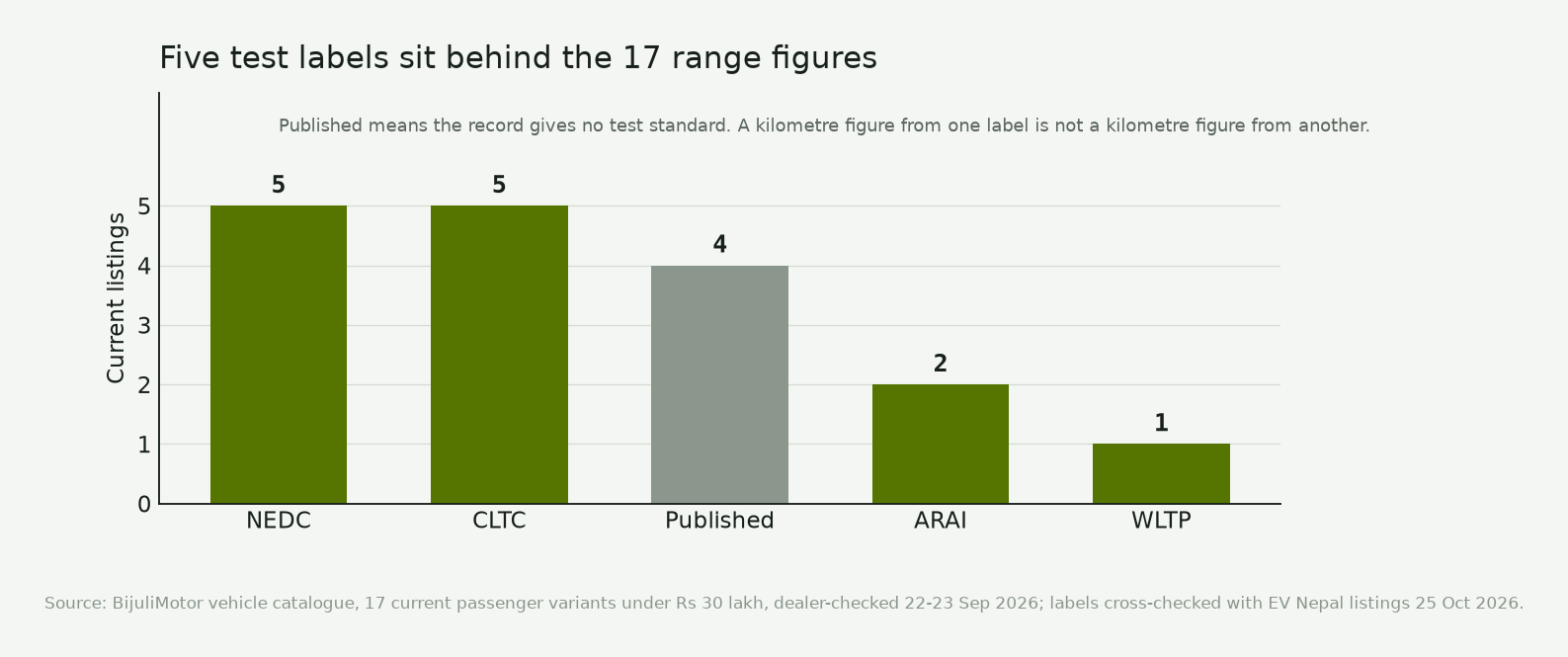
Treat the label as a warning about how the range figure was measured. It does not rank one car above another. The range-label guide explains the cycles.
What the charging table can tell you
The charging list has 392 records, checked on 23 September 2026. It is a directory built from records. It does not show what is happening at a station right now. 251 records do not name a connector, 73 name GB/T only and 68 name CCS2. Of the CCS2 records, 49 are rated 30 kW and 19 are rated 60 kW. 80 records are in the Kathmandu Valley.
Of the 17 cars, eight state a DC capability, five say AC only and four do not state either way. Only the two Tata listings name the connector, CCS2. A DC claim without a named connector is not enough for trip planning.
Ask the dealer to show the inlet on the car you will buy. A GB/T car and a CCS2 charger are not a match without an adapter that both sides support. Even then, the charger's cable and the car's limit decide the speed.
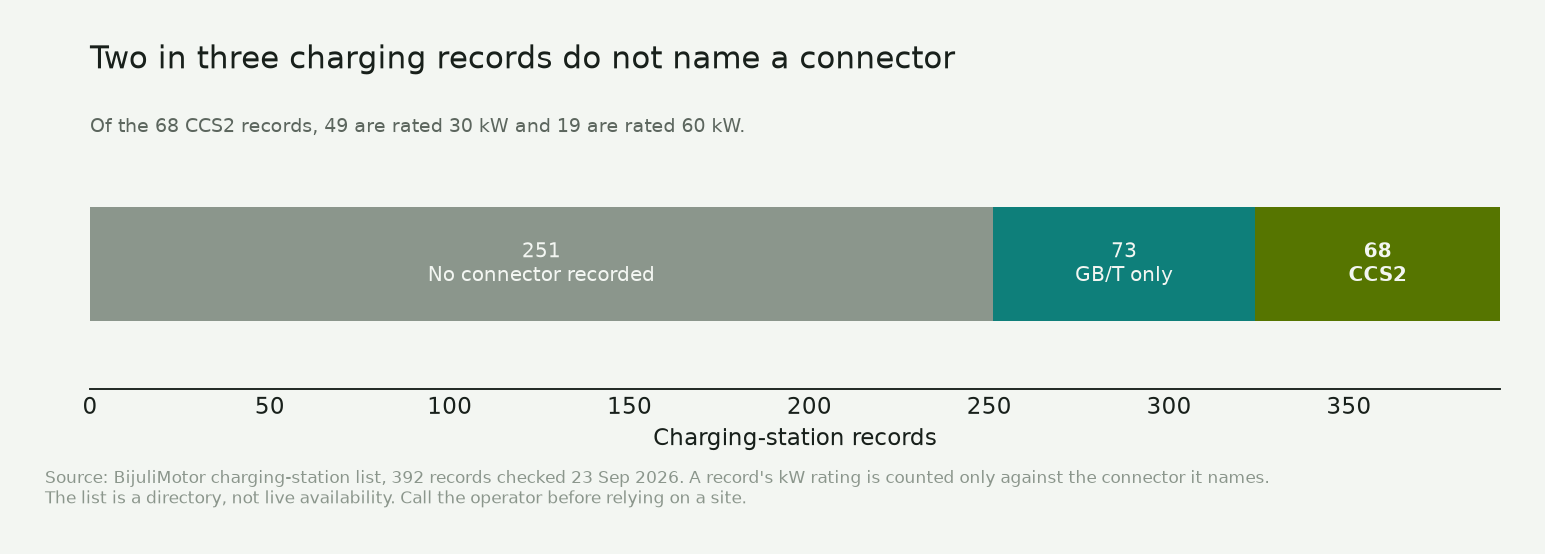
If your route depends on public charging, start with the charging-station list and call the operator. The list shows what was recorded on the day it was checked. Whether the unit works today is a separate question.
Warranty cover is not the same across brands
Warranty cover varies more than the price table suggests. The table collects what the Nepal distributor pages state. A blank cell means the source did not publish that figure. It does not mean the cover is zero.
| Brand and model | Vehicle warranty | Battery warranty | Distributor |
|---|---|---|---|
| MG Comet | 3 years or 1,00,000 km | 8 years or 1,20,000 km, first owner | GO Automobiles |
| Henrey Volts | Not stated | 5 years or 60,000 km, battery and motor | S. Cube Enterprises |
| Tata Tiago EV | 3 years or 1,25,000 km | 8 years or 1,60,000 km, battery and motor | Sipradi Trading |
| Wuling Air EV | Not stated | 8 years, no km limit stated | EV Nepal Motors |
| BAW Brumby | 6 years or 1,20,000 km | Component not stated | LRR Motors |
MG's battery cover is limited to the first owner. Tata's battery and motor cover runs for 8 years or 1,60,000 km. Henrey covers the battery and motor for 5 years or 60,000 km. The BAW Brumby's 6-year cover does not say which components it includes.
The 17 listings come from nine distributor names. MG's service page lists one centre, in Dhobighat, Lalitpur, checked on 25 October 2026. The pages checked did not list a complete workshop network for the other brands, so ask for the address that will handle your car.
Ask for the warranty document in writing, with the kilometre limit and the parts covered. The battery warranty guide explains why a taxi can reach the limit long before the years run out.
A first-year budget for two trims
Take the Comet Executive as a first example. Its 31.26 kW motor falls in the lower Bagmati road-tax band for FY 2083/84. The table adds the annual fees, an insurance example and one year of charging. It leaves out one-time registration and the charger installation.
| Cost item | Amount |
|---|---|
| Vehicle price | Rs 18,75,000 |
| Road tax, Bagmati FY 2083/84 | Rs 6,500 |
| Bluebook renewal | Rs 500 |
| Service charge | Rs 350 |
| Third-party insurance example | Rs 8,495 |
| First-year electricity | Rs 20,400 |
| Total | Rs 19,11,245 |
| Left from Rs 30 lakh | Rs 10,88,755 |
Those amounts are worked examples. A dealer quote may be higher or lower. The road tax and fees come from the site's bluebook calculator for Bagmati, FY 2083/84. The insurance figure is a third-party example from the same calculator. The electricity working uses NEA's single-phase 30 A domestic table, as reproduced in the home-charging guide.
Assumption: the car travels 1,000 km a month at 15 kWh per 100 km. That is 150 kWh a month. A household already at 200 units pays Rs 1,900; adding 150 units takes the bill to Rs 3,600. The extra 150 kWh cost Rs 1,700, or about Rs 11.33 each. Twelve months at that rate is Rs 20,400.
Registration is a separate one-time cost, and charger installation depends on wiring, earthing and the distance to the parking space. Neither is in the total.
The Tiago needs a separate calculation. Its 55 kW motor moves it to the Rs 15,000 road-tax band. With the same renewal, service, insurance and electricity examples, the Creative +24 total comes to Rs 30,43,745. That is Rs 43,745 over the ceiling. The Pure +24 total comes to Rs 29,43,745, leaving Rs 56,255.
Use the EMI calculator if you plan to borrow. A loan changes how the money leaves your account each month. The total price stays the same. Ask for a written quote with the vehicle, insurance, registration, tax and charger separated.
Which one fits your week
| If you need | Look at | Why |
|---|---|---|
| A low price for city use | Henrey Volts Model H, Rs 18,50,000 | Four seats, 200 km NEDC, AC charging only |
| Five seats and a short DC stop | Kaiyi e-Qute 04, Rs 25,96,000 | Five-seat cabin, 300 km CLTC, 30 to 80 percent in about 30 minutes |
| A CCS2 inlet and more power | Tata Tiago EV Pure +24, Rs 28,99,000 | 55 kW, CCS2 30 kW, 205 km city estimate |
| The longest catalogue range | Jinpeng Lingbox EC01 Premium, Rs 24,99,000 | 340 km NEDC from a 31.45 kWh battery, DC not stated |
None of these cars is a highway tourer. The Tiago has the most power and the only named CCS2 inlet, but its city estimate is 205 km. The micro-EV safety guide explains what to check before taking a small car on a long trip. Use Compare to put two of them side by side.
FAQ
What is the cheapest electric car under Rs 30 lakh in Nepal?
The Henrey Volts Model H is listed at Rs 18,50,000. It has a 17 kWh battery and a 200 km NEDC range claim.
Which one has the longest range?
The Jinpeng Lingbox EC01 Premium lists 340 km NEDC from a 31.45 kWh battery. That figure comes from a lab test cycle. Do not treat it as a road result.
Is the Proton e.MAS 5 Prime under Rs 30 lakh?
No. Its Rs 29,99,000 launch price was an introductory offer that ended in August 2026. The regular price is Rs 32,99,000, according to Nepal Drives and Meroauto, and EV Nepal showed the same figure on 28 October 2026. The catalogue now lists Rs 32,99,000, so this guide leaves it out.
Can I charge any of these at home?
Every listing has AC charging. The socket, circuit and earthing still need an electrician's check. The car's onboard charger sets the AC limit. A higher-rated wall unit does not raise it.
Sources and checks
- BijuliMotor vehicle catalogue, 206 records, dealer-checked 22 and 23 September 2026; Proton e.MAS 5 prices corrected 28 October 2026.
- BijuliMotor charging-station list, 392 records, checked 23 September 2026.
- EV Nepal price list, checked 25 October 2026.
- EV Nepal Henrey Volts page, Changan Lumin page, BAW E7 Pro page, Kaiyi e-Qute 04 page, Tata Tiago EV page, Wuling Mini EV page and Proton e.MAS 5 page, checked 25 October 2026.
- MG Nepal Comet page and Kaiyi Nepal lineup, checked 25 October 2026.
- Home EV charging guide, with NEA's single-phase 30 A tariff table, checked 25 October 2026.
- BijuliMotor bluebook calculator, Bagmati FY 2083/84, checked 25 October 2026.
- Proton e.MAS 5 price change: Nepal Drives and Meroauto, both 10 August 2026, checked 28 October 2026. Proton's Nepal site did not respond, so the price comes from press reports and EV Nepal rather than the distributor.