
Small EV safety in Nepal: family fit and highway limits
Compare seven small EVs sold in Nepal on seats, boot space, airbags, DC charging and the crash evidence that exists for each model.
The seven small EVs compared here run from Rs 18,75,000 for the MG Comet Pace to Rs 35,99,000 for the Citroën eC3 Shine. Most are fine as city cars for a small family. For regular highway trips, only some are suited, and the safety evidence is thinner than the showroom pitch suggests: of the seven, only the eC3 has a published crash-test result for the same model and airbag count sold here, and that result is zero stars for adult protection.
That gap matters more than the shape of the body. A small car can be the right size for a Kathmandu lane and still be the wrong choice for a monthly Pokhara trip or a child seat. The decision comes down to three checks: who fits, what the crash evidence covers, and whether the charging stops work on the road you actually drive. The crash evidence below was checked on 25 October 2026.
Seven cars in one price band
Prices below are ex-showroom and come from BijuliMotor's vehicle records, checked 25 October 2026. The table uses the cheapest variant of each model because that is where most buyers start. The range column names the maker's own test cycle where one is published, since ARAI, WLTP, CLTC and MIDC numbers are not interchangeable. The seven form a comparison set. Other models are on sale outside it. Two cheaper catalogue entries are not ranked: the Henrey Volts Model H at Rs 18,50,000, which lists four seats and one airbag, and the Seres E1 at Rs 16,49,000, whose specification page is gone. A reader who shortlists either should start with the airbag count.
| Model and cheapest variant | Price | Seats | Battery | Published range | DC charge | Airbags |
|---|---|---|---|---|---|---|
| MG Comet Pace | Rs 18,75,000 | 4 | 17.3 kWh | 230 km ARAI | Not listed; Type 2 AC only, 3.3 or 7.4 kW | 2 |
| Wuling Mini EV Standard | Rs 19,99,000 | 4 | 16.2 kWh | 201 km (published) | Not published; 30-80% in 35 min | 2 |
| Kaiyi e-Qute 02 | Rs 22,96,000 | 4 | 28.08 kWh | 300 km CLTC | Not published | 2 |
| Kaiyi e-Qute 04 | Rs 25,96,000 | 5 | 28.08 kWh | 300 km CLTC | Not published; 30-80% in 0.5 h | 2 |
| Tata Tiago EV XT | Rs 27,49,000 | 5 | 24 kWh | 205 km (no cycle stated) | 30 kW | 2 |
| BYD Atto 1 Dynamic | Rs 30,75,000 | 5 | 30.08 kWh | 230 km WLTP | 30 kW | 4 |
| Citroën eC3 Live | Rs 34,99,000 | 5 | 29.2 kWh | 320 km MIDC | Not published; 10-80% in 57 min | 2 |
Three variants outside the table matter for highway use. The e-Qute 02 also comes with a 17.69 kWh battery for Rs 20,96,000 and a 200 km CLTC claim. The Wuling Top costs Rs 21,99,000 and claims 301 km CLTC. The Atto 1 Premium costs Rs 34,80,000, has a 38.88 kWh battery and a 300 km WLTP claim. If a highway trip is part of the plan, those larger-battery versions matter.
Only three of the seven publish a boot volume on a page we could check: the Tiago EV at 240 L, the Wuling Mini EV at 170 L and the eC3 at 315 L. BYD's Nepal brochure does not list one for the Atto 1. MG and Kaiyi do not publish one for the Comet or either e-Qute. The e-Qute 02's four-seat layout comes from the Nepal specification listing; Kaiyi's own brochure does not state a seat count for that model. Tata's specification page lists the boot and the 5.1 m turning radius but no range figure, so the Tiago's 205 km comes from our catalogue and the test cycle is not stated.
Crash evidence, model by model
The table lists the results we could match to these models. "None located" means a search of Global NCAP's India results, Euro NCAP's results and Bharat NCAP's rating list on 25 October 2026 returned nothing for that model.
| Model | Result located | Tested car | What it covers |
|---|---|---|---|
| MG Comet | None | None | No result for the Comet in the three databases checked. |
| Wuling Mini EV | None | None | No result for the Mini EV. |
| Kaiyi e-Qute 02 | None | None | No result for the e-Qute. |
| Kaiyi e-Qute 04 | None | None | No result for the e-Qute. |
| Tata Tiago EV | 4 stars adult, 4 stars child, Global NCAP 2021 | Tigor EV sedan, 2 airbags | The Tigor EV is a different body from the Tiago EV hatch. A 2020 petrol Tigor/Tiago test (4 stars adult, 3 stars child) also exists, but the tested car was a sedan. |
| BYD Atto 1 | 5 stars, Euro NCAP 2025 | Dolphin Surf, left-hand drive, 1,390 kg | The European version of the Atto 1. Nepal's Dynamic has a 1,225 kg kerb weight, so the result tells you about the design. It does not certify this exact car. |
| Citroën eC3 | 0 stars adult, 1 star child, Global NCAP 2024 | ë-C3, India-built, 2 airbags | The closest match here: same model and airbag count. Confirm the Nepal import is the tested build. |
Read the tested car column before the stars. Global NCAP's 2020 test called the model Tigor/Tiago, but the car it bought was the Tigor sedan. The 2021 test was the Tigor EV, also a sedan. Neither is the Tiago EV hatchback that Tata sells in Nepal. The hatch shares a platform and a name with the tested cars. Its body has not been tested.
The Citroën result is the one to read carefully, because it is the only one for the same model and airbag count sold here. Global NCAP tested the India-built ë-C3 with two airbags. It found poor protection for the front passenger's chest and weak protection for the driver's chest. Side head protection was absent even as an option, ESC was not offered, not every seating position had a three-point belt, and there was no passenger airbag cutoff switch. The child score was one star, and the heads of both child dummies hit the interior.
BYD's five stars come with a weight caveat. Euro NCAP tested the Dolphin Surf in September 2025 and recorded a 1,390 kg kerb weight. The Nepal Atto 1 Dynamic is 1,225 kg and the Premium is 1,280 kg. That 110 to 165 kg gap is enough to make the result indirect, even though the body and the name are shared. Treat it as evidence about the structure and restraint design. It does not rate the exact car in the showroom.
For the Comet, Wuling Mini EV and both e-Qute models, no result was located. That is not the same as a failed test. It means a buyer cannot use a star rating to compare them, and a dealer who claims one should be asked for the test page.
Family fit starts at the rear door
Rear access decides more family purchases than the seat count. The Comet and e-Qute 02 have two side doors, so reaching a child seat in the back means folding a front seat. The e-Qute 04, Tiago EV, Atto 1 and eC3 have four side doors. The Wuling's Nepal listing describes four doors, which makes its rear bench easier to use than the Comet's.
| Model | Side doors | Boot with all seats up | ISOFIX |
|---|---|---|---|
| MG Comet | 2 | Not published | Yes |
| Wuling Mini EV | 4 | 170 L | Yes |
| Kaiyi e-Qute 02 | 2 | Not published | Yes |
| Kaiyi e-Qute 04 | 4 | Not published | Yes |
| Tata Tiago EV | 4 | 240 L | Yes |
| BYD Atto 1 | 4 | Not published | Yes |
| Citroën eC3 | 4 | 315 L | Not stated |
Boot volume with all seats up is published for three cars. The eC3's 315 L is the largest of those, the Tiago's 240 L is the middle and the Wuling's 170 L is small for four people's luggage. For the other four, take a cabin bag and the folded pushchair to the showroom. A litre figure also hides the shape of the opening and the height of the load lip.
ISOFIX is listed on six of the seven. Citroën's reviewed specification does not state it, which is another thing to check on the actual car. Fit your own child seat before you discuss price. Check the buckle, the top tether and the space left for the front passenger. A seat that fits in the showroom may still be hard to use every morning. Our child-seat guide covers the fitting checks in more detail.
Payload is the other family limit. BYD publishes both kerb and gross weight for the Atto 1: 1,225 kg and 1,635 kg for the Dynamic, and 1,280 kg and 1,690 kg for the Premium. That leaves 410 kg for people and luggage in both. The other makers did not publish a gross weight on the pages we checked, so compare their payload figures in the showroom.
Highway reality: range, plugs and time
Published range is a test result. Treat it as a starting point and plan the trip yourself. Our trip planner starts from 80% of the published figure, then treats 80% as the charge target at a stop. Against the 210 km planning example in our Kathmandu to Pokhara guide, four of the seven cheapest variants fall short before any charging: the Comet and Atto 1 at 184 km, the Tiago at 164 km and the Wuling at 161 km. The two Kaiyi models reach 240 km and the eC3 reaches 256 km. The 210 km figure is an assumption for the energy calculation. It is not a surveyed road distance.
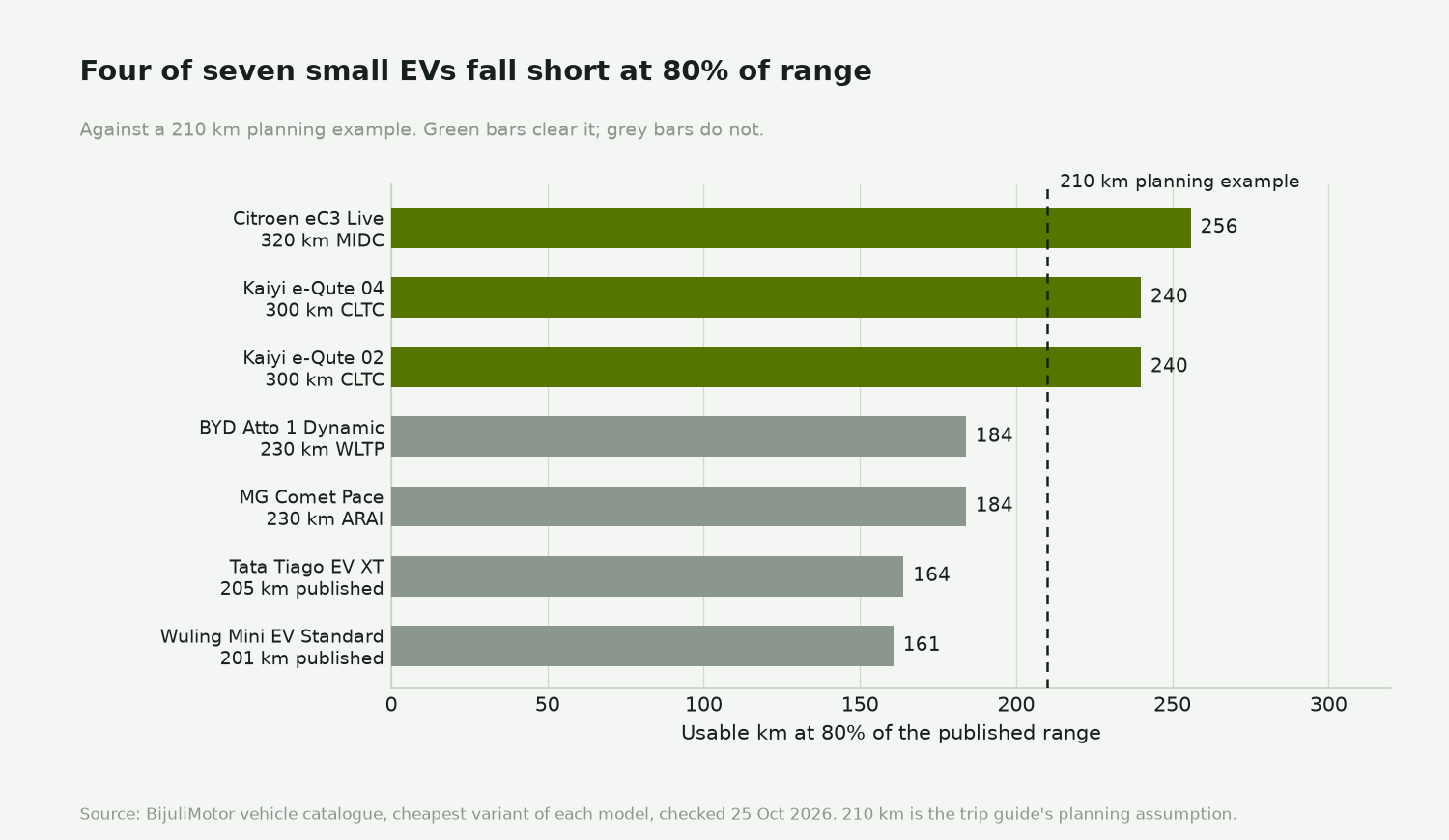
Those figures are planning numbers. They do not come from road tests. They use four named test cycles, and none includes a climb, a headwind, rain or a full load. A car rated at 210 km on paper can still need a stop with four adults and luggage.
A car that falls short can still make the trip with a planned DC stop. MG's Nepal material does not list DC charging for the Comet. The brochure lists a Type 2 AC connection, with 3.3 kW on the base cars and 7.4 kW on the FC variants. No DC rating appears on the Nepal page or in the brochure. A 210 km trip in a Comet becomes a long meal stop. It will not be a 35-minute top-up.
Where a maker publishes a 30-80% time but not a kW rating, the time still tells you something. The e-Qute 04's 30-80% in 0.5 h works out to about 28 kW average on a 28.08 kWh battery. The eC3's 10-80% in 57 minutes works out to about 22 kW average on 29.2 kWh. Those are averages over the session. They are not peak ratings. A car that averages 22 kW will spend more time at a 60 kW site than the site's label suggests.
The network has more 30 kW CCS2 records than 60 kW ones. Of 392 records in the charging list, 68 name a CCS2 connector. Forty-nine of those are listed at 30 kW and 19 at 60 kW. Nine records list a single rating for both a CCS2 and a GB/T connector, so the split is not perfectly clean.
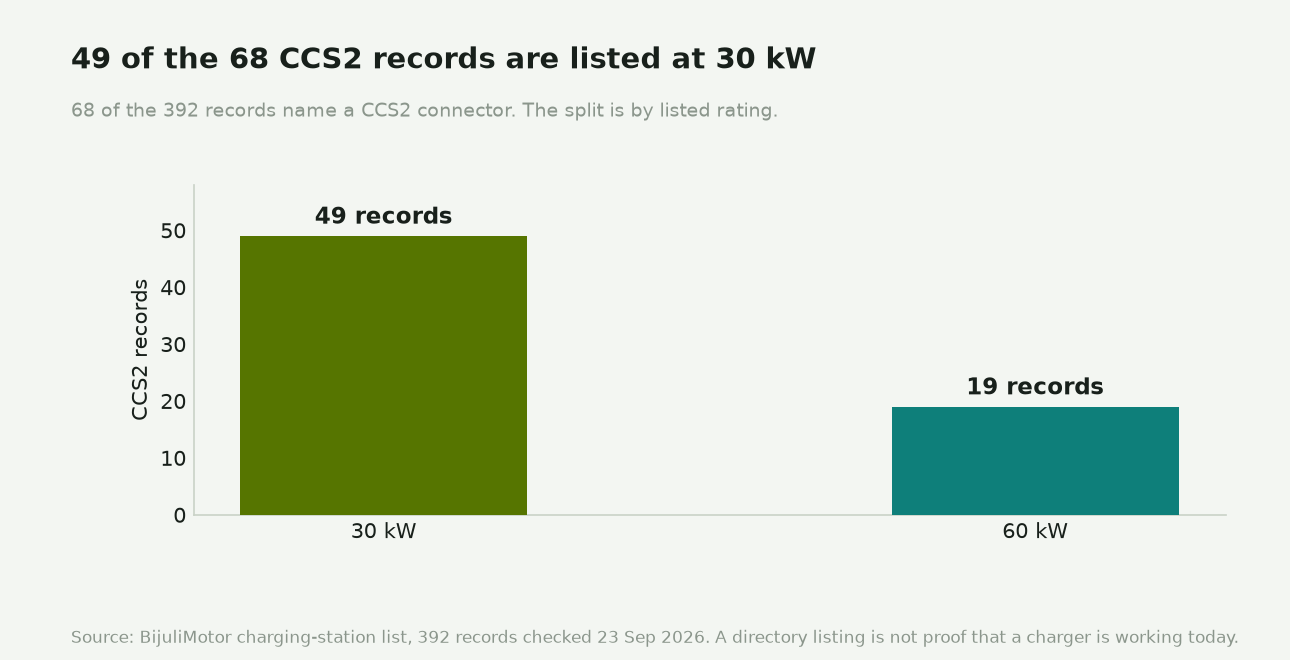
The list is a directory. It cannot show live status. It was checked on 23 September 2026. A site can be closed, occupied or broken when you arrive. Call the operator and identify a second site before you leave. The trip planner can help with the distance and the stops, but it cannot confirm that a charger is working. The charging map shows the candidates.
One more connector check belongs in the showroom. The Kaiyi brochures and the Wuling listing do not name a DC connector type. Ask the dealer to show you the inlet on the car you will buy, then compare it with the sites on your route. A GB/T car can use a dual-connector site. It cannot use a CCS2-only site.
City only, or occasional highway?
The verdict below is about the cheapest variant in each row. A better version of the model may score differently. A larger battery can move a car up a category.
| Model | Verdict | Reason |
|---|---|---|
| MG Comet | City only | No DC rating, 100 km/h top speed, two side doors, 4 seats. |
| Wuling Mini EV | City first | 4 seats and 170 L; DC time published but no kW rating; 201 km Standard. |
| Kaiyi e-Qute 02 | City only | Two side doors, 4 seats, no DC rating published. |
| Kaiyi e-Qute 04 | Occasional highway | 5 seats, ESC, 300 km CLTC, 30-80% in 0.5 h. |
| Tata Tiago EV | Occasional highway | 5 seats, 240 L, 30 kW DC, 205 km; plan one stop. |
| BYD Atto 1 | Occasional highway | 5 seats, ESC, 30 kW DC on Dynamic; the Premium's 300 km clears the example. |
| Citroën eC3 | Occasional highway, safety caveat | 320 km and 315 L, but the 0-star adult result is the weakest crash evidence here. |
Two cars are city-only in practice. The Comet's size and price make sense in a tight lane, but its charging and top speed do not suit a regular highway trip. The e-Qute 02 is also a two-door city car, and Kaiyi does not publish a DC rating for it.
The Wuling sits between the groups. Its Standard battery gives 161 km at our 80% allowance, so a 210 km trip needs a DC stop. The Top's 301 km CLTC claim gives 241 km at the same allowance. The missing kW rating makes the stop time harder to plan.
The Tiago EV and Atto 1 are the practical occasional-highway choices in the middle of the price band. Both have five seats, four side doors and a 30 kW DC rating. The Tiago's 205 km claim gives 164 km at 80%, so it needs a stop on the 210 km example. The Atto 1 Dynamic gives 184 km, also a stop. The Atto 1 Premium, at Rs 34,80,000, gives 240 km and clears the example. For a direct comparison of those two, see our Atto 1 and Tiago EV guide.
The eC3 has the longest range in the group and the largest boot of the three that publish one. It also has the weakest crash result. A buyer who values the range and space has to decide whether the safety evidence is acceptable. The compare tool puts the variants side by side.
Two family cases
Two adults, one child, city during the week and Pokhara once a month. The Atto 1 Premium is the easiest recommendation on paper: five seats, four side doors, ESC, six airbags, a 38.88 kWh battery and a 40 kW DC rating. At 80% of its 300 km WLTP figure it has 240 km, so the 210 km example needs no charging stop. It costs Rs 34,80,000. The Tiago EV Creative +24 is Rs 4,81,000 cheaper, has five seats and a 240 L boot, but its 30 kW DC rating means a stop. If the monthly trip is the deciding use, the Atto 1 Premium is the cleaner fit. If the car is mostly a city car and the Pokhara trip is optional, the Tiago saves money and the stop is manageable.
Four adults, city only. The Wuling Mini EV is the more usable four-seat city car: four side doors, a 170 L boot, two airbags, ESC and ISOFIX in the Nepal listing, and a 201 km Standard range. It costs Rs 19,99,000. The Comet is Rs 1,24,000 cheaper and turns in a 4.2 m circle, but two side doors and no DC rating make it harder to live with for four adults. If the car rarely carries more than two people, the Comet's price and size still make sense.
A test route for the jobs you will repeat
Use a route you already know. Include Ring Road traffic, a hill, a basement ramp and a broken patch of road. Ask the dealer to let you start with the car loaded, or bring two adults for the rear seat. On the hill, stop and restart; check whether the car holds or rolls back. On the ramp, approach slowly and at an angle; listen for a scrape. In traffic, check the mirrors and the rear window, because a small car's blind spots are different from a sedan's.
Fit the child seat before you leave the showroom. Put the folded pushchair in the boot. Plug your phone into the charger the car will use. These are the jobs the car will do every week, and they are easier to judge in a showroom than on a spec sheet. Our test-drive route guide and parking-ramp guide list the checks in order.
The used alternative
A new small EV at Rs 30 lakh is not the only way to buy five seats and a longer range. A used larger EV may be an alternative at a similar budget, but the battery health report and the warranty terms decide whether it is a good buy. Ask for a diagnostic report rather than the dashboard's state-of-health number, and check whether the battery warranty transfers to you. Our used-battery guide explains what a 94% reading does and does not prove.
Questions buyers ask
Is the MG Comet safe on the highway?
It is the least suited to highway trips in this group. MG lists a 100 km/h top speed and a Type 2 AC connection, with no DC rating. Its 230 km ARAI range gives 184 km at our 80% allowance, so a 210 km trip needs a long AC stop. Use it as a city car.
Are Chinese micro EVs crash-tested?
Some are. Euro NCAP gave the BYD Dolphin Surf, the European version of the Atto 1, five stars in 2025. No result was located for the MG Comet, Wuling Mini EV or Kaiyi e-Qute in the three databases checked. The star rating belongs to the tested car. It says nothing about the country that built it.
Can I fit a child seat in a small EV?
ISOFIX is listed on the Comet, Wuling, both e-Qute models, Tiago EV and Atto 1. Citroën's reviewed specification does not state it. Fit your own seat in the showroom and check the buckle, the top tether and the space left for the front passenger.
Is four seats enough for a family?
For two adults and one child, usually. For four adults, the rear bench and boot decide it. The Wuling's 170 L boot is small for four people's luggage. The Comet's boot is not published, so measure it with your own bags.
What about hills?
Motor power matters less than load and gradient on a hill. Test a loaded car on a slope, check hill-hold and ESC, and use regenerative braking on the descent. The Atto 1 and e-Qute 04 list ESC. The eC3's tested specification does not have it.
Sources and checks
All pages were checked on 25 October 2026 unless a different date is given. Prices and battery/range figures come from BijuliMotor's vehicle records. The links below cover equipment, seat counts and crash results.
- MG Comet: Nepal model page and brochure.
- BYD Atto 1: Cimex model page and Cimex specification API.
- Tata Tiago EV: Tata specification page.
- Kaiyi e-Qute: Kaiyi Nepal and the e-Qute 02 and 04 specification sheets linked there.
- Wuling Mini EV and Citroën eC3 specifications: Wuling listing and Citroën listing.
- Cheaper city EVs: Henrey Volts listing for seats and airbags; Seres E1 price from BijuliMotor's records, and its specification page returned 404 on 25 October 2026.
- Crash results: Global NCAP results, Euro NCAP Dolphin Surf and Bharat NCAP ratings.
- Charging: BijuliMotor charging-station list, 392 records checked 23 September 2026; highway range guide.
- Trip distance assumption: Kathmandu to Pokhara EV guide.