
EVs under Rs 40 lakh in Nepal: what extra money buys
All 22 current variants between Rs 30 and 40 lakh, grouped by body type, with battery, range label, DC charging, boot space and price per kWh.
Twenty-two current EV variants in Nepal are listed above Rs 30 lakh and at or below Rs 40 lakh. They run from the Rs 30,75,000 BYD Atto 1 Dynamic to the Rs 38,99,000 Hozon Neta V V50, and 13 of them cost less than Rs 35 lakh. Body size, battery size and charging speed do not rise together, so range alone does not settle the choice.
The tables below cover every current passenger variant in the BijuliMotor catalogue in that price range. Another 17 current variants sit at Rs 30 lakh or below; the under-Rs-30 guide covers those. Older records no longer marked current are left out, and so is the Foton TM1, a cargo vehicle. The current Nexon EV is the 45 kWh model at Rs 42,49,000, above this ceiling.
The prices given are the listed vehicle prices, so they leave out on-road costs. Catalogue checks ran from 22 September to 3 October 2026, and live model pages were checked again on 25 October 2026. Where a live page gives a different price or specification, the conflict is stated.
The full list, grouped by body type
Hatchbacks
Thirteen hatchbacks sit in the band. The Air EV and T03 are four-seat city cars; the Atto 1, Nammi Box, Binguo and eC3 are five-door, five-seat cars except the Binguo, whose Nepal page does not state a seat count. The Arcfox T1 and Proton e.MAS 5 are larger, with 459 and 375 litre boots.
| Model and trim | Listed price | Battery | Claimed range | DC peak | Boot | Rs lakh/kWh |
|---|---|---|---|---|---|---|
| BYD Atto 1 Dynamic | Rs 30,75,000 | 30.08 kWh | 230 km WLTP | 30 kW | 230 L | 1.02 |
| Dongfeng Nammi Box E2 330 | Rs 30,99,000 | 31.4 kWh | 330 km CLTC | Not stated | 326 L | 0.99 |
| Wuling Air EV Long Range | Rs 30,99,000 | 26.7 kWh | 300 km WLTP | Not stated | Not stated | 1.16 |
| Leapmotor T03 Standard | Rs 31,99,000 | 37.3 kWh | 265 km WLTP | 48 kW | 210 L | 0.86 |
| Wuling Binguo Standard | Rs 31,99,000 | 31.9 kWh | 330 km WLTP | Not stated | Not stated | 1.00 |
| Arcfox T1 LV2 | Rs 32,96,000 | 42.4 kWh | 310 km WLTP | Not stated | 459 L | 0.78 |
| Dongfeng Nammi Box E2 430 | Rs 32,99,000 | 42.3 kWh | 430 km CLTC | Not stated | 326 L | 0.78 |
| Proton e.MAS 5 Prime | Rs 32,99,000 | 30 kWh | 225 km WLTP | 53 kW | 375 L | 1.10 |
| BYD Atto 1 Premium | Rs 34,80,000 | 38.88 kWh | 300 km WLTP | 40 kW | 230 L | 0.90 |
| Citroen eC3 Live | Rs 34,99,000 | 29.2 kWh | 320 km MIDC | Not stated | 315 L | 1.20 |
| Arcfox T1 LV3 | Rs 35,96,000 | 42.4 kWh | 310 km WLTP | Not stated | 459 L | 0.85 |
| Citroen eC3 Shine | Rs 35,99,000 | 29.2 kWh | 320 km MIDC | Not stated | 315 L | 1.23 |
| Proton e.MAS 5 Premium | Rs 36,99,000 | 40 kWh | 325 km WLTP | 71 kW | 375 L | 0.92 |
The Arcfox T1 LV2 is the value outlier. It has 42.4 kWh, a 310 km WLTP claim, a 459 litre boot and a Rs 32,96,000 price. The LV3 costs Rs 3,00,000 more for the same battery, range and boot, so that money is for equipment.
The Nammi Box E2 430 has the same price per kWh as the Arcfox, Rs 0.78 lakh, but different trade-offs. Its 430 km figure is CLTC. EV Nepal gives 237 km WLTP for the E2 330 and 317 km for the E2 430, so the badge is not a WLTP number. Its 49.5 kW motor is the weakest in the band apart from the Air EV and eC3.
The eC3 sits at the other end. Its 29.2 kWh battery is the smallest on a five-seat car in the band, and its price per kWh is the highest. The Shine costs Rs 1,00,000 more than the Live for the same battery and range. EV Nepal lists a 0-star Global NCAP result from 2024 and two airbags, which matters more than the equipment difference.
The Atto 1 Premium is the cleanest battery upgrade in the group. It costs Rs 4,05,000 more than the Dynamic, adds 8.8 kWh and 70 km WLTP, and raises the DC peak from 30 to 40 kW. Boot and motor stay the same, so all of that extra money goes on range alone.
The e.MAS 5 Premium costs Rs 4,00,000 more than the Prime. It adds 10 kWh, 100 km WLTP, a 85 kW motor against 58 kW and a 71 kW DC peak against 53 kW. The boot is the same 375 litres.
Compact SUVs and crossovers
Eight variants across five models. The Punch EV accounts for three and the Chery Q for two; the others are the Kia Syros, Dongfeng Nammi Vigo and Hozon Neta V.
| Model and trim | Listed price | Battery | Claimed range | DC peak | Boot | Rs lakh/kWh |
|---|---|---|---|---|---|---|
| Tata Punch EV Smart +32 | Rs 33,98,933 | 32 kWh | 250 km C75 | 65 kW | 366 L | 1.06 |
| Chery Q Comfort | Rs 34,49,000 | 41.2 kWh | 400 km NEDC | Not stated | 375 L | 0.84 |
| Chery Q Premium | Rs 35,99,000 | 41.2 kWh | 400 km NEDC | Not stated | 375 L | 0.87 |
| Tata Punch EV Empowered 40 | Rs 36,99,000 | 40 kWh | 325 km published | 65 kW | 366 L | 0.92 |
| Kia Syros EV HTK | Rs 37,90,000 | 42 kWh | 443 km ARAI | 100 kW | 390 L | 0.90 |
| Tata Punch EV Empowered +S 40 | Rs 37,99,000 | 40 kWh | 325 km published | 65 kW | 366 L | 0.95 |
| Dongfeng Nammi Vigo E2 | Rs 37,99,000 | 44.94 kWh | 300 km WLTP | 60 kW | 500 L | 0.85 |
| Hozon Neta V V50 | Rs 38,99,000 | 40.7 kWh | 380 km NEDC | Not stated | 335 L | 0.96 |
The Punch EV is the only car here with a five-star Bharat NCAP result. It has 195 mm clearance, a 366 litre boot and a 65 kW DC peak. The Empowered 40 at Rs 36,99,000 is the one to compare. The +S adds Rs 1,00,000 for equipment with no mechanical change; the Smart +32 saves Rs 3,00,067 but drops to 32 kWh and a 250 km C75 claim.
The Chery Q Comfort is the value alternative. For Rs 50,067 more than the Punch Smart it has 9.2 kWh more battery, a 90 kW motor and a 375 litre boot. Its 400 km is NEDC, and its DC peak is not stated, only a 30-80% time of about 16.5 minutes. The Premium adds Rs 1,50,000 for equipment, including driver assistance, with no change to battery or motor.
The Kia Syros has the highest ARAI number, 443 km, and a 100 kW DC peak. It has a 390 litre boot, 197 mm clearance and a lifetime battery warranty for the first user, but its Nepal page lists no crash-test result. The network caps it: the fastest CCS2 site in the list is 60 kW.
The Vigo E2 is the space and battery pick. It has the largest battery in the band, a 500 litre boot and a 300 km WLTP claim. Its DC peak is 60 kW and its Nepal page does not publish a warranty.
The Neta V V50 is the dearest car in the table. At Rs 38,99,000 it has 0.7 kWh more battery than the Punch Empowered 40, but a 50 kW motor against 95 kW, a 335 litre boot against 366, 170 mm clearance against 195, and a 0-star ASEAN NCAP result from 2024. Its eight-year or 1,50,000 km battery and motor warranty is competitive, but the rest does not match the price.
The MPV-style option
The MG Windsor Commute is the only car in the band packaged like a small MPV. Its 604 litre boot is 104 litres larger than the Vigo's and 238 litres larger than the Punch's. It has a 38 kWh battery, a 332 km WLTP claim, a 100 kW motor and 186 mm of clearance.
| Model and trim | Listed price | Battery | Claimed range | DC peak | Boot | Rs lakh/kWh |
|---|---|---|---|---|---|---|
| MG Windsor Commute | Rs 34,99,000 | 38 kWh | 332 km WLTP | 45 kW | 604 L | 0.92 |
At Rs 34,99,000 it is the cheapest way to get this much space. The DC peak is the weakness: EV Nepal lists 45 kW, while MG's own Nepal page lists 50 kW and a 331 km ARAI range for the Excite, a different trim. Confirm the Commute figure with the dealer.
Three prices that need a second check
The Vigo E2 needed a correction. The catalogue record for the Rs 37,99,000 E2 carries the E2+ figures, 51.87 kWh and 350 km. EV Nepal's Vigo variant table gives the E2 44.94 kWh and 300 km WLTP, and puts the E2+ at Rs 43,99,000. Dongfeng's own Nepal page lists the same two prices. The table uses the E2 because it is inside the ceiling.
The Proton e.MAS 5 prices needed a correction. The catalogue had Rs 29,99,000 for the Prime and Rs 34,99,000 for the Premium. Nepal Drives and Meroauto reported on 10 August 2026 that these were Jagdamba Motors' introductory prices for the first 100 buyers, that the offer had ended, and that the regular prices are Rs 32,99,000 and Rs 36,99,000. EV Nepal lists the same figures. The catalogue was corrected to the regular prices on 28 October 2026, which brings the Prime into this band. Proton's 3 August 2026 launch statement gave different introductory figures, Rs 35 lakh for the Prime and Rs 40 lakh for the Premium. The tables use the regular prices, which put price per kWh at Rs 1.10 lakh for the Prime and Rs 0.92 lakh for the Premium. Ask Jagdamba Motors for a dated quotation.
The MG Windsor Excite is just outside the table. The catalogue has Rs 41,49,000 and EV Nepal lists Rs 39,75,000. If the lower price is current it becomes a 23rd variant, and only Rs 25,000 is left before insurance, registration and charging. That is not enough room for a real budget.
What Rs 6.24 lakh buys
The step from the Atto 1 Dynamic to the Punch Empowered 40 is the clearest example of what extra money buys in this band. The gap is Rs 6,24,000, or about 20% of the Atto's price. For that you get 9.92 kWh more battery, 50 kW more motor, 35 kW more DC peak, 136 litres more boot and 20 mm more clearance. You also get a five-star crash rating instead of no rating on the Atto's Nepal page.
The range comparison is less clean. The Atto's 230 km is WLTP. The Punch's 325 km is a published figure that EV Nepal describes as a real-world estimate, and the same page also lists 468 km on the MIDC cycle for the 40 kWh car. Those numbers come from different tests, so subtracting them would be false precision. The range-label guide explains the difference.
The top of the band is not automatically better
A higher price does not settle the choice.
| Step up from Punch Empowered 40 | Extra price | What changes |
|---|---|---|
| Kia Syros EV HTK | Rs 91,000 | 2 kWh more battery, 100 kW DC peak, 390 L boot, lifetime first-user battery cover |
| Dongfeng Nammi Vigo E2 | Rs 1,00,000 | 4.94 kWh more battery, 500 L boot, 60 kW DC peak |
| Hozon Neta V V50 | Rs 2,00,000 | 0.7 kWh more battery, 50 kW motor instead of 95 kW, 335 L boot, 0-star ASEAN NCAP |
The Syros is the most defensible step: more battery, boot space and warranty cover for less than Rs 1 lakh, though its 100 kW peak is unusable on the current network. The Vigo adds more battery and a much larger boot but gives up 5 kW of DC peak. The Neta adds almost no battery, loses 45 kW of motor power and 31 litres of boot space, and carries a 0-star crash result. Its case rests on equipment and the V2L function. The hardware that costs money to build is a weaker part of the offer.
Price per kWh and price per km
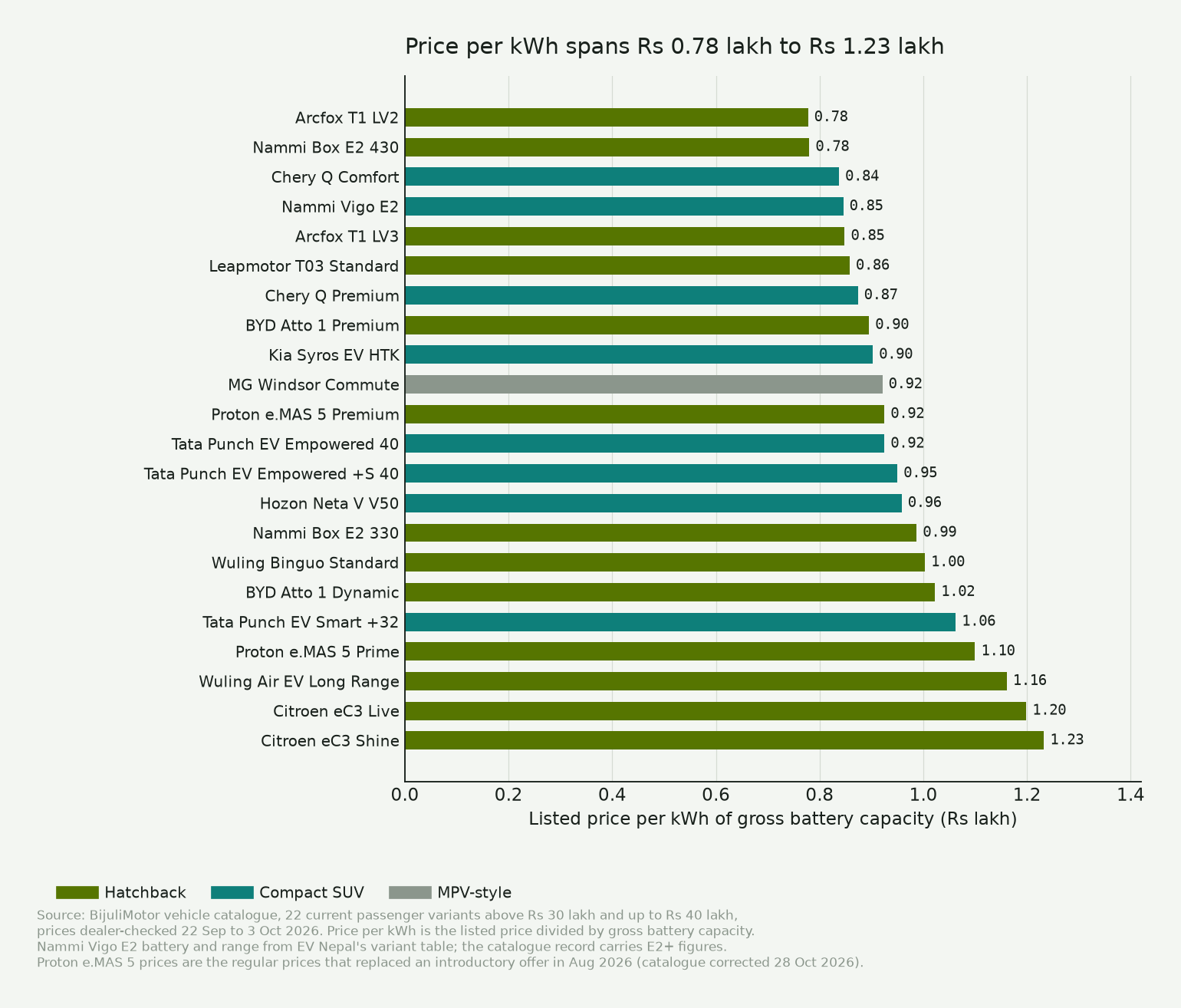
Price per kWh runs from Rs 0.78 lakh for the Arcfox T1 LV2 and Nammi Box E2 430 to Rs 1.23 lakh for the Citroen eC3 Shine. The spread is about 59%. That is a large difference for a measure that only counts gross battery capacity, and it is one reason the cheapest car is not automatically the best value.
The measure has limits. It counts gross capacity and ignores motor power, equipment, warranty, crash safety and home charging cost. Usable capacity is a separate figure and the ratio does not use it. A car with a large battery and a weak motor can look cheap per kWh and still be slow on a hill. Use the ratio to find outliers, then read the rest of the row.
Price per kilometre of claimed range has a bigger problem. The Nammi Box E2 430 looks cheapest at Rs 7,672 per claimed kilometre because its 430 km is CLTC; the same Nepal page gives 317 km WLTP, which works out to about Rs 10,407. The Proton e.MAS 5 Prime looks dearest at Rs 14,662 on a 225 km WLTP figure, a stricter test, and the Punch Smart is next at Rs 13,596 on a 250 km C75 figure. The metric mostly ranks the test label, so it says little about the car itself.
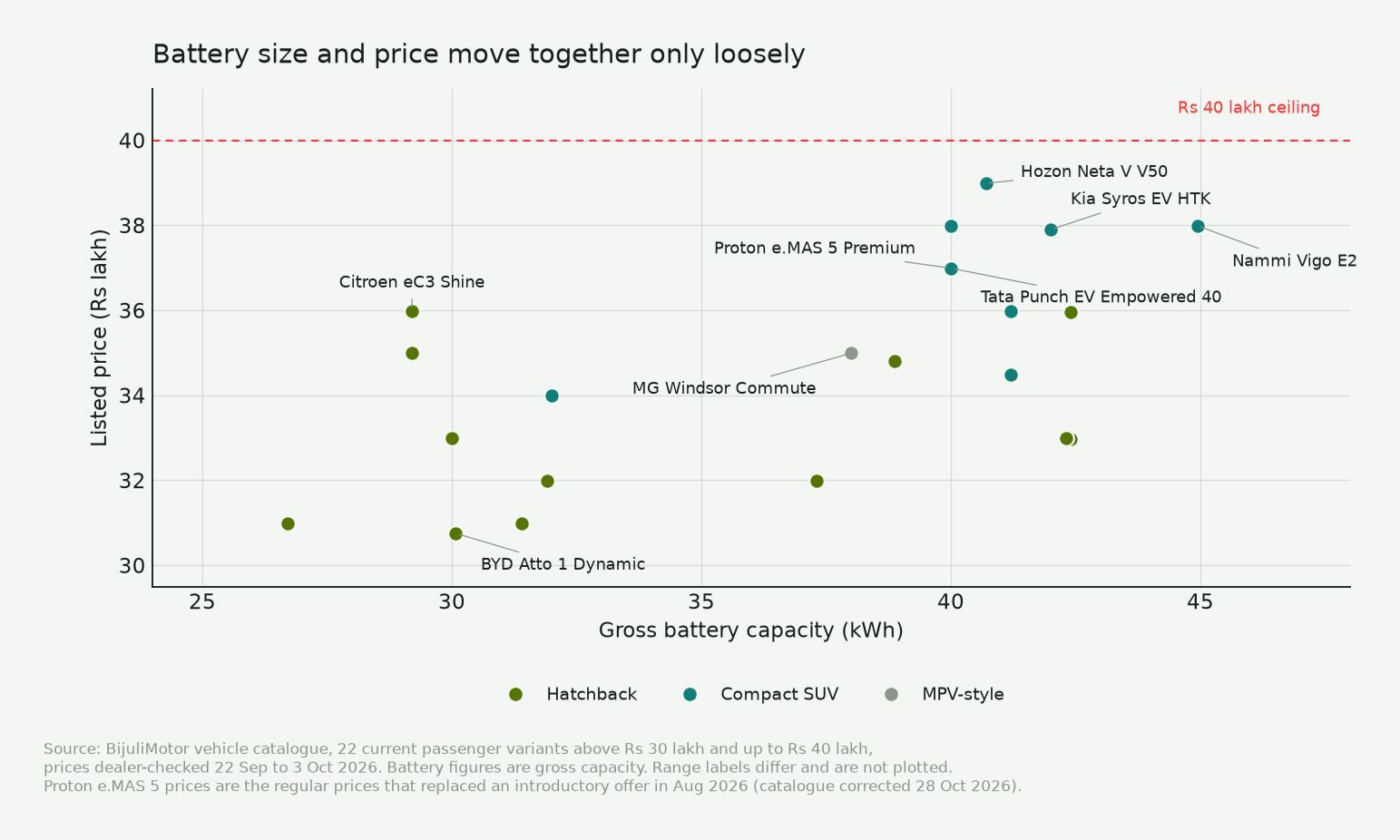
The scatter makes the same point. A 42.4 kWh Arcfox T1 costs Rs 32,96,000, while a 40 kWh Proton e.MAS 5 Premium costs Rs 36,99,000 and a 38 kWh MG Windsor Rs 34,99,000. Battery size explains part of the price. Other things account for the rest.
Charging: no listed CCS2 site beats 60 kW
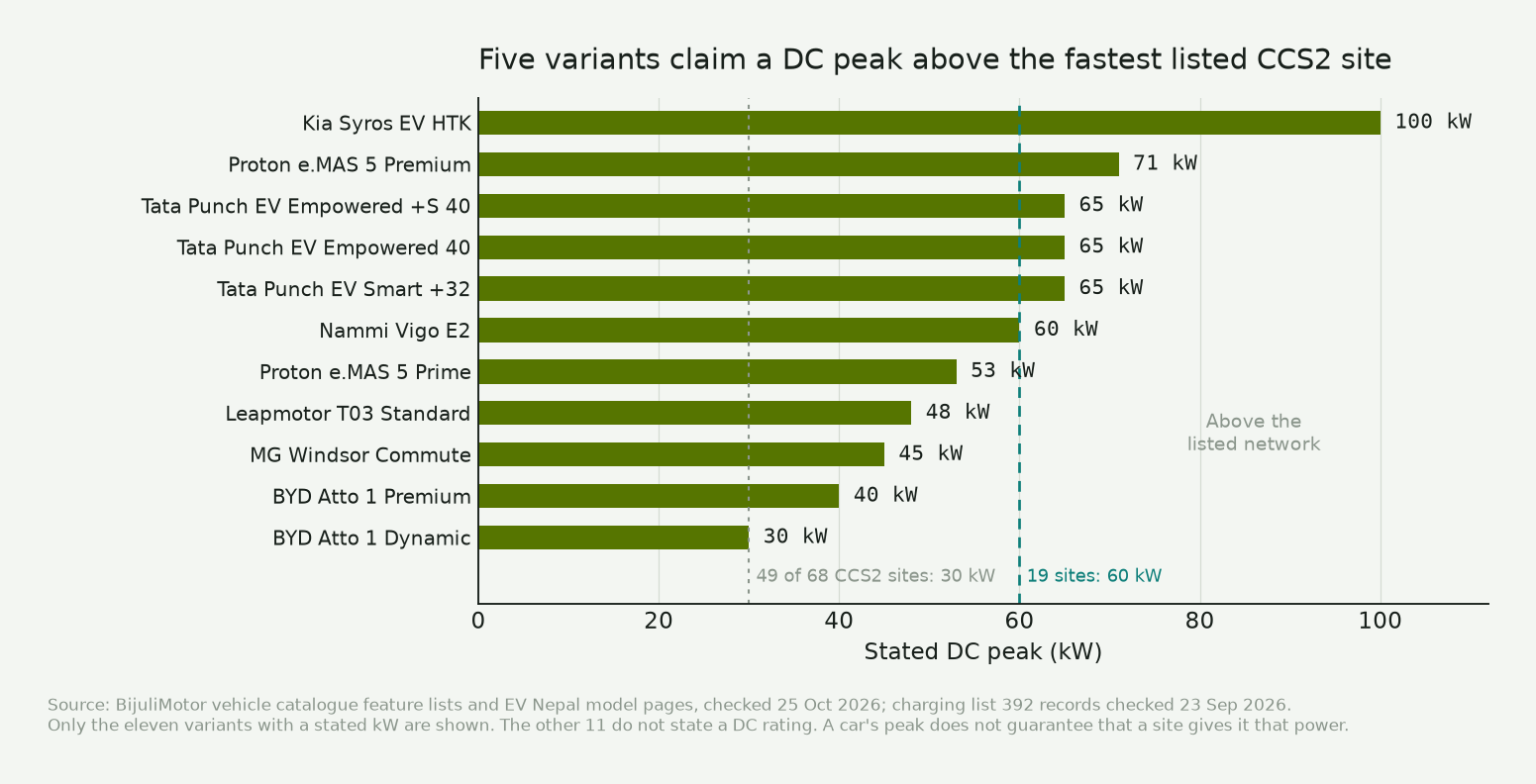
The BijuliMotor charging list has 392 records. Of those, 251 do not record a connector, 73 name only GB/T, and 68 name CCS2 with a DC rating. Among the 68, 49 are 30 kW and 19 are 60 kW. Nine of the 19 put CCS2 and GB/T under a single 60 kW rating, so the list does not say whether the CCS2 side gets full power. None is faster than 60 kW.
That matters for the Proton e.MAS 5 Premium, which lists 71 kW, and the Kia Syros at 100 kW. On every CCS2 site in the list, both are capped at 60 kW. The Punch's 65 kW peak is also capped. The Vigo, Proton Prime and Windsor peaks of 60, 53 and 45 kW fit inside the ceiling.
A 10-80% stop on a 40 kWh car adds 28 kWh: at least 56 minutes at 30 kW, 28 minutes at 60 kW. The Vigo's 44.94 kWh battery adds 31.5 kWh, so about 63 and 32 minutes. These are minimums before the charging curve tapers. Real stops are longer.
The Neta V's 30-80% time of 20 minutes for a 40.7 kWh battery implies about 61 kW average, above the fastest CCS2 site in the list. Treat it as a best case at a charger that is not in the directory.
For Kathmandu to Pokhara, the trip guide works from 210 km. Even cars with 300 km WLTP claims should plan a top-up with a full load and hill climbs. The Proton e.MAS 5 Prime, Atto 1 Dynamic and Punch Smart, at 225, 230 and 250 km, will need one.
| Stop | Station in the list | Listed equipment |
|---|---|---|
| Kathmandu | CG Motors, Naxal | 60 kW CCS2 |
| Kurintar | Thee Digo, Darechowk | 60 kW DC, CCS2 and GB/T |
| Kurintar | MG, Riverside Spring Resort | 30 kW CCS2 |
| Damauli | Yatri, The Original Highway Restaurant | 60 kW DC, CCS2 and GB/T |
| Pokhara | CG Motors, Pokhara | 60 kW and 30 kW CCS2; 30 kW GB/T |
These entries come from a directory and cannot show whether a charger is free right now. Call the operator before leaving and know where the next compatible site is. The charging map has the full list, and the charging-plugs guide explains connector compatibility.
Warranty: read the transfer clause
Warranty terms differ more than the headline years suggest. Kia and MG tie the lifetime battery cover to the first owner; on a resale it falls to eight years or 1,60,000 km. Proton's vehicle cover is the longest at six years with unlimited kilometres. Tata and Citroen pair three years of vehicle cover with a longer battery term.
| Model | Vehicle warranty | Battery warranty | Transfer |
|---|---|---|---|
| Tata Punch EV | 3 years / 1,25,000 km | 8 years / 1,60,000 km | Not stated |
| Citroen eC3 | 3 years / 1,25,000 km | 7 years / 1,40,000 km, private use | Not stated |
| MG Windsor | 3 years, unlimited km | Lifetime for first owner; 8 years / 1,60,000 km after | First owner only |
| Kia Syros | 3 years, unlimited km | Lifetime for first user; 8 years / 1,60,000 km after | First user only |
| Hozon Neta V | Not stated | 8 years / 1,50,000 km, battery and motor | Not stated |
| Leapmotor T03 | 3 years / 1,00,000 km | 8 years / 1,60,000 km | Not stated |
| Wuling Binguo | 3 years / 1,00,000 km | 8 years / 1,00,000 km | Not stated |
| Dongfeng Nammi Box | Not stated | 8 years / 2,00,000 km, battery and motor | Not stated |
| Proton e.MAS 5 | 6 years, unlimited km | 8 years, km limit not stated | Not stated |
| Wuling Air EV | Not stated | 8 years, km limit not stated | Not stated |
The Citroen catalogue feature list says eight years or 1,60,000 km for the battery. EV Nepal's eC3 table says seven years or 1,40,000 km for private users, and three years or 1,25,000 km for commercial use. The table uses the EV Nepal terms. Confirm which booklet comes with the car.
BYD, Chery, Arcfox and the Vigo do not publish warranty terms on their Nepal pages. That means the warranty term is missing from the listing, and a missing term tells you nothing about the length of cover. Ask for the written booklet, the capacity-loss threshold and the service intervals that keep the cover valid before comparing headline years. The battery warranty guide explains the clauses that usually decide a claim.
The Rs 40 lakh ceiling is a list price
A car listed at Rs 39,99,000 leaves Rs 1,000 inside a Rs 40 lakh budget. Insurance, registration and a home charging point will exceed that. The ceiling here is a list price. On-road costs come on top of it. Take the Punch Empowered 40 and the Neta V V50 as the two ends of the list.
| Item | 40 kWh compact SUV | 40.7 kWh crossover |
|---|---|---|
| Listed price | Rs 36,99,000 | Rs 38,99,000 |
| Assumed other costs | Rs 1,50,000 | Rs 1,50,000 |
| Total | Rs 38,49,000 | Rs 40,49,000 |
| Room under the ceiling | Rs 1,51,000 | Over by Rs 49,000 |
The Rs 1,50,000 is an assumption covering insurance, registration and a basic home charging point, and it is there to be replaced with real quotes. Replace it with your own itemised figures. The Punch has room for those costs, and the Neta does not.
Registration and insurance vary by province, vehicle power and insurer. A single national figure would be false. The bluebook tool needs the province and vehicle details, and the quote checklist lists the items to put beside the showroom price. If you plan to borrow, use the EMI calculator with the rate your bank offers. A showroom sample rate is only an illustration.
Questions buyers ask
Is the Nexon EV inside the band?
The current 45 kWh Nexon is listed at Rs 42,49,000, above the ceiling. The Rs 38,99,000 Nexon EV Prime XM in the catalogue is an older 30.2 kWh trim and is not marked current. If a dealer still has one, ask for the battery size and build date before comparing it with the cars here.
Which car has the longest range?
On the label each maker chose, the Kia Syros has the highest number at 443 km ARAI, followed by the Nammi Box E2 430 at 430 km CLTC. Neither is a WLTP figure. The longest WLTP claim in the band is the MG Windsor at 332 km, then the Wuling Binguo at 330 km. The Nammi Box's own Nepal page gives 317 km WLTP for the E2 430, which shows how much the label can change the answer.
Which car is the best value in the band?
There is no single answer. The Arcfox T1 LV2 and Nammi Box E2 430 have the lowest price per kWh at Rs 0.78 lakh. The MG Windsor Commute has the most space for the money. The Punch Empowered 40 has the strongest mix of crash rating, clearance, boot and DC charging. Decide which of those measures matches your own driving before you pick a car.
Is the Windsor Excite inside the band?
It depends on which price is current. The catalogue has Rs 41,49,000, outside the band. EV Nepal lists Rs 39,75,000, which is inside it but leaves only Rs 25,000 before other costs. The table uses the Commute, at Rs 34,99,000. Confirm the Excite price with MG before treating it as an option here.
Sources and checks
- Vehicle prices, battery capacity, range labels and ground clearance: BijuliMotor vehicle catalogue, 22 current passenger variants above Rs 30 lakh and up to Rs 40 lakh; dealer checks 22 September to 3 October 2026; Proton e.MAS 5 prices corrected 28 October 2026.
- Live prices, boot space, DC ratings and warranty terms: EV Nepal model pages for the 14 models, checked 25 October 2026. Pages used for corrections: Nammi Vigo, Tata Punch EV, Nammi Box, Citroen eC3, Kia Syros EV, MG Windsor and Proton e.MAS 5.
- Proton e.MAS 5 prices: Nepal Drives and Meroauto, both 10 August 2026, and EV Nepal's e.MAS 5 page, checked 28 October 2026; launch prices from Proton's 3 August 2026 statement. MG Windsor specifications: MG Motor Nepal's Windsor page, checked 25 October 2026. Vigo variant prices: Dongfeng Nepal's Vigo page, same date.
- Charger counts: BijuliMotor charging-station list, 392 records checked 23 September 2026. A record's DC rating is counted only against the connector it names. The list is a directory and cannot tell you whether a charger is free today.
- On-road budget: the Rs 1,50,000 figure is a labelled assumption. Get a written quote before you rely on it. The calculations are in
notes.mdwith the article.