
Top 5 EVs in Nepal 2082: what the import data shows
Nepal imported 10,847 electric cars in FY 2082/83. BYD's Atto 2 led with 2,264 units. See the top five, their prices, and why imports are not sales.
The BYD Atto 2 was the most imported electric car in Nepal in fiscal year 2082/83, with 2,264 units. The BYD Atto 1 came second with 1,299, the Tata Tigor EV third with 1,002, the Deepal S05 fourth with 785 and the Dongfeng Nammi Vigo fifth with 687. Together they accounted for 6,037 of the 10,847 electric cars, SUVs and vans Nepal imported that year, or 55.7%.
Those are customs import counts for FY 2082/83, which ran from July 2025 to mid-July 2026. Nepal AutoMart and Meroauto both reported the model-level figures from Department of Customs data in July 2026; I checked the pages on 23 October 2026. The count is not a retail sales figure. A car can cross the border and sit in a dealer yard for months, or be registered by the distributor before a buyer signs.
The Tata Tigor EV shows why that distinction matters. It was the third most imported EV, and whether it is still sold new is unclear. Nepal AutoMart's model page, updated 26 September 2026, says Sipradi withdrew it in 2026 and lists no current ex-showroom price. Sipradi's online booking page still showed the Tigor EV XZ+ at Rs 35,99,000 when I checked on 28 October 2026.
An earlier version of this page removed its ranking because the sales numbers could not be checked. This version restores a ranking with a narrower claim. These are imports for a stated year, from a named source. It does not say that 2,264 buyers took delivery of an Atto 2.
What counts in this ranking
The table covers passenger cars, SUVs and vans. It excludes electric scooters, motorcycles, buses, trucks and three-wheelers. The period is Nepal's fiscal year 2082/83. It does not cover the calendar year 2082.
The ranking is EV-only. The Hyundai Creta, a petrol SUV, was the fourth most imported passenger model overall with 793 units, ahead of the Deepal S05. Mix the fuels and the S05 drops to fifth and the Nammi Vigo to sixth. The table below leaves them out so the EV numbers can be compared on their own.
No official model-level registration table was available on 23 October 2026. The Department of Transport Management's site, dotm.gov.np, timed out on repeated attempts, and I found no accessible model-level dataset from it. That is not a strong enough base for a sales ranking, so this page does not publish one.
One caveat on the share. Nepal AutoMart and Meroauto describe EVs as about 65% of passenger vehicle imports. Their published totals, 10,847 EVs out of 15,806 passenger vehicles, divide to 68.6%. The two outlets do not explain the gap. Treat 65% as an approximation. The 55.7% top-five share uses 10,847 as the denominator, because that is the EV total both model-level articles publish.
The top five by imports
| Rank | Model | Imports | Share of EV imports | Price range | Status |
|---|---|---|---|---|---|
| 1 | BYD Atto 2 | 2,264 | 20.9% | Rs 45,95,000 to Rs 51,99,000 | On sale |
| 2 | BYD Atto 1 | 1,299 | 12.0% | Rs 30,75,000 to Rs 34,80,000 | On sale |
| 3 | Tata Tigor EV | 1,002 | 9.2% | Rs 35,99,000 (XZ+) on Sipradi's booking page; last catalogue price Rs 29,99,000 (XE) | Unclear; reported withdrawn in 2026 |
| 4 | Deepal S05 | 785 | 7.2% | Rs 57,99,000 to Rs 62,99,000 | On sale |
| 5 | Dongfeng Nammi Vigo | 687 | 6.3% | Rs 37,99,000 to Rs 43,99,000 | On sale |
| Top five | 6,037 | 55.7% | |||
| All EV imports | 10,847 | 100% |
Prices are ex-showroom and come from the BijuliMotor vehicle catalogue, checked 23 October 2026. Current distributor listings were checked on the same day. For the Tigor EV, the catalogue's last XE price and Sipradi's booking-page XZ+ price are both shown. Neither figure is a dealer quote. Shares are rounded.
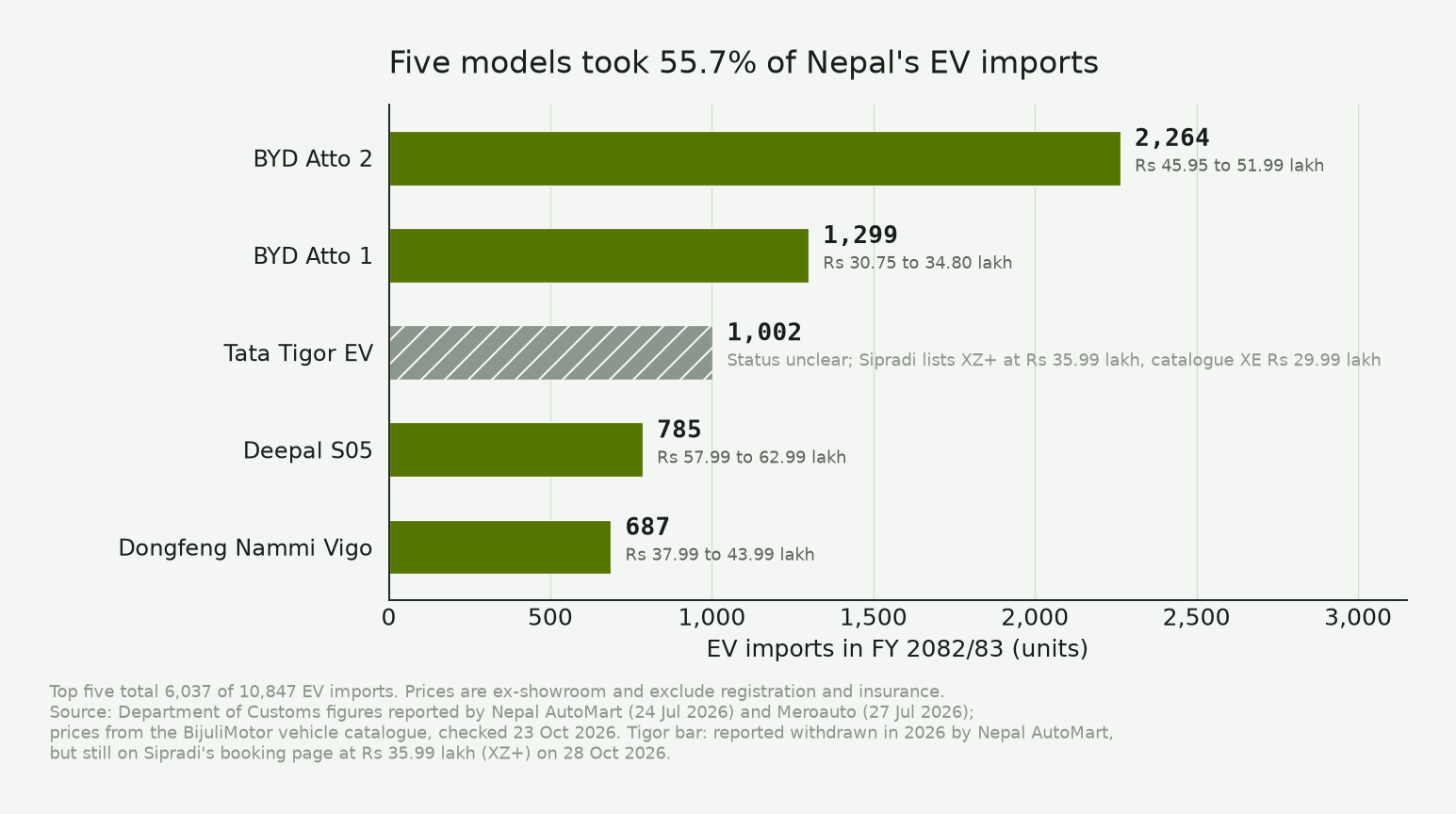
The Atto 2's 2,264 imports were 20.9% of the EV total, about one in five. It was also the most imported passenger car overall, petrol models included. That measures what distributors ordered. It does not measure what customers chose.
A concentrated market
The top five models took 55.7% of EV imports. The other 4,810 units were spread across the rest of the market, which imported EVs from 33 brands in total. BYD's two models alone accounted for 3,563 units, 59% of the top five. The brand total was 4,270, almost twice Tata's 2,236.
Four of the five models come from two distributors: Cimex brought in the two BYDs, and MAW Vriddhi brought in the Deepal S05 and the Dongfeng Nammi Vigo. A ranking that looks like a buyer shortlist is partly a picture of which distributors ordered the most stock.
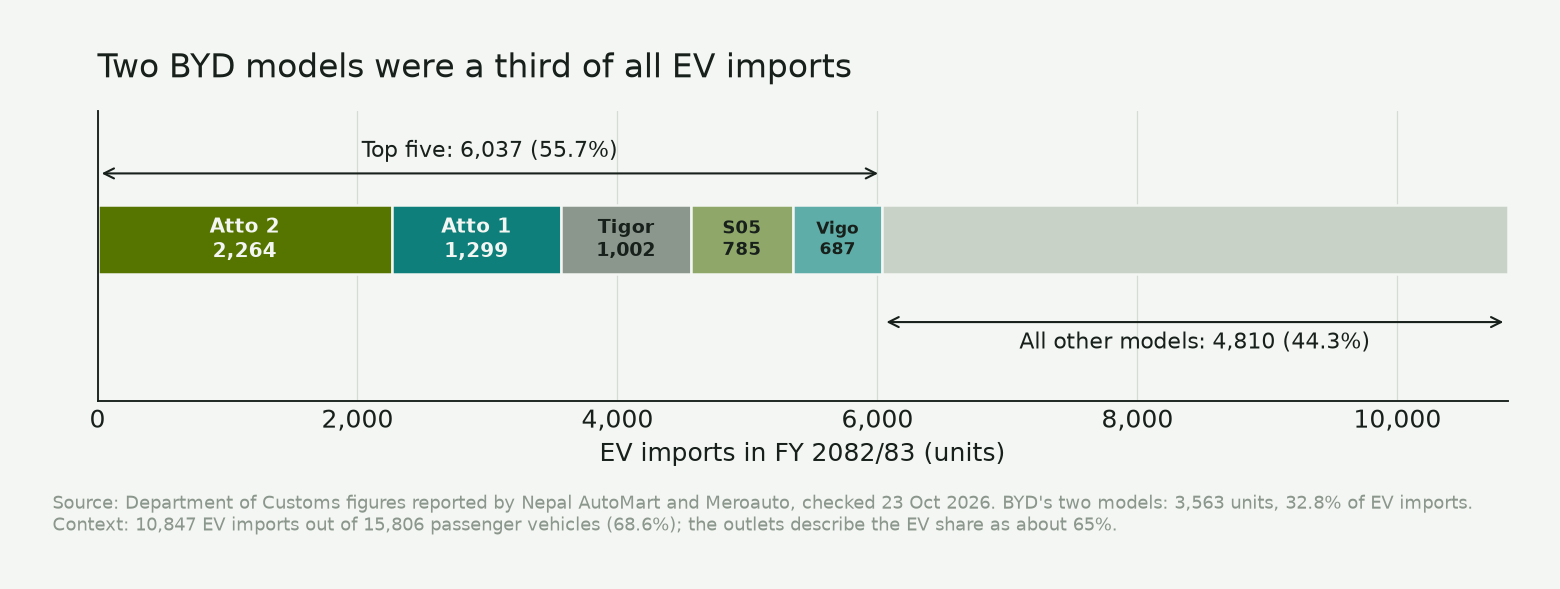
The price spread is wide. The five run from Rs 30,75,000 for the Atto 1 Dynamic to Rs 62,99,000 for the Deepal S05 Max. Import volume does not follow price. The cheapest model is second and the most expensive is fourth. The third is a sedan of uncertain status whose imports were driven mainly by taxi demand.
That taxi detail comes from Nepal AutoMart's import report, which says the Tigor's 1,002 units were "largely driven by demand from the taxi segment". A fleet order and a family purchase both count as imports. They do not tell you the same thing about retail demand.
The five models, and what each one costs
BYD Atto 2
The Atto 2 is the only model in the top five with three current trims. The Essential is Rs 45,95,000, the Premium Rs 48,99,000 and the Superior Rs 51,99,000. The Atto 2 Essential has a 45.12 kWh battery and a 312 km WLTP claim. The Atto 2 Premium and Superior have 51.13 kWh and 345 km. The Atto 2 uses a 100 kW motor and lists 200 mm of ground clearance.
The equipment ladder is worth reading before you compare the headline price. The Essential lists four airbags. The Premium and Superior list six, along with a 360-degree camera and level 2 driver assistance. The Superior adds a sunroof. The gap from Rs 45,95,000 to Rs 51,99,000 is Rs 6,04,000, and most of it is equipment rather than battery.
The import count does not say which trim dealers ordered. Cimex sold the Premium for the model's first 11 months and added the Essential and Superior later, so check the build date and battery size on the invoice.
BYD Atto 1
The Atto 1 is the cheapest current car in the top five. The Atto 1 Dynamic is Rs 30,75,000 and the Atto 1 Premium Rs 34,80,000. The Atto 1 Dynamic has a 30.08 kWh battery and a 230 km WLTP claim. The Atto 1 Premium has 38.88 kWh and 300 km. Both Atto 1 trims use a 45 kW motor.
The Premium costs Rs 4,05,000 more than the Dynamic, at Rs 34,80,000 against Rs 30,75,000, and adds 8.8 kWh of battery (38.88 minus 30.08) and 70 km of claimed range. That is the clearest range-for-money step in the five. It is still a city car. The 45 kW motor and the small body suit Kathmandu traffic better than a monthly Kathmandu–Pokhara run. The shortlist for small EVs puts it beside the other small EVs on sale.
Tata Tigor EV
The Tigor EV is the anomaly in the table. Its 1,002 imports put it third, but its status as a new car is contested. Nepal AutoMart's page says Sipradi withdrew it in 2026, gives no current ex-showroom price and keeps the page for owners and the used market. Sipradi's online booking page still listed the Tigor EV XZ+ at Rs 35,99,000, with a 26 kWh battery, on 28 October 2026. That page is undated, so it may be stale. In India, Tata still lists the Tigor.ev from ₹12.49 lakh. The last Tigor EV catalogue record is Rs 29,99,000 for the XE, with a 26 kWh battery and a 306 km MIDC/ARAI claim.
If the old Rs 29,99,000 price is what brought you here, the shortlist for cheaper EVs shows what is listed in that band. The Tigor EV's current Sipradi listing is above it. A used one needs a battery health report and a check that the warranty transfers to you; the used-EV battery guide explains what a health percentage does and does not prove.
Deepal S05
The S05 is the largest and most expensive car in the top five. The distributor-verified listing has two trims: Plus at Rs 57,99,000 and Max at Rs 62,99,000. Both S05 trims use a 56.1 kWh battery, a 99 kW motor and a 405 km WLTP claim.
The catalogue also carries a Plus (2026) at Rs 53,99,000 and a Max Orange Interior at Rs 59,99,000. Neither appears on the live page checked on 24 October 2026. That does not prove they are unavailable, but it does mean you should ask which trims the dealer can order before you compare a catalogue price with a showroom quote.
Deepal imported 788 vehicles in total, so the S05 was almost the whole brand. A model can rank fourth on this list and still have a thin local base. Ask how many service centres handle high-voltage work and how long a battery pack takes to arrive.
Vigo E2 and E2+
The Vigo sits between the Atto 1 and the Atto 2 on price. The E2 is Rs 37,99,000 and the E2+ Rs 43,99,000. Both Vigo trims list a 99 kW motor and 190 mm of ground clearance. The Vigo E2+ has a 51.87 kWh battery and a 350 km WLTP claim.
The catalogue records the same 51.87 kWh battery for both trims. The live E2 listing shows a smaller pack and a shorter range, so confirm the battery on the exact car rather than the brochure headline. The Vigo's clearance is useful on broken roads, though the Atto 2 lists 200 mm.
Dongfeng Nammi imported 939 vehicles, including 250 Nammi Box hatchbacks. The Vigo was the larger part of that total. The brand's dealer list is smaller than BYD's or Tata's, so check service coverage where you live.
What imports do not tell you
Customs data counts arrivals at the border. It does not say how many cars were sold, how long they sat in stock, or what discount cleared them. Nepal AutoMart reports that importers began FY 2082/83 with large unsold stocks, including about 5,500 extra vehicles brought in before the previous budget. That is why imports can fall while showrooms still have cars.
A distributor can also register a car to its own business, use it as a demonstrator, or sell it to a fleet. Those cars may appear in registration data without a retail buyer at the end. A registration table would still need a caveat. An import table needs a bigger one.
The published model-level table does not break down by province. A buyer in Kathmandu and a buyer in Biratnagar see different dealer stock and waiting times. The national total hides that.
Resale is another gap. A high-volume model may have better parts availability, but resale also depends on condition, battery health and local demand. No public model-level resale index for Nepal was available. The resale guide explains what a used EV price actually reflects.
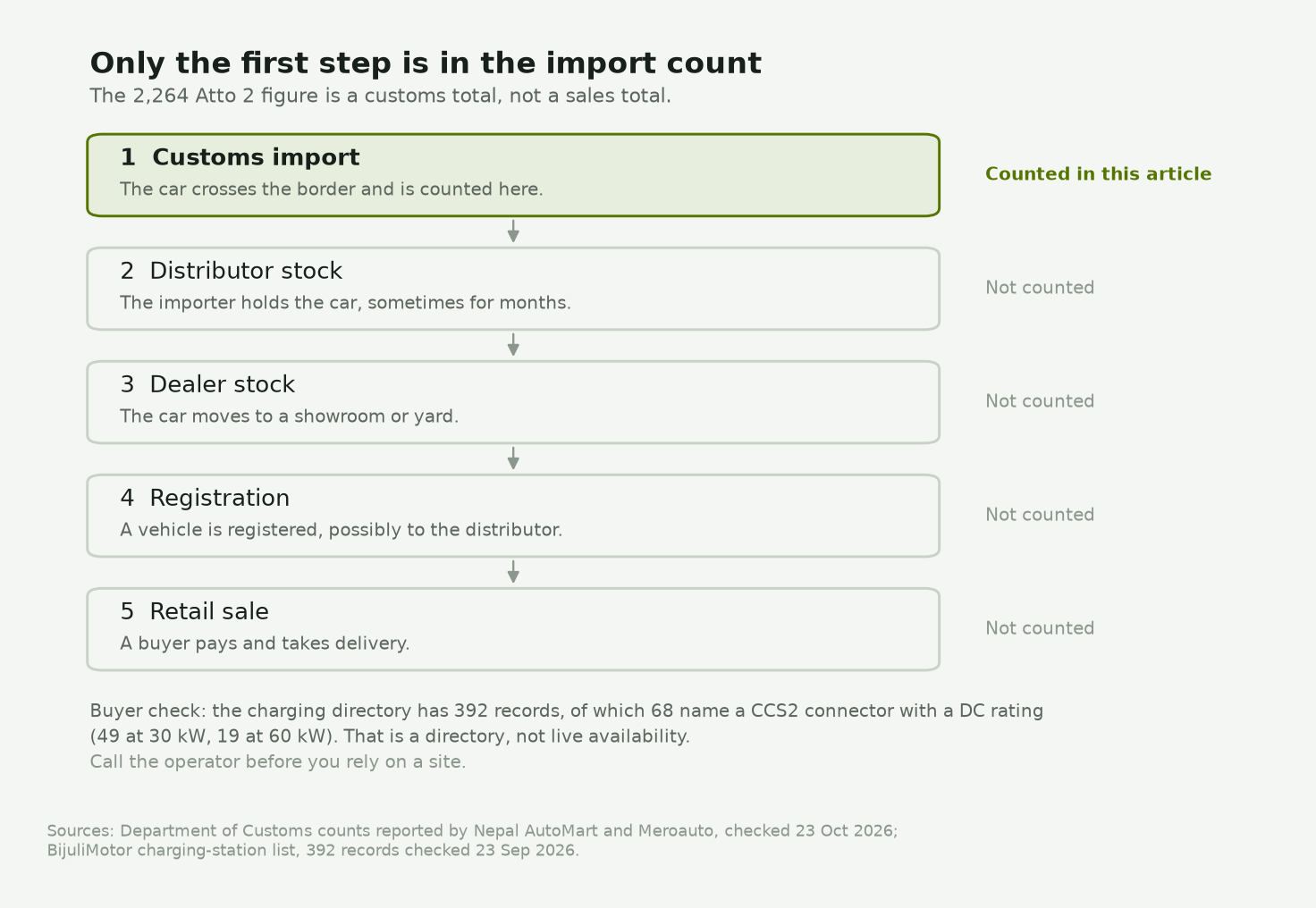
The chain matters for the headline. The 2,264 Atto 2 imports are a customs count. They are not 2,264 registrations, and they are not 2,264 sales.
How to use the list
Start with the price you can pay, then the space you need. The Atto 1 is the cheapest current car in the top five, at Rs 30,75,000. The Vigo is next, from Rs 37,99,000. The Atto 2 starts at Rs 45,95,000, and the S05 at Rs 57,99,000. For the Tigor, ask Sipradi whether new stock exists.
Do not choose on rank. The Atto 2's first place reflects what Cimex ordered as well as what buyers chose. The same is true of the Tigor's third place, which was driven by taxi demand. A test drive on a road you know will tell you more than a national total.
Check the charging before the range. The BijuliMotor charging directory has 392 records. Of those, 68 name a CCS2 connector with a DC rating: 49 at 30 kW and 19 at 60 kW. Another 251 records have no connector recorded, and 73 name only GB/T. The list is a directory. It cannot tell you whether a charger is free right now. Call the operator before you rely on a site, and read the charging-plugs guide before you assume your car fits.
For the exact trim, use the EV price list and the comparison tool. The EMI calculator takes your own rate and tenure. A showroom quote and a catalogue price can differ once registration, insurance and charging equipment are added, so get the total in writing.
Questions buyers ask
What is the best-selling EV in Nepal in 2082?
By imports, the BYD Atto 2, with 2,264 units in FY 2082/83. No official model-level registration table was available, so this page does not call it the best-selling car.
Are these retail sales?
No. They are customs import counts. A car can be imported and stay in stock, or be registered before a retail buyer takes it.
Why is Tesla not on the list?
Tesla imported 17 EVs in FY 2082/83, according to Meroauto's brand table. That is well outside the top five.
Does the list include electric scooters?
No. It covers electric cars, SUVs and vans. Electric scooters and motorcycles are a separate market with different import categories.
Is the Tata Tigor EV still available new?
It is unclear. Nepal AutoMart reported that Sipradi withdrew it in 2026, but Sipradi's online booking page still listed the XZ+ at Rs 35,99,000 on 28 October 2026. Ask Sipradi before you plan around either answer. The 1,002 imports were largely taxi demand. Tata's other EVs were imported in smaller numbers: 516 Punch EVs and 174 Nexon EVs. Check the current price list before you visit a showroom.
How many EVs did Nepal import in 2082/83?
10,847, down 20% from 13,578 the year before. The top five accounted for 6,037 of them.
Sources and checks
- Nepal AutoMart, "Car imports fall as EVs take 65% share; BYD Atto 2 leads in Nepal", 24 July 2026: https://nepalautomart.com/news/car-imports-fall-petrol-models-rise-as-ev-shipments-to-nepal-drop-20. Checked 23 October 2026. Gave total passenger imports, EV imports, the top model counts and the petrol comparison.
- Meroauto, "BYD Atto 2 leads Nepal's imported car market in FY 2025/26", 27 July 2026: https://www.en.meroauto.com/byd-atto-2-leads-nepals-imported-car-market-in-fy-2025-26/. Checked 23 October 2026. Gave the top-10 model order and the 516/515 Punch EV discrepancy.
- Meroauto, "Nepal imported EVs from 33 brands last fiscal year", 28 July 2026: https://www.en.meroauto.com/nepal-imported-evs-from-33-brands-last-fiscal-year-heres-how-many-each-brought-in/. Checked 23 October 2026. Gave brand totals, including BYD 4,270 and Tata 2,236.
- Nepal AutoMart model pages for the Atto 2, Atto 1, Deepal S05, Nammi Vigo and Tigor EV. Checked 23 and 24 October 2026. Gave current trims, prices, battery and range.
- Nepal AutoMart, "BYD Atto 2 and BYD's 11,000 Sales Milestone in Nepal", 5 September 2026: https://nepalautomart.com/news/byd-atto-2-reaches-a-new-ev-import-milestone-in-nepal. Checked 23 October 2026. Gave the Atto 2's first-11-months Premium-only run and the later trim additions.
- Cimex public product API: https://cimex.com.np/api/client/product. Checked 23 October 2026. Gave the Atto 1 and Atto 2 model pages and base prices; variant prices were checked against Nepal AutoMart's distributor-verified tables.
- BijuliMotor vehicle catalogue, 206 records. Prices and specifications checked 23 October 2026. The Tigor EV's last price and 26 kWh battery come from this catalogue.
- Sipradi Tata online booking page for the Tigor EV: https://tatacars.sipradi.com.np/vehicle/bookvehicle/tigor-ev. Checked 28 October 2026. Gave the XZ+ at Rs 35,99,000, 26 kWh and 48.64 kW. The page carries no date.
- Tata.ev India Tigor.ev page: https://ev.tata.cars/tigor/ev.html. Checked 28 October 2026. Gave the India starting price of ₹12.49 lakh.
- BijuliMotor charging directory, 392 records checked 23 September 2026. Counts use a record's DC rating only against the connector it names.
- Department of Transport Management: https://dotm.gov.np/ and http://www.dotm.gov.np/. Both timed out on 23 October 2026. No model-level registration table was obtained.